
USCIS Public Charge Rule Changes in 2026: What Green Card Applicants Need to Know
USCIS Public Charge Rule Changes in 2026: What Green Card Applicants Need to Know
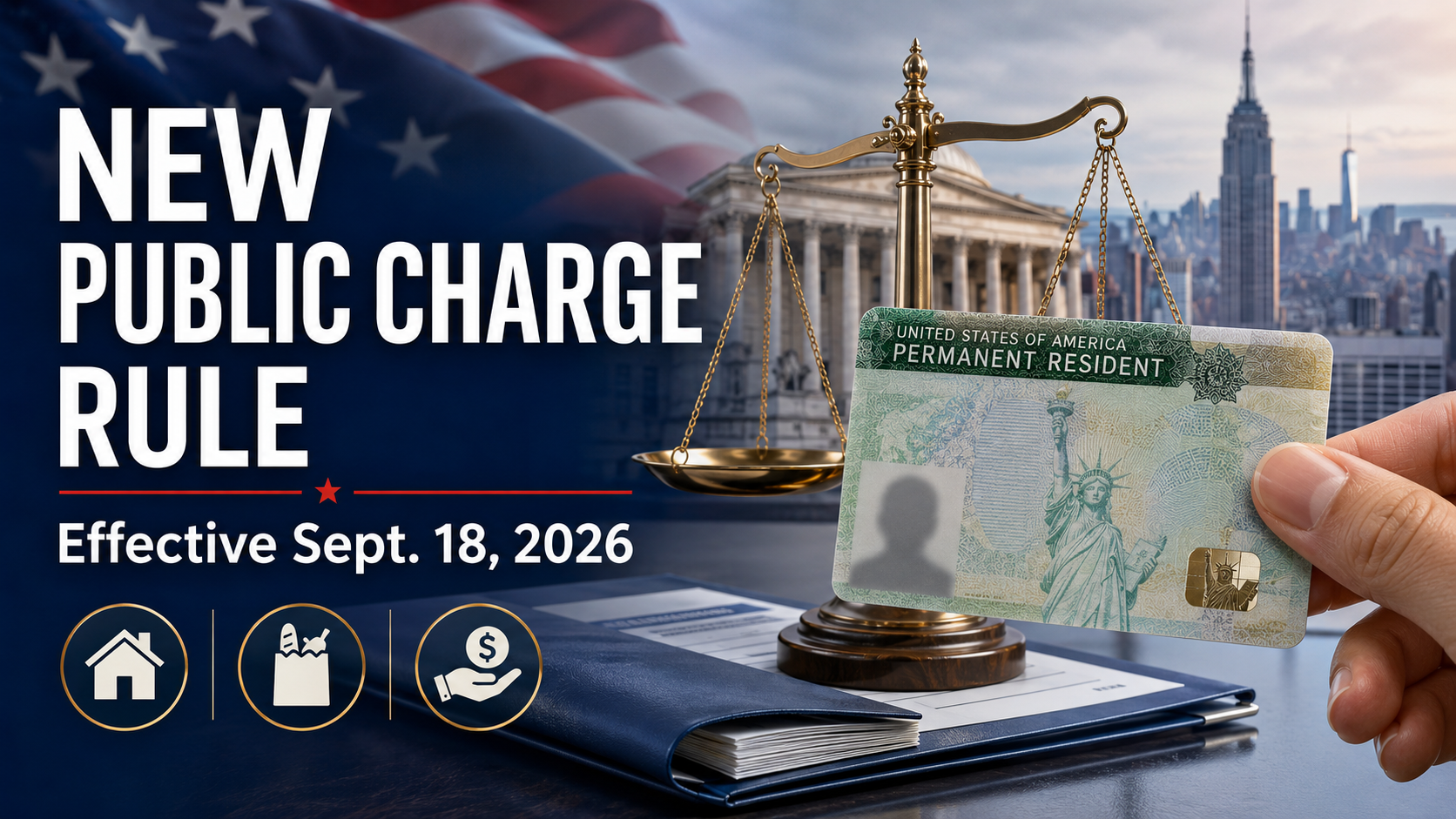
USCIS has announced a major change in how it will decide whether certain green card applicants are likely “at any time to become a public charge.” The new guidance takes effect on September 18, 2026, and applies to covered Forms I-485 postmarked or electronically submitted on or after that date.
This is not a minor technical update. The Department of Homeland Security has rescinded the 2022 public charge regulations and restored much broader discretion to immigration officers. Under the new framework, USCIS may consider a wider range of means-tested public benefits, together with the applicant’s age, health, family situation, finances, education, skills, Affidavit of Support, and other case-specific evidence.
If you plan to apply for adjustment of status, do not assume that a sufficient sponsor or a properly signed Form I-864 automatically resolves every public charge concern. The case must be prepared as a complete financial and personal record.
What Changed in the USCIS Public Charge Rule?
On July 20, 2026, DHS published a final rule rescinding the 2022 public charge regulations. The rule becomes effective on September 18, 2026. USCIS then issued updated Policy Manual guidance on August 18, 2026 explaining how officers should apply the new framework.
The final rule removes narrow regulatory definitions and restrictions that previously limited the public benefits and evidence officers could consider. DHS states that the change restores a highly individualized, fact-specific review based on the “totality of the circumstances.”
The legal basis remains INA § 212(a)(4), 8 U.S.C. § 1182(a)(4). That statute makes certain applicants inadmissible if, in the opinion of the appropriate immigration officer, they are likely at any time to become a public charge.
The most important practical points are:
- The new guidance generally applies to covered Forms I-485 postmarked or electronically submitted on or after September 18, 2026.
- USCIS will continue to make an individualized decision rather than apply a single automatic test.
- Officers must consider five factors identified by Congress and may consider other relevant evidence.
- Receipt of means-tested public benefits on or after September 18, 2026 may receive broader consideration.
- A sufficient Form I-864 is important when required, but it is not necessarily the only evidence USCIS will evaluate.
- Some immigration categories remain exempt from the public charge ground of inadmissibility.
- In a case denied only on public charge grounds, USCIS may invite the applicant to post a public charge bond.
Which Green Card Applicants Are Subject to Public Charge Review?
As a general rule, a person applying to adjust status to lawful permanent residence is subject to the public charge ground unless Congress has created an exemption for the applicant’s category.
Applicants commonly subject to the rule include:
- Spouses, children, and parents of U.S. citizens;
- Unmarried or married sons and daughters of U.S. citizens, and certain family members;
- Spouses, children, and unmarried sons and daughters of lawful permanent residents;
- Brothers and sisters of adult U.S. citizens;
- Fiancé(e)s of U.S. citizens;
- Widows and widowers of U.S. citizens;
- Employment-based applicants, including priority workers, professionals with advanced degrees, people of exceptional ability, skilled workers, professionals, other workers, and investors;
- Religious workers and certain other special immigrants;
- Diversity visa immigrants; and
- Certain witnesses or informants.
This means the rule can affect both family-based and employment-based adjustment cases. An excellent job, an advanced degree, or an approved immigrant petition does not by itself remove public charge review when the statutory ground applies.
Who Is Exempt From the Public Charge Ground?
Congress has exempted several humanitarian and special categories. Important examples include:
- Refugees and asylees;
- Applicants for Temporary Protected Status;
- VAWA self-petitioners and certain qualified battered immigrants;
- T nonimmigrants who are victims of human trafficking;
- U nonimmigrants who are victims of qualifying criminal activity;
- Special Immigrant Juveniles;
- Applicants adjusting under the Cuban Adjustment Act;
- Certain Cuban and Haitian entrants;
- Certain Nicaraguan, Central American, Haitian, Liberian, Afghan, Iraqi, Syrian, Polish, and Hungarian applicants covered by specific laws;
- Applicants for registry;
- Certain surviving spouses, children, or parents of military members;
- Certain American Indians born in Canada and qualifying members of the Texas Band of Kickapoo Indians; and
- Certain diplomats, ministers, foreign government officials, and their families.
An exemption is determined by the legal basis for the application, not simply by a person’s nationality or personal hardship. Some people may also have more than one possible immigration path, and the public charge consequences can differ. A qualified immigration lawyer should identify the exact statutory category before advising whether the public charge ground applies.
The Five Factors USCIS Must Consider
Under INA § 212(a)(4)(B), USCIS must consider at least five statutory factors:
- Age
USCIS may evaluate how the applicant’s age affects the ability to work, earn income, remain self-sufficient, or require support. Age alone should not decide a case; it is evaluated with the remaining evidence.
- Health
The officer may consider health conditions and how they relate to employability, expenses, insurance, care needs, and financial support. A medical diagnosis is not automatically a public charge finding. The key question is how the condition fits into the entire record and the applicant’s future circumstances.
- Family Status
USCIS may review household size, dependents, caregivers, and available sources of family support. A larger household can affect the financial analysis, but the officer should also consider household income, resources, and responsibilities.
- Assets, Resources, and Financial Status
This can include income, savings, property, debts, liabilities, insurance, employment history, household finances, and other evidence of stability. Applicants should expect USCIS to examine whether the documents are consistent with each other.
- Education and Skills
Degrees, professional licenses, vocational training, certifications, English ability, job skills, work experience, and realistic employment prospects may all help demonstrate future self-sufficiency.
USCIS may also consider a required Form I-864, Affidavit of Support Under Section 213A of the INA, and any other individualized evidence the officer finds relevant. The inquiry is prospective: USCIS is assessing the likelihood that the applicant will become a public charge in the future.
How Will USCIS Treat Public Benefits After September 18, 2026?
The date of benefit receipt is critically important.
For means-tested public benefits received before September 18, 2026, USCIS states that it will apply the narrower 2022 approach. It will consider public cash assistance for income maintenance and long-term institutionalization at government expense.
For means-tested public benefits received on or after September 18, 2026, USCIS states that officers may consider any such benefits. The guidance identifies examples such as:
- Cash assistance for income maintenance;
- Housing assistance;
- Food stamps;
- Financial aid for college; and
- Other similar means-tested benefits.
This does not mean that receiving one benefit automatically causes denial. USCIS must review the whole record and make a case-by-case determination. The type of benefit, amount, duration, reason for receipt, applicant’s eligibility category, timing, present financial situation, health, education, work history, and evidence of future stability may all matter.
Applicants should also avoid making a rushed decision to terminate essential medical, food, or housing assistance based only on fear or social-media rumors. Eligibility for a benefit and immigration consequences are distinct legal questions. Before changing benefits, obtain individualized advice from both a qualified immigration attorney and, when appropriate, the agency or lawyer responsible for benefits eligibility.
Does a Strong Sponsor or Form I-864 Guarantee Approval?
No. A properly completed Form I-864 remains a central part of many family-based cases and some employment-based cases involving a relative’s ownership interest. The sponsor generally must show sufficient income or qualifying assets under the applicable rules.
But the new public charge analysis is broader than a sponsor’s income figure. USCIS can consider the applicant’s own circumstances and other relevant evidence. A sponsor who meets the minimum income requirement is helpful, but it does not necessarily cure inconsistent tax records, unexplained unemployment, substantial liabilities, lack of insurance, questionable household-size calculations, or other weaknesses.
Where permitted, a joint sponsor may solve an Affidavit of Support deficiency, but the applicant’s complete public charge profile still deserves careful review.
What Is a Public Charge Bond?
If USCIS concludes that an applicant is inadmissible only because the person is likely at any time to become a public charge, USCIS may invite the applicant to post a public charge bond.
The bond serves as a financial guarantee. USCIS may determine the amount by considering the government assistance the applicant could potentially receive during the next five years. A qualifying applicant may post a cash bond or use a surety company certified by the U.S. Department of the Treasury.
The procedure is strict:
- The applicant must first receive a Notice of Intent to Deny inviting the bond;
- The applicant then uses Form I-945, Public Charge Bond; and
- USCIS will not accept an unsolicited Form I-945 or bond from someone who has not been invited to submit one.
A bond should therefore be treated as a possible discretionary remedy—not as a filing strategy, substitute for good evidence, or guaranteed opportunity.
Practical Steps Before Filing Form I-485
If the public charge ground applies to you, preparation should begin before the adjustment application is filed.
- Confirm which rule applies. Filing date matters. The new framework applies to covered Forms I-485 postmarked or electronically submitted on or after September 18, 2026.
- Identify whether your category is exempt. Do not assume that every adjustment applicant must complete the same public charge analysis.
- Create an accurate benefits history. Identify the benefit, recipient, administering agency, dates, amounts, and legal basis. Do not guess or conceal information.
- Audit the Affidavit of Support. Confirm sponsor eligibility, domicile, household size, tax transcripts, current income, employment evidence, and any assets or joint sponsor documents.
- Document the applicant’s positive factors. Collect evidence of education, licenses, employment, job offers, savings, property, insurance, skills, and household support.
- Explain difficult facts honestly. A temporary period of unemployment, medical treatment, or past benefit use may require context. A clear legal explanation with reliable records is usually safer than leaving an officer to draw conclusions from incomplete evidence.
- Check consistency across the immigration record. USCIS may compare Form I-485, Form I-864, tax returns, prior applications, benefit records, employment documents, and interview testimony. Contradictions can create problems beyond public charge inadmissibility.
- Do not file Form I-945 unless USCIS invites you. An unsolicited public charge bond will not be accepted.
Why Legal Review Is Especially Important Under the New Rule
The 2026 rule deliberately gives officers more discretion. More discretion means that two cases with similar income figures may receive different outcomes because of health, family obligations, benefit history, employability, assets, documentation, or other circumstances.
A carefully prepared filing should do more than submit the minimum forms. It should tell a coherent, truthful, well-documented story of present and future financial stability while addressing any negative facts directly.
If you are planning to file Form I-485, have received public benefits, have a sponsor with irregular income, are self-employed, have significant medical needs, or are uncertain whether an exemption applies, obtain a case-specific analysis before filing.
Speak With a New York Immigration Lawyer
The public charge rule can affect family-based, employment-based, and diversity visa adjustment applicants. The right strategy depends on your immigration category, filing date, benefits history, household finances, health, education, work record, and sponsorship documents.
To schedule a consultation with the Law Office of Alena Shautsova, call 917-885-2261 or visit shautsova.com. We help clients evaluate public charge issues, prepare adjustment-of-status filings, respond to Requests for Evidence and Notices of Intent to Deny, and present the strongest legally supportable record.
This article provides general information and is not legal advice. Immigration rules and agency guidance may change, and every case is different.
Official Sources
- USCIS: Rescission of the 2022 Public Charge Regulation
- Federal Register: Public Charge Ground of Inadmissibility, 91 Fed. Reg. 33202 (July 20, 2026)
- USCIS Policy Manual, Volume 8, Part G: Public Charge Ground of Inadmissibility
- USCIS Form I-864, Affidavit of Support
- USCIS Form I-945, Public Charge Bond


