
Trump’s New 2026 Executive Orders on Birthright Citizenship and Birth Tourism: Who Could Be Affected?
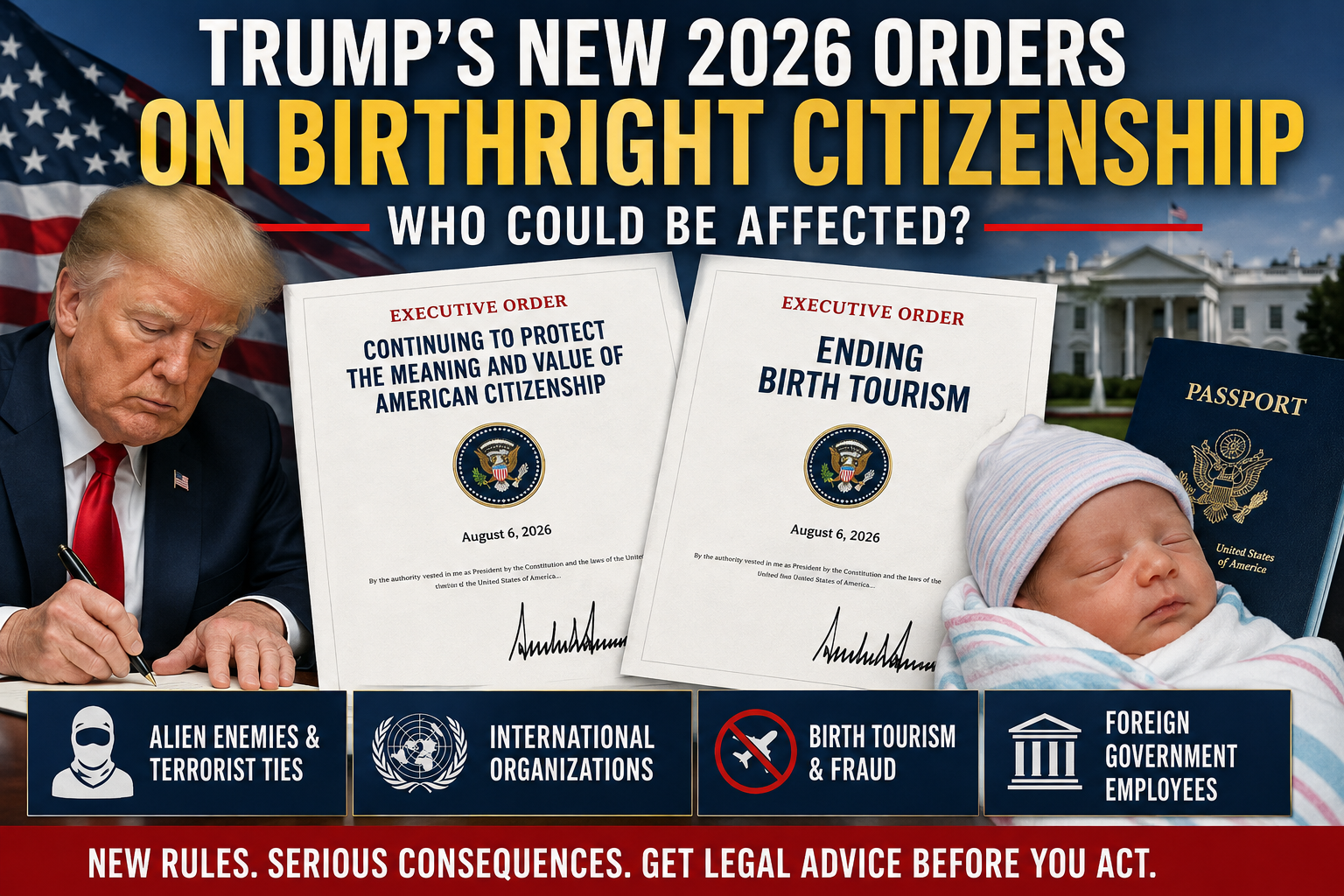 Trump’s New 2026 Executive Orders on Birthright Citizenship and Birth Tourism: Who Could Be Affected?
Updated August 2026
For generations, one of the most familiar principles of American immigration and constitutional law has been birthright citizenship: with limited historical exceptions, a child born in the United States becomes a U.S. citizen at birth.
On August 6, 2026, President Donald Trump signed two new Executive Orders that could significantly affect how the federal government applies that principle in certain situations.
The first order, “Continuing to Protect the Meaning and Value of American Citizenship,” directs federal agencies not to recognize U.S. citizenship for certain children born in the United States when neither parent is a U.S. citizen and specified circumstances exist.
The second order, “Ending Birth Tourism,” gives the Departments of State and Homeland Security broad authority to target people who travel to the United States on nonimmigrant visas for the purpose of giving birth, as well as businesses and individuals that facilitate such travel.
These orders were issued shortly after the Supreme Court’s June 30, 2026 decision in Trump v. Barbara, and they represent a new and more targeted attempt by the Trump Administration to restrict birthright citizenship.
If you are pregnant, planning to travel to the United States, working for a foreign government or international organization, or concerned about whether your child will receive U.S. citizenship at birth, it is important to understand exactly what these orders say—and equally important to understand what they do not say.
Birthright Citizenship Is Not Being Eliminated for Every Child of Noncitizens
First, there is an important distinction that has already caused confusion.
The August 6 Executive Orders do not simply declare that every child born in the United States to two non-U.S.-citizen parents is no longer an American citizen.
The first Executive Order instead states that federal agencies should not recognize citizenship when neither parent is a U.S. citizen and one of several additional conditions exists.
This distinction is extremely important.
The White House describes the identified categories as “non-exhaustive,” meaning the Administration may contend that other historical exceptions exist. Nevertheless, families should not assume that merely having two foreign-national parents automatically places a U.S.-born child within one of the categories listed in the August 6 order.
Why Is the Trump Administration Doing This Now?
President Trump previously signed Executive Order 14160, “Protecting the Meaning and Value of American Citizenship,” on January 20, 2025.
That earlier order attempted to deny federal recognition of birthright citizenship in much broader circumstances, including certain children whose mothers were unlawfully present and certain children whose mothers were lawfully but temporarily present in the United States when the father was neither a U.S. citizen nor lawful permanent resident.
The issue produced major constitutional litigation.
On June 30, 2026, the Supreme Court decided Trump v. Barbara. The August 6 Executive Order expressly relies on the Court’s discussion of the Citizenship Clause and its reference to children born to parents in the United States for whom no “extraterritorial fiction” applies.
The Administration is now attempting to build its new policy around what it views as historically recognized exceptions to birthright citizenship.
That does not mean the new Executive Orders are immune from litigation. Their interpretation of the Fourteenth Amendment and the scope of the historical exceptions can be expected to generate significant legal challenges.
Category #1: Childr en of People Classified as “Alien Enemies” or Certain Terrorists
One of the most consequential provisions concerns children whose parent is classified as an “alien enemy.”
Under the August 6 Executive Order, when neither parent is a U.S. citizen, federal agencies are directed not to recognize the child as a U.S. citizen if either parent is an alien enemy as defined by the order.
The Executive Order expressly states that this category includes:
- a member of a designated Foreign Terrorist Organization under 8 U.S.C. § 1189; or
- a Specially Designated Global Terrorist, consistent with the International Emergency Economic Powers Act and Executive Order 13224.
This is an extraordinary provision because citizenship consequences are being connected to the status or designation of a parent.
Families potentially affected by terrorism-related designations should obtain individualized legal advice immediately. The factual and legal issues involved may extend far beyond ordinary immigration law.
Category #2: Children of Foreign Government Employees
The order also addresses certain children of foreign government personnel.
The traditional example used in birthright-citizenship law is the child of a foreign ambassador or diplomat. Because accredited diplomats may enjoy immunity and are not considered subject to U.S. jurisdiction in the same way as ordinary foreign nationals, their U.S.-born children historically have not necessarily acquired citizenship under the Fourteenth Amendment.
The August 6 order goes considerably further in defining the foreign-government category.
It includes children when neither parent is a U.S. citizen and either parent is:
- An ambassador;
- A person employed by a foreign embassy or consulate who is a national of that foreign country;
- A person employed by a foreign government in an official capacity; or
- A person employed by an international organization who possesses international-organization immunity.
This provision could be especially important in New York because New York City is home to the United Nations, foreign missions, consulates, and numerous international organizations.
The exact immigration status, employment position, accreditation, and immunity of the parent may therefore become critically important.
Being a foreign national who happens to work in the United States should not automatically be confused with being a foreign-government employee covered by this provision.
Category #3: Employees of International Organizations With Immunity
Another provision deserves special attention for families connected with international organizations.
The Executive Order specifically includes a parent who is employed by an international organization and possesses international-organization immunity.
This language matters.
The order does not simply say that every employee of every international organization falls within the exception. The existence and scope of immunity may be central to determining whether the provision applies.
For families associated with the United Nations or another international organization, it may therefore be necessary to review the parent’s precise status and privileges rather than relying simply on the name of the employer.
Category #4: Commercial Birth Tourism and Fraud
The Executive Order also directly attacks what the Administration calls the commercial purchase or acquisition of birthright citizenship.
Under the citizenship order, when neither parent is a U.S. citizen, citizenship recognition may be denied where a parent engaged in a commercial transaction to purchase or access birthright citizenship for the child or engaged in fraudulent activity to obtain citizenship.
The order specifically identifies two situations.
The first involves parents engaging in a commercial transaction designed to ensure that the child’s mother is present in the United States—or a U.S. territory—to give birth.
The second involves parents engaging in a commercial transaction with a surrogate who is present in the United States or a U.S. territory to give birth.
This is substantially more specific than simply saying:
“Two foreign nationals came to America and had a baby.”
The focus of this part of the citizenship order is on commercial arrangements and fraudulent activity connected with obtaining citizenship.
The Separate “Ending Birth Tourism” Executive Order
President Trump signed a second Executive Order on the same day titled “Ending Birth Tourism.”
This order primarily addresses entry into the United States and the use of nonimmigrant visas, rather than simply declaring the citizenship status of children after birth.
For purposes of this order, “birth tourism” is defined as:
the entry of a foreign national into the United States through a nonimmigrant visa for the purpose of giving birth on American soil; or
an effort by a foreign national to facilitate another foreign national’s entry on a nonimmigrant visa for the purpose of giving birth in the United States.
The order delegates presidential authority under INA § 215(a), 8 U.S.C. § 1185(a), to the Secretary of State and the Secretary of Homeland Security to implement the policy.
This means the practical consequences could begin well before a child is born.
Could a Pregnant Visitor Be Denied a Visa or Entry?
Yes, depending on the circumstances.
The new birth-tourism order authorizes the State Department and Department of Homeland Security to develop rules, policies, operational guidance, and other measures designed to prevent birth tourism.
The order specifically contemplates actions including:
- preventing entry into the United States;
- denying a visa or other travel authorization;
- revoking a visa or travel authorization;
- permanently barring entry of a person who enters or attempts to enter for birth tourism;
- denying entry to someone who previously participated in birth tourism;
- removing certain individuals from the United States; and
- taking action against businesses, organizations, or individuals inside or outside the United States that facilitate birth tourism.
These are potentially severe immigration consequences.
A person who makes a material misrepresentation to obtain a visa or admission may also encounter separate immigration-law consequences beyond these Executive Orders.
Pregnancy Itself Is Not the Same as Birth Tourism
This distinction is critical.
The Executive Order defines birth tourism by reference to purpose: entering through a nonimmigrant visa for the purpose of giving birth on American soil.
Therefore, pregnancy alone should not automatically mean that a person is a “birth tourist.”
For example, the immigration analysis may be very different for someone who legitimately entered the United States for employment, education, family reasons, or another authorized purpose and later gives birth here.
Intent, visa classification, representations made during the visa process, representations made at the port of entry, travel history, financial arrangements, and involvement with a commercial birth-tourism business may all become important.
Never make a false statement to a U.S. consular officer, CBP officer, USCIS officer, or other government official.
Could Birth Tourism Result in a Permanent Bar From the United States?
The new order expressly allows the Secretary of State and Secretary of Homeland Security, within their legal authority and discretion, to take action that may include permanently barring entry of an individual who enters or attempts to enter the United States for the purpose of birth tourism.
That makes obtaining legal advice before traveling particularly important.
A decision made during one trip to the United States could potentially create consequences lasting many years—or longer.
What About Humanitarian Situations?
The “Ending Birth Tourism” Executive Order contains an important exception.
The Secretary of State or Secretary of Homeland Security may exempt a foreign national from measures imposed under the order on humanitarian grounds or when the person’s entry is determined to be in the national interest.
This may become important in unusual medical, humanitarian, diplomatic, or national-interest situations.
However, an exemption should never be assumed. It will depend on the applicable rules and the government’s exercise of authority.
Category #5: Births in U.S. Territories
The citizenship Executive Order contains another category involving a person born in a territory or territorial waters of the United States where citizenship is not conferred by federal statute.
This language is important because citizenship rules applicable to U.S. territories can depend upon federal statutes and the particular territory involved.
Axios reported that the Administration’s broader territorial objective would require congressional action in circumstances where federal law currently confers citizenship.
In other words, the Executive Order itself cannot simply erase citizenship that Congress has expressly granted by statute.
When Do the New Rules Take Effect?
This is one of the most important practical questions.
The August 6 citizenship order directs the Secretary of State, Attorney General, Secretary of Homeland Security, Commissioner of Social Security, and other executive agencies to bring their policies into conformity with the order.
Importantly, all executive departments and agencies are directed to issue public implementation guidance within 30 days of August 6, 2026.
That guidance will be extremely important.
It should provide more information about how agencies such as the State Department, DHS, USCIS, and potentially the Social Security Administration will determine whether a child falls within one of the categories.
The separate “Ending Birth Tourism” order directs the Secretaries of State and Homeland Security to take actions and update rules, policies, operational guidance, or other guidance as necessary to implement its policy.
Therefore, immigration lawyers will need to monitor not only the Executive Orders themselves but also subsequent agency guidance, regulations, consular instructions, CBP practices, litigation, injunctions, and court decisions.
Does This Affect Children Who Were Already Born?
The Administration has publicly characterized the new citizenship policy as applying to future births, and contemporary reporting on the orders likewise describes the policy in those terms.
Families should nevertheless be extremely careful before making assumptions about an individual child’s citizenship status.
Citizenship is one of the most important legal statuses a person can possess. Questions concerning an existing child’s citizenship should be evaluated based on the law applicable to that child, the date and place of birth, the parents’ citizenship and immigration circumstances, and any applicable court orders.
Expect Litigation Over These Executive Orders
These orders are almost certain to generate litigation.
The Fourteenth Amendment states:
“All persons born or naturalized in the United States, and subject to the jurisdiction thereof, are citizens of the United States and of the State wherein they reside.”
The central legal dispute will continue to concern the meaning and boundaries of the phrase “subject to the jurisdiction thereof.”
The Trump Administration maintains that its August 6 order operates within historical exceptions recognized by the Supreme Court.
Opponents are likely to argue that at least some of the new categories improperly expand those historical exceptions and conflict with the Fourteenth Amendment and federal citizenship law.
Until courts resolve these issues and agencies publish detailed implementation guidance, families should be extremely cautious about relying on social-media posts, headlines, or generalized statements about the new rules.
What Should Expectant Parents Do Now?
If you are a foreign national who is pregnant or planning to have a child in the United States, do not panic—but do not ignore these developments.
Your individual circumstances matter.
In particular, you should obtain legal advice if:
- you plan to enter the United States while pregnant;
- you are applying for a B-1/B-2 or other nonimmigrant visa while pregnant;
- your trip involves a company advertising U.S. childbirth or citizenship services;
- you have paid a business to arrange travel, housing, medical care, or childbirth in the United States;
- you are considering a U.S.-based surrogate arrangement connected to citizenship planning;
- you or your spouse works for a foreign government;
- you or your spouse works for an embassy or consulate;
- you or your spouse works for the United Nations or another international organization and may possess immunity;
- you are concerned about an “alien enemy,” terrorism-related, sanctions, or Foreign Terrorist Organization designation; or
- you are uncertain whether your future child will acquire U.S. citizenship at birth.
The legal analysis can be very different depending upon the parents’ citizenship, immigration status, employment, diplomatic privileges, intent at entry, representations to U.S. officials, and circumstances surrounding the child’s birth.
Do Not Rely on the Simplified Claim That “Two Foreign Parents Means No Citizenship”
That is not an accurate description of the August 6, 2026 Executive Orders.
The new citizenship order requires that neither parent be a U.S. citizen plus an additional circumstance specified by the order, such as the alien-enemy/terrorism category, covered foreign-government employment, qualifying international-organization employment with immunity, commercial or fraudulent birth-tourism arrangements, or the territorial provision.
That distinction can determine the future of an entire family.
Immigration Law Is Changing Quickly—Get Advice Before You Act
Birthright citizenship is now one of the fastest-developing areas of U.S. immigration and constitutional law.
The August 6, 2026 Executive Orders may affect visa issuance, admission at airports and borders, citizenship documentation, passports, Social Security records, birth-tourism businesses, foreign-government employees, certain international-organization employees, surrogacy arrangements, and families whose children are born in the United States.
At the same time, implementation guidance is still developing and further litigation is highly likely.
If you are planning to travel to the United States while pregnant, are expecting a child in the United States, or believe one of these new categories may apply to your family, do not wait until you are at the airport, consulate, hospital, or passport office to find out how the rules may affect you.
An immigration strategy should be developed before you make representations to a consular officer or CBP officer and before taking actions that may have long-term immigration consequences.
For an individualized evaluation of your immigration situation, contact the Law Office of Alena Shautsova at 917-885-2261 or visit shautsova.com to schedule a consultation.
Primary Sources and References
- The White House, “Continuing to Protect the Meaning and Value of American Citizenship,” Executive Order, August 6, 2026.
- The White House, “Ending Birth Tourism,” Executive Order, August 6, 2026.
- The White House, “Fact Sheet: President Donald J. Trump Ends Birth Tourism and Protects the Meaning and Value of American Citizenship,” August 6, 2026.
- Trump v. Barbara, 609 U.S. ___, 146 S. Ct. 2438 (2026).
- U.S. Constitution, Amendment XIV, § 1.
- 8 U.S.C. § 1189 — Designation of Foreign Terrorist Organizations.
- 8 U.S.C. § 1185(a) — Travel Control of Citizens and Aliens.
- 50 U.S.C. § 1701 et seq. — International Emergency Economic Powers Act.
- Executive Order 13224 — Blocking Property and Prohibiting Transactions With Persons Who Commit, Threaten to Commit, or Support Terrorism.
- Axios, “Trump targets birth tourism and citizenship in new executive orders,” August 6, 2026.
This article is provided for general informational purposes and does not constitute legal advice. Immigration and citizenship law is highly fact-specific, and the implementation and legal status of the August 6, 2026 Executive Orders may change as agencies issue guidance and courts consider legal challenges.


