
Federal Judge Rules the 75-Country Immigrant Visa Freeze Unlawful
Federal Judge Rules the 75-Country Immigrant Visa Freeze Unlawful
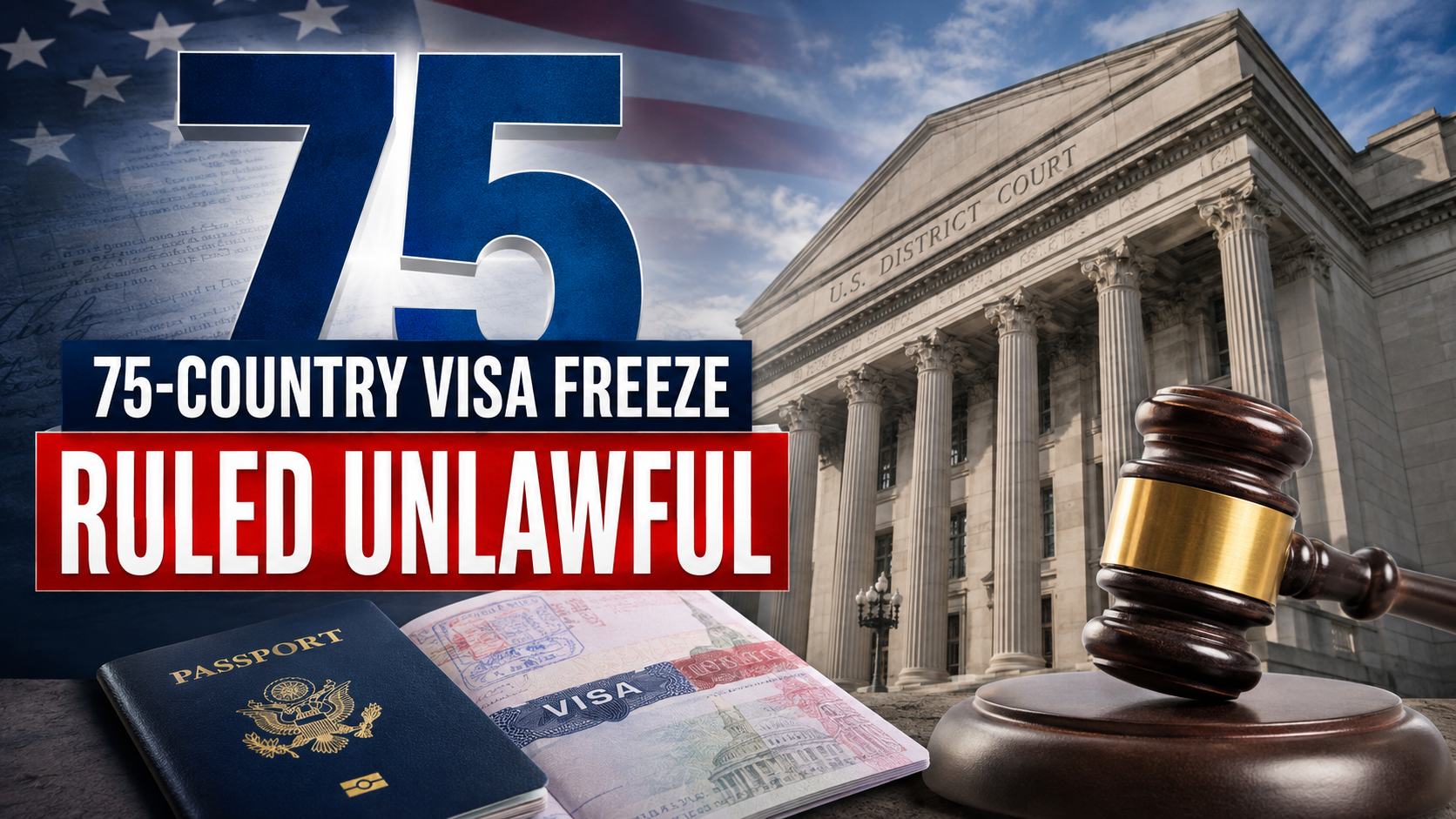
What Judge Amit Mehta actually decided—and what affected green-card applicants should expect next
By Alena Shautsova, New York Immigration Lawyer | Updated August 5, 2026
| THE BOTTOM LINE: The court found the State Department’s blanket immigrant-visa refusal policy unlawful, but the order currently gives direct relief only to the Brazilian EB-5 plaintiff and his family. It is not yet a nationwide reopening of immigrant visa issuance for all 75 countries. |
A federal judge in Washington, D.C., has delivered an important decision for immigrant visa applicants affected by the so-called 75-country green-card ban. On July 31, 2026, U.S. District Judge Amit P. Mehta ruled in De Moura Gomes v. Rubio that the Department of State’s blanket “public charge” policy violates the Immigration and Nationality Act (INA). The policy required consular officers to refuse immigrant visa applications from nationals of 75 listed countries—even when the officer found no individualized legal basis to deny the visa.
This is a significant victory for the rule of law. It confirms a basic principle: the government may screen applicants carefully, request evidence, and deny a visa when the law supports denial, but the Secretary of State cannot dictate a predetermined refusal based only on nationality when Congress assigned the decision to individual consular officers.
At the same time, affected families must understand the limits of the ruling. Judge Mehta did not vacate the policy nationwide. The plaintiffs specifically requested narrow relief, and the court ordered individualized adjudication for their case. Unless the State Department voluntarily withdraws the policy, another court issues broader relief, or an appellate decision changes the landscape, most applicants from the 75 countries may continue to encounter the pause.
What Was the 75-Country Immigrant Visa Pause?
On January 14, 2026, Secretary of State Marco Rubio issued a directive titled “Pausing Immigrant Visa Issuances for Nationalities at High Risk of Public Charge.” Effective January 21, the directive covered immigrant visa applicants who were nationals of 75 countries, including Russia, Belarus, Ukraine’s neighboring states such as Moldova, as well as Brazil, Colombia, Nigeria, Pakistan, Armenia, Georgia, Kazakhstan, Uzbekistan, Egypt, Morocco, and many others.
The policy did not formally stop applicants from submitting documents or attending interviews. Instead, it instructed consular officers to continue examining possible inadmissibility grounds but then to refuse a covered application under INA §221(g) if no other ground of refusal applied. This mattered because §221(g) is often described as administrative processing, yet here it became an indefinite holding mechanism.
Even an applicant who persuaded the consular officer that he or she was not likely to become a public charge still had to be refused. The directive also reached some cases already approved: if the visa had not been printed—or had been printed but had not left the consular section—the case could be reopened and refused. The principal exceptions identified by the policy involved qualifying dual nationals and certain national-interest cases.
This was not a ban on tourist visas or other nonimmigrant visas. The State Department’s own public notice says the pause concerns immigrant visa issuance. It also did not revoke immigrant visas already issued. Applicants should therefore avoid treating every visa category as if the same rule applies.
The Plaintiff: An EB-5 Investor Facing an Urgent Medical Crisis
Newton De Moura Gomes, a Brazilian entrepreneur, invested $500,000 in a qualifying hotel project in Arizona in December 2018 and pursued permanent residence through the EB-5 immigrant investor program. His wife and two daughters were derivative beneficiaries. The family’s case had already taken years.
The urgency was extraordinary. Mr. Gomes was living with advanced, incurable cancer. His family argued that if he died before visa issuance, their derivative eligibility could disappear. The court did not simply count how many months had passed since the latest medical examination; it evaluated the real human consequences of an indefinite freeze after more than six years of waiting.
Why Judge Mehta Found the Policy Unlawful
1. Congress gave visa adjudication authority to consular officers
INA §104(a), codified at 8 U.S.C. §1104(a), grants the Secretary of State broad authority over visa administration. But the same provision expressly withholds from the Secretary the powers and functions assigned to consular officers concerning the granting or refusal of visas. The INA also requires immigrant visa applications to be reviewed and adjudicated by a consular officer.
Judge Mehta concluded that the directive crossed that statutory line. A policy saying that consular officers “must refuse” every otherwise approvable case from a listed country does not merely manage procedure. It controls the outcome of individual visa applications—the very power Congress did not give the Secretary.
2. Public-charge decisions must be individualized
INA §212(a)(4) makes an applicant inadmissible when, in the opinion of the consular officer, the person is likely at any time to become a public charge. Congress required consideration, at minimum, of age, health, family status, assets and resources, financial status, education, and skills. This is a totality-of-the-circumstances inquiry focused on the individual applicant.
The 75-country directive nullified that discretion. After considering all the evidence, the officer was still required to reach one result: refusal. The court held that an unconditional result based on inclusion in a nationality list is contrary to the structure Congress enacted.
3. The policy was reviewable final agency action
The government argued that the directive was not final agency action under the Administrative Procedure Act (APA). The court disagreed. The Secretary sent it to all diplomatic and consular posts as an action request; it commanded a specific outcome; and it produced immediate legal consequences for covered applicants. In the court’s words, the policy “commands, it requires, it orders, it dictates.”
4. Consular nonreviewability did not block the lawsuit
Courts usually do not second-guess the merits of an individual consular officer’s visa decision. But this lawsuit challenged a department-wide policy that prevented a lawful, individualized decision. Judge Mehta explained that courts may review forward-looking claims that the government’s rules or procedures violate the INA. The plaintiffs were not asking the judge to substitute his judgment for a consular officer’s; they were asking the court to require the government to follow the process Congress created.
5. The indefinite hold was agency action unlawfully withheld
The court also applied the familiar TRAC delay factors. Although only about three months had passed since the plaintiff’s medical documentation made the application ready for final processing, the delay was not governed by a reasonable queue. It was indefinite and rested on an unlawful policy. The grave risk to the plaintiff and the possible permanent loss of his family’s immigration opportunity weighed strongly in favor of relief.
What Exactly Did the Court Order?
The court declared the Public Charge Policy unlawful and barred the government from applying it to Mr. Gomes’s application. It ordered the State Department to re-adjudicate the application individually under the INA and applicable regulations no later than 60 days after a consular officer deems the application complete.
The court did not order the visa to be approved. A consular officer may request more evidence and may refuse the case on a lawful, individualized ground. Because the prior medical examination became stale, the plaintiff must also obtain a new examination before final adjudication.
Most importantly, the plaintiffs did not request nationwide vacatur, and the injunction does not automatically protect every applicant from all 75 countries. News reports calling this a complete end to the “green-card ban” are therefore broader than the actual remedy.
What Is Likely to Happen Next?
The government may appeal
The July 31 judgment is final and appealable. The government may seek review in the U.S. Court of Appeals for the D.C. Circuit and may ask to stay the order while the appeal proceeds. As of August 5, 2026, I would not assume an appeal or stay has been filed unless the docket confirms it. Applicants should follow actual court filings, not social-media predictions.
The State Department must decide how to respond beyond this family
The Department could comply only with the narrow injunction while leaving the policy in effect for everyone else. It could revise or rescind the directive. It could also attempt to design a new screening framework that preserves individualized consular decisions. The opinion leaves room for rigorous public-charge adjudication; it rejects a predetermined blanket refusal.
Other lawsuits may seek broader relief
Similar challenges are pending or have arisen in other federal courts, including organizational litigation challenging the 75-country pause. Judge Mehta’s reasoning is persuasive, especially because it relies on the text of the INA and D.C. Circuit precedent, but one district judge’s ruling does not bind every other federal judge. A class-wide or nationwide remedy in another case could dramatically change the practical effect of this decision.
Public-charge scrutiny is still increasing
This ruling does not abolish the public-charge ground of inadmissibility. It also does not invalidate DHS’s separate July 2026 action rescinding the 2022 USCIS public-charge regulation for adjustment-of-status cases. The agencies and procedures are different: the challenged 75-country policy governs Department of State immigrant visa issuance abroad, while USCIS, within DHS, adjudicates adjustment of status inside the United States. Applicants should expect financial evidence, sponsorship, health, age, education, skills, insurance, and household circumstances to receive careful scrutiny.
What Should Affected Applicants Do Now?
- Do not assume your case has reopened. Check the State Department’s current notice, your embassy’s instructions, and your CEAC case status.
- Continue preparing a strong record. Maintain updated tax returns, Forms I-864 where required, proof of income and assets, employment evidence, insurance information, education and professional credentials, and any evidence addressing age or health concerns.
- Attend scheduled interviews unless instructed otherwise. The official policy allowed applications and interviews to continue even though issuance was paused. Missing an appointment can create a separate problem.
- Watch document expiration dates. Medical examinations, police certificates, passports, and civil documents may become stale while a case is delayed.
- Preserve evidence of harm. Medical urgency, expiring age-out protection, family separation, job loss, investment deadlines, and other concrete prejudice may matter in evaluating litigation.
- Obtain individualized legal advice before filing suit. The Gomes family had unusual facts, a long-pending EB-5 case, a completed application, and grave medical urgency. Litigation strategy depends on jurisdiction, procedural posture, exhaustion, standing, timing, and the relief requested.
Why This Decision Matters
The most important principle in De Moura Gomes v. Rubio is not that every applicant must receive a visa. It is that the government must make visa decisions under the law Congress enacted. Nationality may be relevant where a statute or lawful presidential restriction makes it relevant, but the State Department cannot convert a fact-specific public-charge standard into a mandatory refusal for millions of people through an internal directive.
For affected families, the decision creates momentum but not certainty. It may influence negotiations, future injunction requests, and other courts reviewing the same policy. It may also prompt the State Department to replace the freeze with more demanding individualized screening. In practical terms, applicants should prepare for two tracks at once: continued litigation over the legality of the pause and intensified examination of public-charge evidence.
If your immigrant visa case involves one of the 75 countries, a §221(g) refusal, lengthy administrative processing, an urgent medical or age-out issue, or a public-charge concern, your strategy should be based on your case record—not on a headline. A careful legal review can identify whether the problem is the blanket policy, a separate inadmissibility ground, missing evidence, a documentary defect, or unreasonable agency inaction.
Speak With a USA Immigration Lawyer
You do not have to navigate a rapidly changing immigrant visa case alone. I can review your consular processing history, refusal notice, public-charge evidence, sponsorship documents, and litigation options, then explain the realistic next steps for your family or business.
To schedule a paid consultation with the Law Office of Alena Shautsova, call 917-885-2261 or visit shautsova.com.
Sources
- De Moura Gomes v. Rubio, No. 1:26-cv-01883 (D.D.C. July 31, 2026), Memorandum Opinion
- S. Department of State: Immigrant Visa Processing Updates for Nationalities at High Risk of U.S. Public Benefits Reliance
- S. Department of State Foreign Affairs Manual, 9 FAM 302.8—Public Charge
- USCIS: Rescission of the 2022 Public Charge Regulation (July 16, 2026)
- Times of India report supplied by the reader
Legal notice: This article provides general information as of August 5, 2026, and is not legal advice. Immigration policies, court orders, and agency procedures can change quickly. Reading this article does not create an attorney-client relationship.


