
New DHS Rule Ends “Duration of Status” for Student Visas: What Every International Student Must Know About the New F-1 Status Changes
New DHS Rule Ends “Duration of Status” for Student Visas: What Every International Student Must Know About the New F-1 Status Changes
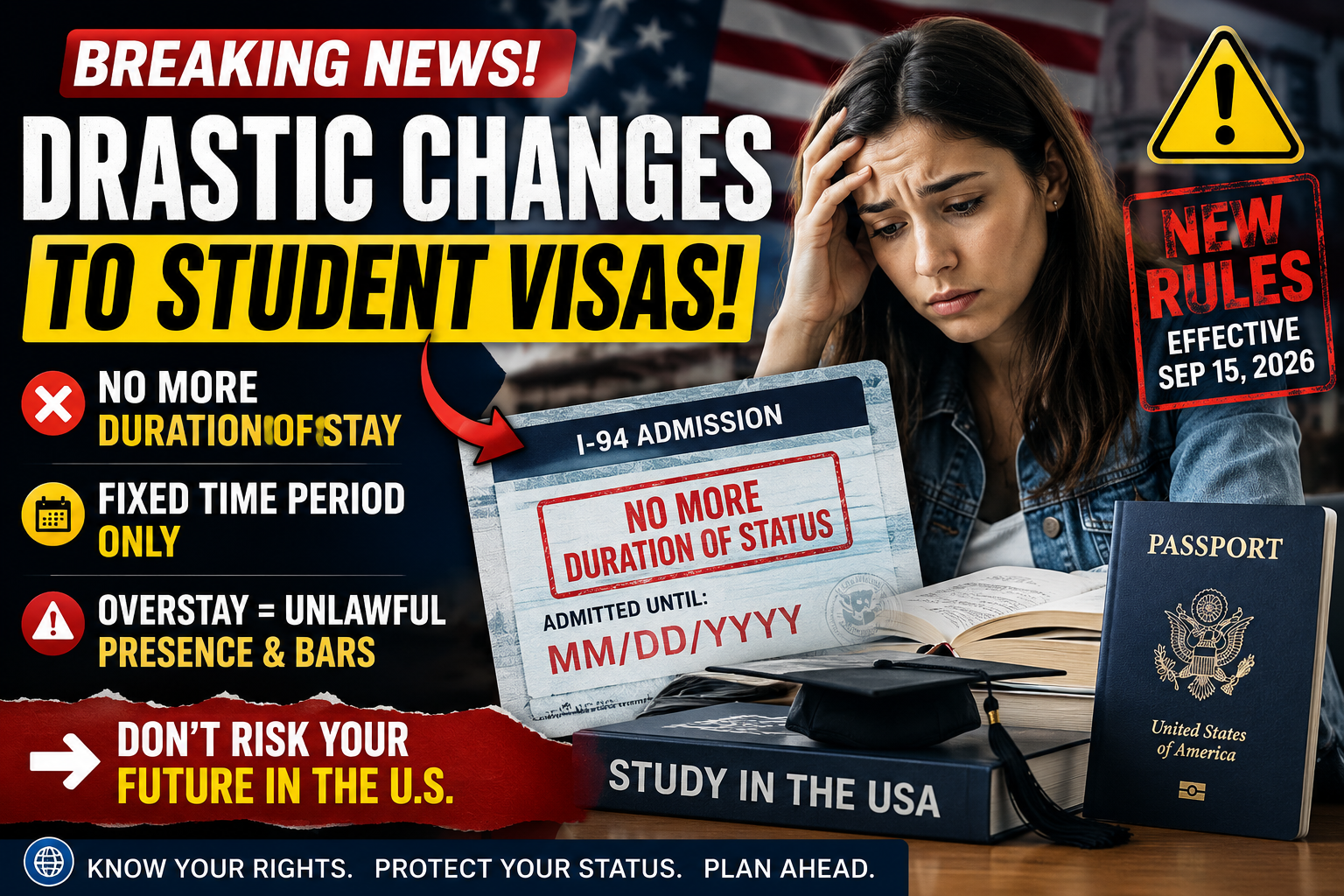
For decades, most international students studying in the United States under F-1 visas enjoyed a unique immigration benefit known as Duration of Status (D/S). Instead of receiving a specific expiration date on their I-94 admission record, students were generally allowed to remain in the United States for as long as they continued to maintain valid student status, completed their educational program, and complied with immigration regulations.
That system is about to change.
On July 17, 2026, the Department of Homeland Security (DHS) published a sweeping final rule that replaces the long-standing Duration of Status framework with fixed admission periods for F, J, and I nonimmigrant classifications. The rule creates a completely new extension process, significantly changes how international students maintain lawful status, and dramatically increases the immigration consequences of overstaying. The rule is scheduled to take effect on September 15, 2026, subject to congressional review.
If you are an international student—or plan to become one—these new rules for student visas in the USA could have a significant impact on your immigration future.
As a New York immigration lawyer, I believe these changes will fundamentally alter how international students should plan their education, Optional Practical Training (OPT), and future immigration strategy.
What Is “Duration of Status” (D/S)?
Under the old system, students admitted in F-1 status did not receive a fixed expiration date on their Form I-94.
Instead, their admission simply stated:
D/S — Duration of Status
That meant they could legally remain in the United States as long as they:
- attended their approved school,
- maintained full-time enrollment,
- complied with SEVIS requirements,
- followed immigration regulations,
- completed authorized OPT or STEM OPT,
- and departed during the applicable grace period.
If a student’s program lasted two years, four years, or even seven years for certain doctoral programs, there was generally no need to file an extension of stay with USCIS merely because additional time was needed, provided the school properly updated the student’s SEVIS record.
This system was unique among U.S. nonimmigrant visa classifications.
What Has DHS Changed?
The new DHS regulation eliminates Duration of Status for:
- F-1 academic students
- J exchange visitors
- I representatives of foreign media
- Their qualifying dependents
Instead, every admission will now include a fixed expiration date on the individual’s I-94 record.
This is one of the most significant F-1 status changes in decades.
Students Will Now Receive a Fixed Admission Period
Instead of remaining in the United States indefinitely while maintaining status, students will now receive an admission period based primarily on:
- the length of the educational program listed on Form I-20,
- subject to a maximum admission period generally not exceeding four years,
- plus limited periods before program start and after completion.
If additional time is needed, students generally cannot simply rely on an updated I-20.
Instead, many will have to request an extension of stay from USCIS before their authorized admission expires.
Filing Extensions Will Become Part of Student Life
One of the biggest practical consequences of the rule is that many students who previously never interacted with USCIS during their studies will now have to do so.
Examples include students who:
- change educational levels,
- pursue another degree,
- require additional semesters,
- experience research delays,
- participate in post-completion OPT,
- participate in STEM OPT,
- experience illness,
- or otherwise need additional time.
Rather than relying solely on their Designated School Official (DSO), many students will now need to file formal extension requests with USCIS before their authorized stay expires.
Why This Matters So Much
Previously, many students misunderstood the difference between:
- visa expiration, and
- lawful status.
Under the Duration of Status system, even if an F-1 visa stamp expired, a student often remained lawfully present as long as the student maintained status.
The new regulation makes the expiration of the authorized admission period much more significant.
Students must now carefully monitor:
- their I-94 expiration,
- their program completion,
- USCIS processing times,
- extension filing deadlines,
- and future immigration plans.
Missing one deadline could have severe immigration consequences.
Overstaying May Now Lead to Unlawful Presence
Perhaps the most important consequence of the new regulation involves unlawful presence.
Under the previous Duration of Status system, unlawful presence generally did not begin automatically simply because a student violated status. In many situations, unlawful presence was not triggered until an immigration officer made a formal finding or an immigration judge entered an order.
The new rule changes that framework.
Once the authorized admission period expires, individuals who remain without a timely extension or another lawful basis to stay may begin accumulating unlawful presence.
This is an enormous change.
Why Unlawful Presence Is Dangerous
Accumulating unlawful presence can trigger some of the harshest penalties in U.S. immigration law.
For example:
More than 180 days
A person who remains unlawfully present for more than 180 days before departing may become subject to the three-year bar from reentering the United States.
One year or more
Someone who accumulates one year or more of unlawful presence before departing may face the ten-year bar.
These bars can prevent future:
- student visas,
- employment visas,
- immigrant visas,
- adjustment of status,
- and other immigration benefits.
That makes timely compliance absolutely critical.
OPT Planning Will Become Even More Important
Many international students rely on:
- Optional Practical Training (OPT)
- STEM OPT extensions
to gain valuable U.S. work experience.
Under the new rule, students planning to engage in post-completion OPT may need to obtain an extension of stay if their authorized admission period does not already cover the requested training period.
This means students should begin planning months—not weeks—in advance.
The Grace Period Is Also Shorter
Another important change is the reduction of the traditional F-1 grace period.
Previously, most F-1 students received 60 days after completing their studies to:
- depart,
- transfer schools,
- change status,
- begin another educational program,
- or otherwise prepare for the next immigration step.
Under the new regulation, that grace period is generally reduced to 30 days.
That leaves much less room for error.
Students Will Need Better Recordkeeping
The new system places much greater responsibility on students.
International students should carefully maintain copies of:
- every Form I-20,
- every I-94,
- extension filings,
- USCIS receipts,
- approval notices,
- employment authorization documents,
- SEVIS updates,
- passport validity,
- financial documentation,
- enrollment records.
Future immigration benefits may depend on proving continuous lawful status.
Schools Will Continue to Play an Important Role
Designated School Officials (DSOs) remain essential.
However, under the new rule, schools alone will no longer be sufficient to extend many students’ lawful stay.
Instead, there is now greater involvement by USCIS through formal extension adjudications. DHS explains that this allows immigration officers to review whether individuals continue to satisfy the requirements of their nonimmigrant classification before granting additional time in the United States.
Current Students Also Need to Pay Attention
Many students assume the rule only affects future arrivals.
Not necessarily.
DHS has provided transition provisions for individuals already in F, J, and I status before the effective date. Those transition rules are detailed and depend on when the person was admitted and the applicable program dates.
Every current international student should review how the transition provisions apply to their specific circumstances.
Increased USCIS Filings Could Mean Longer Processing Times
One practical consequence of this regulation may be a dramatic increase in USCIS filings.
Thousands of students who previously never filed extension applications may now be required to submit:
- Form I-539,
- supporting evidence,
- filing fees,
- biometrics if required,
- and additional documentation.
If filing volumes increase significantly, USCIS processing times could also become longer.
Students should therefore avoid waiting until the last minute.
Practical Tips for International Students
If you are studying in the United States, consider the following steps:
Monitor your I-94
Do not rely solely on your I-20.
Know the exact expiration date of your authorized admission.
Start planning early
If your degree may require additional time, discuss it with your DSO well before your authorized stay expires.
File extensions on time
Late filings may result in unlawful presence and loss of status.
Keep copies of everything
Immigration history becomes increasingly important with each future immigration application.
Think ahead about OPT
If you intend to pursue OPT or STEM OPT, understand how the new extension procedures affect your timeline.
Consult an experienced immigration attorney
Many students assume immigration compliance is straightforward until a deadline is missed. Unfortunately, a single mistake can have consequences that last for years.
What Does This Mean for Universities?
Universities will likely need to devote additional resources to:
- educating students,
- monitoring admission expiration dates,
- coordinating extension filings,
- updating compliance procedures,
- and helping students avoid status violations.
International student offices may experience substantially increased workloads as these new procedures are implemented.
My Perspective as a New York Immigration Attorney
As a New York immigration attorney, I believe this regulation represents one of the most consequential changes to student immigration law in recent years.
The traditional Duration of Status system emphasized school oversight and SEVIS compliance. The new framework shifts much of that responsibility to formal USCIS adjudications, creating more filing obligations, stricter deadlines, and potentially more opportunities for inadvertent violations.
While DHS explains that the rule is intended to strengthen oversight, improve compliance monitoring, and enhance the government’s ability to verify that nonimmigrants continue to qualify for their status, students should understand that the practical effect is increased complexity in maintaining lawful status.
International students already face demanding academic schedules, financial pressures, and immigration regulations. Adding fixed admission periods, mandatory extension procedures in many cases, and automatic unlawful presence consequences for overstays means careful planning is now more important than ever.
Final Thoughts
The new rules for student visas in the USA fundamentally change how many international students will maintain lawful immigration status.
The elimination of Duration of Status means that students can no longer assume their lawful stay will simply continue as long as they remain enrolled. Instead, many will need to monitor expiration dates closely, file timely extension applications with USCIS, and ensure they never remain beyond their authorized admission period without legal authorization.
Perhaps most importantly, overstaying the authorized admission period may now result in the accumulation of unlawful presence, exposing students to the three-year and ten-year reentry bars that can jeopardize future immigration opportunities.
If you are an international student, a parent of a student, or a university employee trying to understand these changes, now is the time to review your immigration strategy—not after your admission period expires.
An experienced New York immigration lawyer can help you understand how these F-1 status changes apply to your individual circumstances, prepare timely extension applications, preserve lawful status, and develop a long-term immigration plan that protects your future in the United States. Call to reserve your strategy session: 917 885 2261.


