
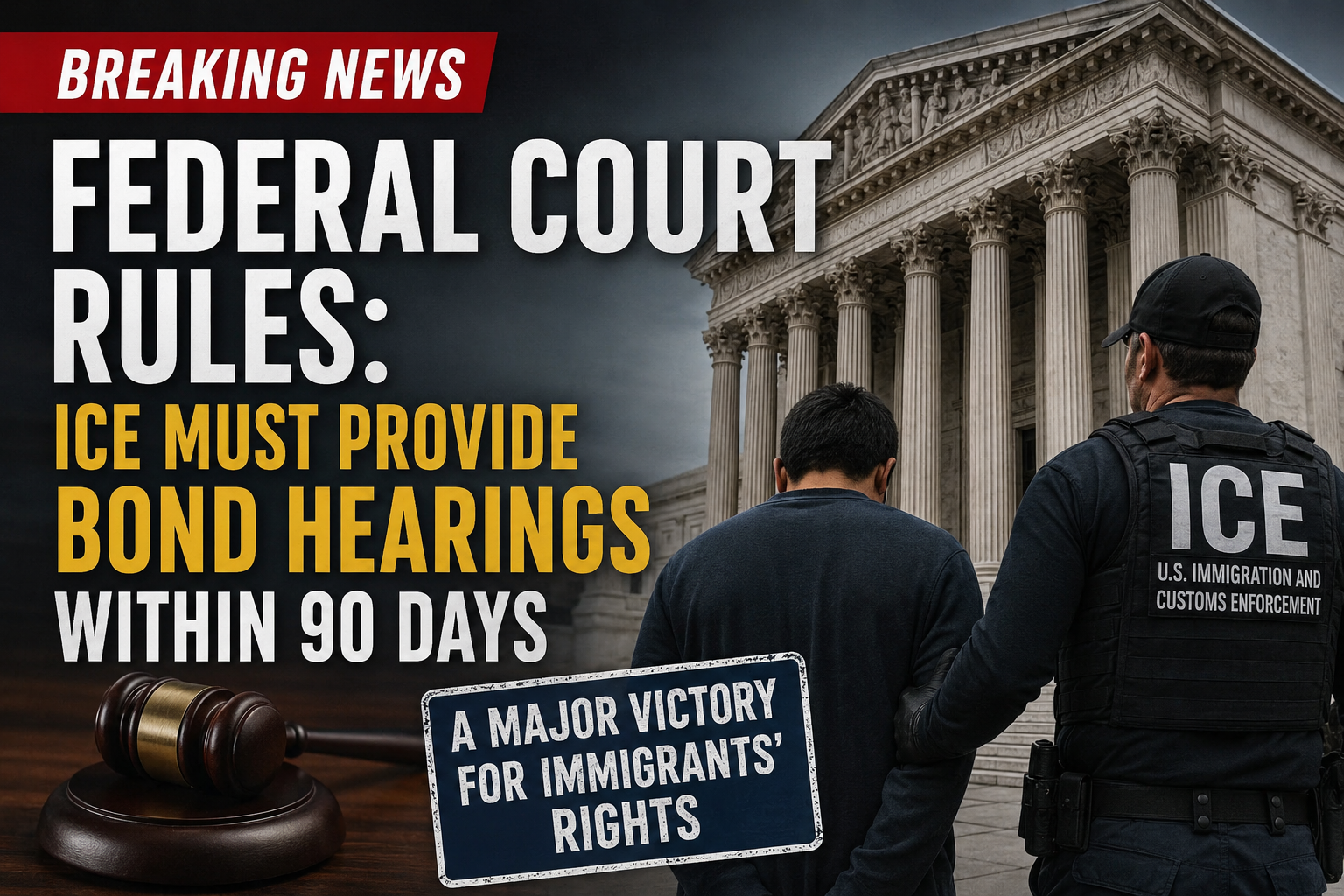
Federal Court Rules ICE Must Provide Bond Hearings Within 90 Days: A Major Victory for Immigrants Facing Detention
Federal Court Rules ICE Must Provide Bond Hearings Within 90 Days: A Major Victory for Immigrants Facing Detention
By Alena Shautsova, New York Immigration Lawyer
A major federal court decision issued this week has given hope to thousands of immigrants and their families across the United States. In an important ruling, a federal appeals court held that many immigrants who are detained by ICE are entitled to receive an individualized bond hearing if their detention extends beyond 90 days. This is one of the most significant due process victories in immigration law this year and could affect thousands of people currently held in immigration detention.
For families watching their loved ones remain behind bars month after month without any opportunity to ask a judge for release, this decision represents something extremely important: the government cannot simply lock people away indefinitely without meaningful judicial review.
However, it is equally important to understand what this ruling does not mean.
This decision does NOT automatically release detained immigrants. Instead, it gives eligible detainees the right to appear before an immigration judge and ask for bond after prolonged detention. Whether bond will actually be granted depends on the facts of each individual case.
If you or someone you love is currently detained by ICE, this decision could be life-changing—but only if it is properly understood and strategically used.
Why This Decision Is Such a Big Deal
Immigration detention has expanded dramatically over the last several years.
Thousands of people—including asylum seekers, individuals with strong family ties in the United States, and people who have lived here for decades—have found themselves detained for months while waiting for immigration court proceedings.
Many detention cases take much longer than anyone expected.
Some immigrants remain detained:
- six months
- one year
- even longer
without ever receiving a meaningful opportunity to argue that they should be released while fighting their immigration cases.
The federal court recognized that this raises serious constitutional concerns for those who entered without inspection.
The court explained that civil immigration detention cannot become endless imprisonment without meaningful procedural protections. The Constitution requires more.
What the Court Actually Ruled
The court concluded that when detention extends beyond approximately 90 days, continued detention without an individualized hearing violates fundamental due process protections.
The judges emphasized that detention cannot continue automatically forever simply because removal proceedings remain pending.
The court explained that prolonged detention requires an individualized assessment instead of mechanical detention.
As the court explained, due process requires a hearing where the government must justify continued detention rather than relying solely on the original detention decision.
This is precisely why immigration attorneys around the country are calling this ruling one of the most important immigration detention decisions of 2026.
Why This Is a Major Victory
For years, many detained immigrants had no realistic opportunity to challenge prolonged detention.
Instead, they remained in detention centers while:
- waiting for asylum hearings
- waiting for appeals
- waiting for immigration judges to issue decisions
- waiting for federal court review
Sometimes these delays were caused entirely by government backlogs—not by anything the immigrant did.
The new decision recognizes that prolonged detention requires additional procedural safeguards.
That is a major victory for due process.
Does This Mean Everyone Gets Released?
Absolutely not.
This is probably the biggest misunderstanding people will have after hearing the news.
A bond hearing is not the same thing as release.
Instead, an immigration judge will evaluate several factors, including:
- whether the person presents a danger to the community
- whether the person is likely to appear for future hearings
- criminal history
- immigration history
- family ties
- employment history
- community support
- humanitarian considerations
Only after reviewing all of the evidence will the judge decide whether bond should be granted.
Some detainees will receive bond.
Others will remain detained.
Every case is different.
The Government Still May Oppose Release
Even after 90 days, ICE attorneys may strongly oppose bond.
Government lawyers frequently argue that a person:
- presents a flight risk
- poses a danger
- has prior immigration violations
- has criminal convictions
- previously missed court
The immigration judge must evaluate all of this evidence before making a decision.
This is exactly why having an experienced deportation lawyer is so important.
A properly prepared bond hearing often includes:
- affidavits
- letters of support
- employment verification
- tax records
- medical evidence
- rehabilitation evidence
- proof of family hardship
- community involvement
Without careful preparation, a bond request can easily be denied.
Why Due Process Matters
Immigration detention is considered civil, not criminal.
That distinction is critically important.
People in immigration detention are generally not serving criminal sentences.
Instead, they are being held while the government decides whether they may remain in the United States.
The court recognized that civil detention cannot become punishment.
Instead, prolonged detention requires procedural safeguards that protect constitutional rights.
That principle reaches back decades in Supreme Court jurisprudence involving immigration detention.
Who May Benefit?
Although every situation must be analyzed individually, this ruling may potentially affect:
- asylum seekers
- individuals in removal proceedings
- long-term undocumented residents
- certain lawful permanent residents fighting removal
- immigrants with pending appeals
- individuals with motions pending before immigration courts
Eligibility depends upon the legal basis for detention.
Different detention statutes apply to different immigrants.
That is why individualized legal analysis remains essential.
The Decision Does Not Eliminate Mandatory Detention
Some immigrants remain subject to mandatory detention under federal immigration law.
For example, certain criminal convictions may trigger mandatory detention provisions under the Immigration and Nationality Act.
This decision does not eliminate those statutes.
Instead, it addresses prolonged detention and the constitutional protections that become necessary when detention extends for lengthy periods.
Why Timing Matters
The court focused on detention extending beyond approximately 90 days because prolonged detention raises increasingly serious constitutional concerns.
The longer someone remains detained, the stronger the due process concerns become.
The court recognized that government efficiency cannot come at the expense of constitutional protections.
Families Should Not Wait
If your loved one has already been detained for months, do not assume that someone else will automatically request a bond hearing.
That often does not happen.
Many detained immigrants do not know their rights.
Others are unrepresented.
Still others mistakenly believe they simply have to wait until their immigration case finishes.
Waiting can be a costly mistake.
What Evidence Helps at a Bond Hearing?
An experienced immigration attorney will often prepare evidence showing:
Strong Family Ties
Judges like to see:
- U.S. citizen children
- lawful permanent resident spouses
- parents
- siblings
- extended family
Stable Employment
Evidence may include:
- pay stubs
- employer letters
- tax returns
Stable Residence
Showing long-term residence helps demonstrate community ties.
Good Moral Character
Evidence may include:
- church letters
- volunteer work
- community organizations
- educational achievements
Medical Issues
Serious health conditions may support release.
Rehabilitation
If criminal history exists, rehabilitation evidence can be extremely important.
Why Legal Representation Matters
Bond hearings move quickly.
Government attorneys appear prepared.
Evidence rules are different than many people expect.
Judges ask difficult questions.
The burden of presenting a persuasive case often falls on the immigrant and counsel.
That is why working with the best immigration lawyer or an experienced deportation lawyer can dramatically improve the quality of the presentation.
Could the Government Appeal?
Possibly.
Major immigration decisions often continue through additional litigation.
Future appeals or Supreme Court review remain possible.
Nevertheless, unless and until the decision is changed, it provides powerful authority for challenging prolonged immigration detention.
What Should Families Do Right Now?
If someone you love is detained:
- Find out exactly when detention began.
- Obtain copies of the Notice to Appear and charging documents.
- Determine the statutory basis for detention.
- Speak with an experienced immigration attorney immediately.
- Begin collecting favorable evidence before the bond hearing.
Waiting until the hearing date is often too late.
Why This Decision Matters Beyond One Case
This ruling reinforces one of the most important principles in American law:
The government cannot deprive people of liberty indefinitely without meaningful judicial review.
Even in immigration cases, constitutional due process remains an essential safeguard.
For thousands of families separated by ICE detention, this decision restores an important opportunity to seek release before an immigration judge.
That opportunity may mean the difference between remaining incarcerated for many additional months or returning home while continuing to fight an immigration case.
Final Thoughts
This federal court ruling is unquestionably one of the biggest immigration law developments of 2026.
It recognizes that prolonged ICE detention requires meaningful procedural protections and that many detained immigrants should receive individualized bond hearings after approximately 90 days of detention.
But remember the most important takeaway:
A bond hearing is not an automatic release.
The immigration judge must still decide whether release is appropriate after carefully reviewing the evidence presented by both sides.
Every detention case is unique. The applicable detention statute, criminal history, immigration history, family circumstances, asylum claims, and humanitarian factors can all affect the outcome.
If you or a loved one has been detained by ICE, this decision may create new opportunities—but those opportunities should be evaluated quickly by experienced counsel. Early legal strategy, careful preparation, and persuasive evidence can make a significant difference in the outcome of a bond hearing.
If you are looking for the best immigration lawyer, an experienced deportation lawyer, a trusted NYC immigration lawyer, or the best asylum lawyer to evaluate an ICE detention case, obtaining legal advice as soon as possible is critical. Immigration detention law is evolving rapidly, and acting promptly may help protect your rights and your family’s future. CALL US 917 885 2261


