
Birthright Citizenship Survives: What the U.S. Supreme Court’s Landmark Decision Means for Immigrant Families
Birthright Citizenship Survives: What the U.S. Supreme Court’s Landmark Decision Means for Immigrant Families
By Alena Shautsova, New York Immigration Lawyer
If you are an immigrant living in the United States, you have probably heard the phrase birthright citizenship many times over the past year. For many families, it is more than a legal concept—it is about their children’s future, their sense of security, and their place in America.
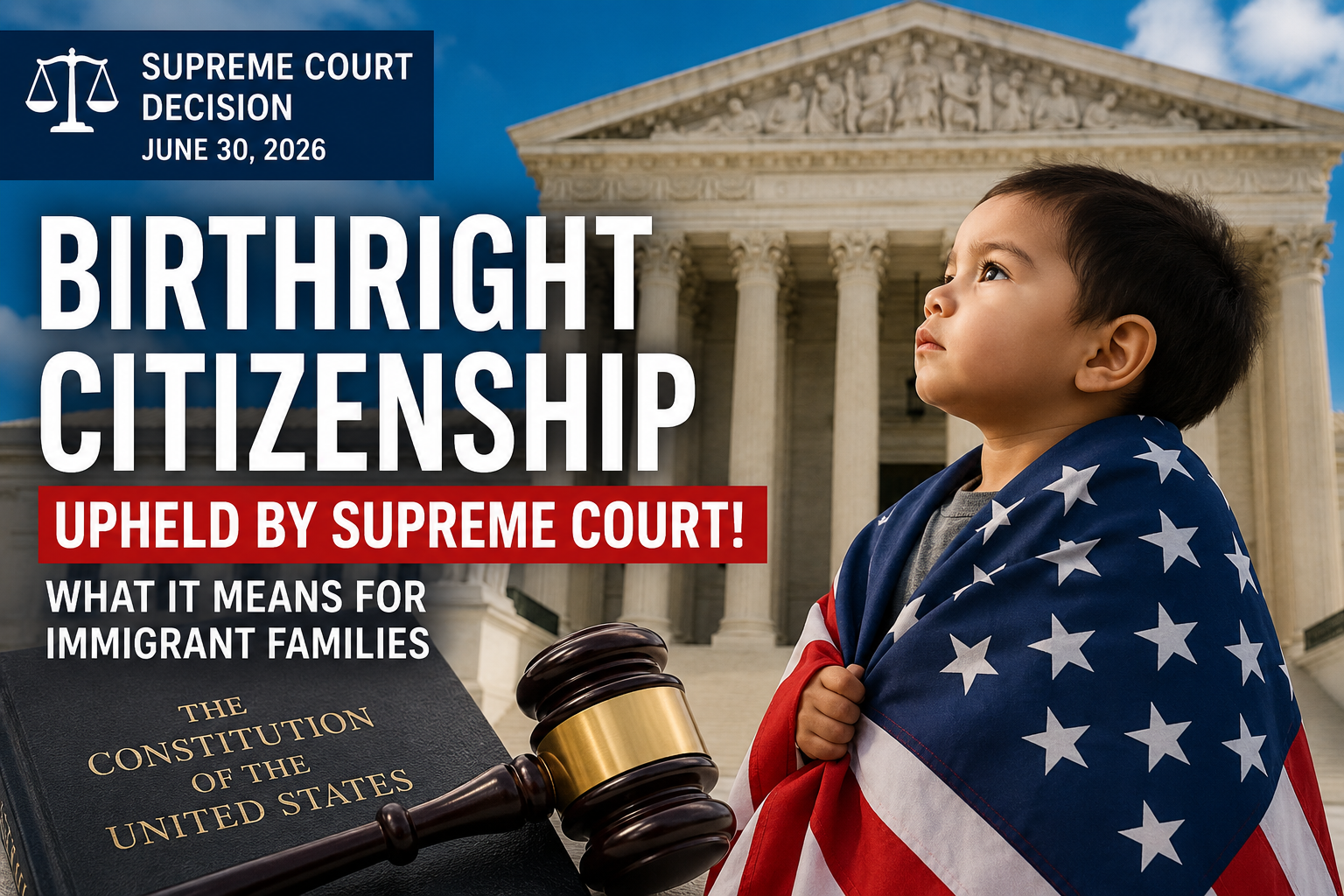
On June 30, 2026, the U.S. Supreme Court issued one of the most important immigration-related constitutional decisions in generations. In Trump v. Barbara, the Court rejected President Donald Trump’s attempt to limit birthright citizenship through an executive order and reaffirmed that children born in the United States are generally U.S. citizens under the Fourteenth Amendment, even if their parents are undocumented or only temporarily present in the country.
For millions of immigrant families, this ruling preserves a constitutional protection that has existed for more than 150 years.
As a New York immigration lawyer, I have spoken with many worried parents over the last year. Some feared that their newborn children might suddenly lose their citizenship. Others wondered whether they should delay having children or whether their children’s passports would remain valid.
The Supreme Court has now answered those questions.
Let’s examine what happened, why this decision matters, and what it means for immigrant families.
What Is Birthright Citizenship?
Birthright citizenship means that a child born in the United States automatically becomes a U.S. citizen at birth, regardless of the immigration status of the parents, subject to only a few narrow exceptions recognized by law.
This principle comes directly from the Citizenship Clause of the Fourteenth Amendment, ratified in 1868, which provides that:
“All persons born or naturalized in the United States, and subject to the jurisdiction thereof, are citizens of the United States…”
While those words appear simple, lawyers, historians, and judges have debated for decades what Congress meant by the phrase “subject to the jurisdiction thereof.”
That debate ultimately reached the Supreme Court once again in Trump v. Barbara.
Why Does America Have Birthright Citizenship?
To understand why this case matters so much, it helps to understand American history.
Before the Civil War, the United States Supreme Court issued one of the most infamous decisions in American history—Dred Scott v. Sandford (1857).
In that decision, the Court ruled that people of African descent could never become citizens of the United States, even if they had been born here.
The decision shocked much of the country and became one of the events leading to the Civil War.
After the Union victory, Congress adopted the Fourteenth Amendment specifically to overturn Dred Scott and ensure that citizenship could no longer depend upon race.
Instead, citizenship would generally depend upon one simple fact:
Where a person was born.
This concept, known by the Latin phrase jus soli, meaning “right of the soil,” has remained one of the defining principles of American constitutional law.
The Case That Defined Birthright Citizenship
Although the Fourteenth Amendment was adopted in 1868, the Supreme Court clarified its meaning thirty years later in one of the most important immigration cases ever decided—United States v. Wong Kim Ark (1898).
Mr. Wong was born in San Francisco to Chinese parents who were not eligible to become U.S. citizens under the discriminatory Chinese Exclusion Acts.
After returning from a trip abroad, the federal government argued that he was not an American citizen because his parents remained subjects of China.
The Supreme Court disagreed.
The Court held that a child born in the United States generally becomes a U.S. citizen regardless of the parents’ nationality.
For more than a century, Wong Kim Ark has been regarded as the leading Supreme Court interpretation of the Citizenship Clause.
What Was Trump v. Barbara About?
On the first day of his second term, President Trump signed an executive order seeking to deny automatic citizenship to many children born in the United States whose parents were either undocumented or in the country on temporary visas.
The administration argued that such children were not “subject to the jurisdiction” of the United States in the constitutional sense and therefore were not protected by the Fourteenth Amendment.
Multiple lawsuits were filed almost immediately.
Federal courts blocked the executive order before it could take effect.
Eventually, the dispute reached the United States Supreme Court.
What Did the Supreme Court Decide?
In a deeply divided decision, the Supreme Court held that the executive order conflicted with the Fourteenth Amendment.
Chief Justice John Roberts wrote the majority opinion.
The Court concluded that children born in the United States to parents who are unlawfully present or temporarily present are nevertheless born under the sovereign authority of the United States and therefore are citizens at birth under the Constitution.
In practical terms, the Court reaffirmed the long-standing understanding that birth in the United States is generally sufficient to establish citizenship.
Why Was This Case So Important?
The significance of the decision goes far beyond immigration policy.
The case asked whether a President could redefine one of the most fundamental constitutional rights through an executive order.
The Supreme Court answered that question with a clear “no.”
The Constitution—not an executive order—determines who is a citizen.
That distinction protects every American.
Different Justices, Different Views
Although the Court reached a final answer, the Justices strongly disagreed about how the Constitution should be interpreted.
The Majority
Chief Justice Roberts relied heavily on the historical understanding of the Fourteenth Amendment, English common law, and more than a century of Supreme Court precedent.
The majority emphasized that citizenship historically followed birthplace, not the immigration status of a child’s parents.
The opinion also discussed the historical meaning of territorial jurisdiction, explaining that individuals born within the sovereign territory of the United States generally owe obedience to American law and therefore fall within the Citizenship Clause.
The Dissents
The dissenting Justices viewed the Constitution differently.
They argued that citizenship should depend not only on birthplace but also on concepts such as permanent allegiance, domicile, and the relationship between the parents and the United States.
In their view, the Fourteenth Amendment should not automatically extend citizenship to every child born to parents who are only temporarily present or unlawfully in the country.
These dissenting opinions were extensive and relied on historical sources to argue for a narrower understanding of the Citizenship Clause.
Justice Kavanaugh’s Separate Opinion
Justice Brett Kavanaugh agreed that the executive order could not stand but wrote separately.
Rather than deciding the entire constitutional question, he would have resolved the dispute on narrower legal grounds, leaving broader constitutional issues for another day.
One Case Appeared Again and Again
Perhaps the most interesting feature of the opinions is that nearly every Justice relied on the same historical precedent—United States v. Wong Kim Ark.
However, they interpreted that decision very differently.
The majority viewed Wong Kim Ark as confirming that the Constitution protects birthright citizenship for almost everyone born on American soil.
The dissenters argued that Wong Kim Ark should be read more narrowly and that it did not necessarily answer every modern immigration question.
This illustrates an important point about constitutional law:
Judges often agree about which historical cases matter but disagree sharply about what those cases actually mean.
What Does “Subject to the Jurisdiction” Mean?
This phrase became the heart of the case.
The majority concluded that individuals born within the United States are generally subject to American laws and courts.
Because of that, they are “subject to the jurisdiction” of the United States for purposes of the Fourteenth Amendment.
The dissent interpreted the phrase differently, arguing that it should require a stronger connection to the United States through parental allegiance or domicile.
Ultimately, the majority’s interpretation prevailed.
Who Is Not Covered by Birthright Citizenship?
Although the rule is broad, it has never been absolute.
Historically recognized exceptions include children born to:
- Accredited foreign diplomats;
- Certain foreign sovereign officials enjoying diplomatic immunity; and
- Historically, some members of invading enemy forces during military occupation.
Those exceptions remain extremely limited.
What Does This Decision Mean for Immigrant Families?
For most immigrants, the decision provides welcome certainty.
If your child is born in the United States, that child generally remains a U.S. citizen regardless of whether you are:
- Undocumented;
- Waiting for asylum;
- In removal proceedings;
- A temporary visitor;
- A student;
- A temporary worker; or
- A visa overstay.
That does not mean the parents receive immigration status.
Birthright citizenship protects the child—not the parents.
Many parents mistakenly believe that having a U.S.-citizen child automatically gives them lawful status or prevents removal.
That is simply not true.
Immigration law remains extremely complex, and every family’s situation is different.
Can Congress Change Birthright Citizenship?
After the decision, some political leaders suggested pursuing legislation.
However, because the Supreme Court interpreted the Fourteenth Amendment itself, ordinary legislation would face enormous constitutional obstacles.
Changing the constitutional rule recognized in Trump v. Barbara would likely require either:
- A future Supreme Court reversing this decision; or
- A constitutional amendment.
Both possibilities are extraordinarily difficult.
Practical Advice From an Immigration Lawyer
Although this decision is encouraging, it should not give families a false sense of security.
Here are several practical recommendations.
First, continue maintaining whatever lawful immigration status you may have.
Second, do not assume your child’s citizenship protects you from removal proceedings.
Third, explore all possible immigration options available to your family, including adjustment of status, asylum, family petitions, VAWA, U visas, T visas, cancellation of removal, employment-based immigration, or other available relief.
Fourth, if your child was born in the United States, obtain a certified birth certificate, apply for a U.S. passport when appropriate, and safeguard those documents.
Finally, if you receive conflicting information from social media or unofficial sources, speak with a qualified immigration lawyer before making important decisions.
Why This Decision Matters Beyond Immigration
The Supreme Court’s ruling is about more than citizenship.
It reaffirms an important constitutional principle: fundamental constitutional rights cannot be rewritten by executive order.
Regardless of political views, constitutional stability benefits everyone.
For immigrant families, the decision provides reassurance during a period of uncertainty.
For lawyers, it reinforces the continuing importance of constitutional precedent.
For the country, it demonstrates how history continues to shape modern immigration law.
Final Thoughts
The Supreme Court’s decision in Trump v. Barbara will almost certainly become one of the defining constitutional decisions of this decade.
By reaffirming the Fourteenth Amendment and the longstanding principle of birthright citizenship, the Court preserved a rule that has governed American citizenship for generations.
The opinions reveal genuine disagreements among the Justices about constitutional interpretation, history, and national identity. Yet the controlling decision ultimately confirms that children born in the United States are citizens because they are born under the sovereign authority of this country—not because of their parents’ immigration status.
For immigrant families, this ruling removes an enormous cloud of uncertainty. It does not solve every immigration problem, nor does it provide legal status to parents. But it does preserve one of the most important constitutional protections in American law.
If you have questions about birthright citizenship, your family’s immigration options, or how this decision may affect your case, consulting an experienced New York immigration lawyer can help you understand your rights and develop the best strategy for your future.


