
T Visa in the USA: A Powerful Immigration Option for Survivors of Human Trafficking
T Visa in the USA: A Powerful Immigration Option for Survivors of Human Trafficking
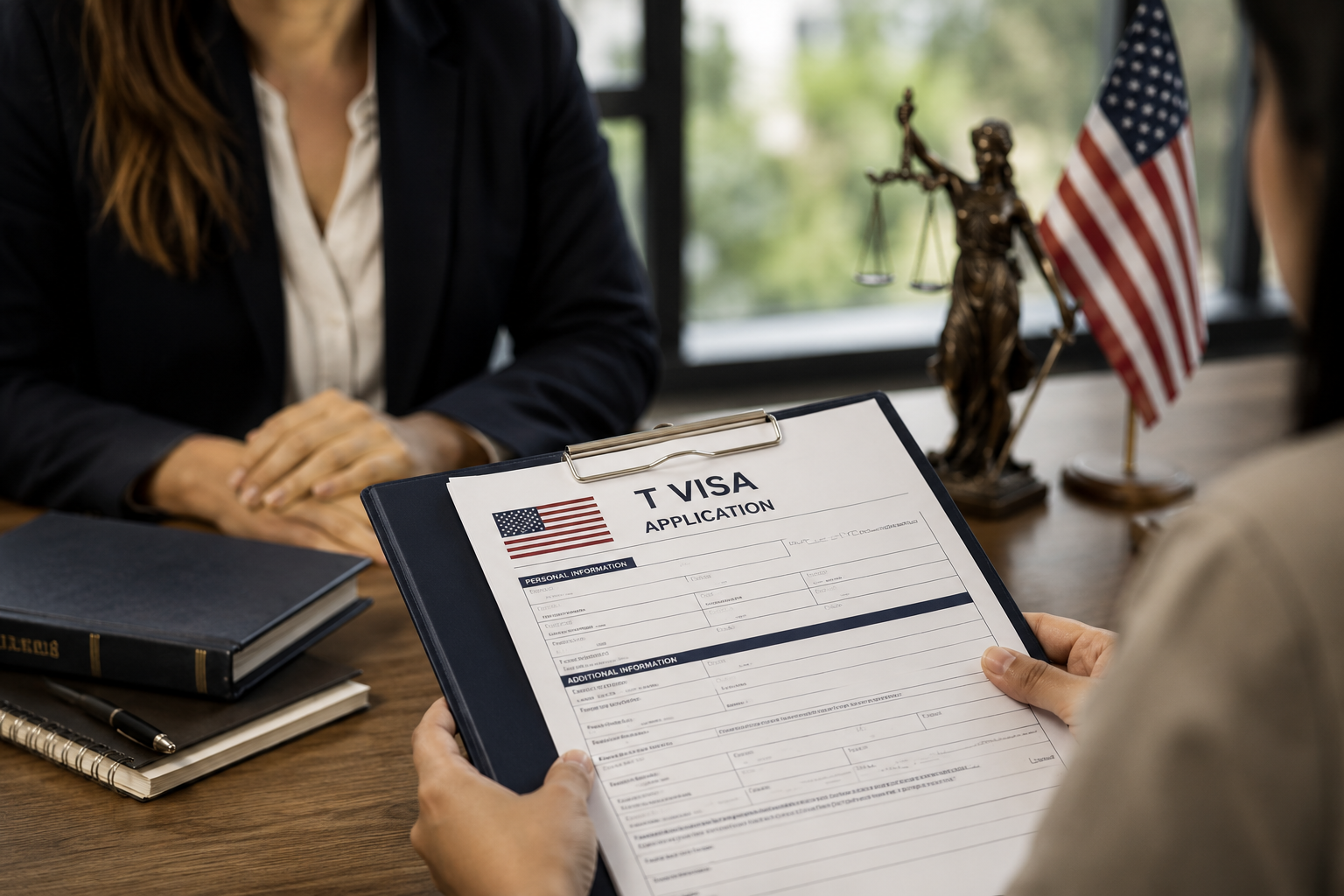
Human trafficking is one of the most devastating crimes in the world. Every year, thousands of people are brought to the United States or exploited inside the country through force, fraud, coercion, manipulation, threats, psychological abuse, or violence. Many victims do not even realize that what happened to them qualifies as human trafficking under U.S. law.
Fortunately, U.S. immigration law provides powerful protection for survivors through the T visa, officially called T nonimmigrant status.
If you are a survivor of labor trafficking or sex trafficking, you may qualify for legal status in the United States — even if:
- you entered without inspection,
- overstayed a visa,
- worked without authorization,
- have a deportation order,
- or are currently in removal proceedings.
A T visa can provide:
- lawful immigration status,
- work authorization,
- Social Security number,
- protection from deportation,
- immigration benefits for family members,
- travel permission through advance parole,
- and eventually a green card and U.S. citizenship.
Most importantly, the T visa is often much faster than a U visa, because there is no massive waiting list backlog like the one affecting U visas today.
If you are searching for a New York immigration lawyer, best deportation lawyer, or asylum lawyer USA, understanding how the T visa works could completely change your future.
What Is a T Visa?
The T visa was created by Congress through the Victims of Trafficking and Violence Protection Act to protect victims of “severe forms of trafficking in persons.”
The visa allows trafficking survivors to remain legally in the United States for up to four years and later apply for permanent residence (a green card).
Unlike many other immigration benefits, the T visa was specifically designed to help vulnerable victims who may have entered illegally, been exploited by employers, smugglers, intimate partners, criminal organizations, or traffickers.
The law recognizes that trafficked individuals are victims of serious crimes — not immigration violators who should simply be deported.
What Counts as Human Trafficking?
Under U.S. law, trafficking generally falls into two major categories:
- Sex Trafficking
Sex trafficking occurs when someone recruits, transports, harbors, solicits, or forces another person into commercial sex acts through:
- force,
- fraud,
- coercion,
- threats,
- manipulation,
- abuse of immigration status,
- or psychological control.
Importantly, if the victim was under 18 years old, force or coercion does not need to be proven.
Examples include:
- forced prostitution,
- escort service exploitation,
- pornography exploitation,
- massage parlor trafficking,
- online sexual exploitation,
- or trafficking by intimate partners.
- Labor Trafficking
Labor trafficking occurs when someone is forced or manipulated into labor or services through:
- threats,
- violence,
- confiscation of documents,
- debt bondage,
- fraud,
- coercion,
- withholding wages,
- isolation,
- or abuse of immigration status.
Examples may include:
- domestic servitude,
- forced restaurant work,
- construction exploitation,
- nail salon exploitation,
- agricultural labor trafficking,
- forced caregiving,
- factory labor,
- or exploitative work by smugglers.
Many trafficking victims were promised lawful jobs or immigration help but later found themselves trapped, unpaid, threatened, or abused.
You Do NOT Need Recent Trafficking to Qualify
One of the biggest misconceptions about the T visa is that trafficking must have happened recently.
That is false.
You may still qualify even if the trafficking occurred:
- years ago,
- during childhood,
- after entry into the United States,
- during smuggling,
- or in a prior abusive relationship.
Many survivors do not understand until much later that what happened to them legally qualifies as trafficking.
The key issue is whether you are physically present in the United States because of the trafficking or its consequences.
Trauma, fear, psychological effects, lack of lawful status, threats, and ongoing harm may all explain continued presence in the United States years later.
Who Qualifies for a T Visa?
Generally, to qualify for a T visa, you must show:
- You Were a Victim of a Severe Form of Trafficking
You must demonstrate labor trafficking or sex trafficking through evidence, testimony, declarations, reports, or other proof.
- You Are Physically Present in the USA Because of the Trafficking
You must show a connection between the trafficking and your presence in the United States.
- You Cooperated With Law Enforcement (With Exceptions)
Many people wrongly believe they need a signed certification before filing for a T visa.
This is incorrect.
Unlike the U visa, a T visa does NOT require waiting for a law enforcement certification before filing. This is one of the major advantages of the T visa.
You generally must report the trafficking or cooperate with reasonable law enforcement requests, but USCIS allows many forms of evidence to prove cooperation.
A certification on Form I-914 Supplement B is helpful but not mandatory.
This is dramatically different from the U visa process, where applicants often wait years simply to obtain police certification.
For T visas:
- police reports,
- emails,
- affidavits,
- communications,
- declarations,
- court records,
- or proof of attempts to cooperate
may be enough.
Additionally, children under 18 and survivors suffering severe trauma may be exempt from cooperation requirements altogether.
- You Would Suffer Extreme Hardship if Removed
You must show that deportation would cause unusual and severe harm.
Examples include:
- danger from traffickers,
- retaliation,
- lack of protection abroad,
- medical trauma,
- PTSD,
- social stigma,
- lack of family support,
- or severe psychological harm.
Family Members Who Can Be Included
One of the most powerful aspects of the T visa is that certain family members may also receive immigration benefits.
If the Main Applicant Is Under 21
You may include:
- spouse,
- children,
- parents,
- and unmarried siblings under 18.
If the Main Applicant Is 21 or Older
You may include:
- spouse,
- and unmarried children under 21.
Family members can often receive:
- lawful status,
- work authorization,
- and eventually green cards as derivatives.
For many trafficking survivors, this protection for family members is life-changing.
You Can Apply Even if You Entered Illegally
Another extremely important benefit of the T visa is that many immigration violations do not prevent approval.
You may still qualify if you:
- entered without inspection,
- crossed the border unlawfully,
- overstayed a visa,
- violated status,
- worked illegally,
- used false documents under coercion,
- or currently have no lawful status.
In fact, trafficking survivors are often specifically targeted because of their vulnerable immigration situation.
Congress designed the T visa to protect people in exactly these circumstances.
You Can Apply Even if You Have a Deportation Order
Many people believe deportation orders make immigration relief impossible.
That is not true.
Even if you have:
- an order of removal,
- voluntary departure order,
- prior deportation proceedings,
- or an active Immigration Court case,
you may still apply for a T visa.
USCIS has authority to approve T visas for eligible trafficking survivors despite serious immigration history.
This is why it is critical to speak with an experienced best deportation lawyer or New York immigration lawyer before giving up hope.
Steps to Apply for a T Visa
Step 1: Prepare Form I-914
The main application for T visa status is Form I-914.
The application typically includes:
- detailed personal declaration,
- trafficking evidence,
- proof of physical presence,
- evidence of cooperation,
- psychological evaluations,
- country conditions,
- witness statements,
- police reports,
- and hardship evidence.
Step 2: Include Family Applications if Applicable
Eligible relatives may be included using derivative forms.
Step 3: Request Waivers if Necessary
Many grounds of inadmissibility can be waived for T visa applicants.
This is another huge advantage compared to many other immigration categories.
Step 4: Submit Evidence of Cooperation
Remember: you do NOT need to wait for certification like in a U visa case.
This can save years of waiting.
Step 5: Attend Biometrics
USCIS will schedule fingerprints and background checks.
Step 6: Receive Work Authorization
T visa beneficiaries are granted employment authorization.
Why T Visas Are Often Faster Than U Visas
Today, U visa applicants face catastrophic delays.
Many applicants wait:
- 10 years or longer,
- just for final approval.
The U visa backlog has become one of the worst delays in immigration law.
T visas are often significantly faster because:
- fewer people apply,
- there is less backlog,
- no mandatory certification delay exists,
- and USCIS processes them more directly.
For many trafficking survivors, the T visa may be the strongest and fastest humanitarian immigration option available.
Can T Visa Holders Travel?
Yes.
One major advantage of the T visa is the possibility of obtaining advance parole for international travel.
Advance parole allows approved T visa holders to:
- temporarily leave the United States,
- travel abroad,
- and legally return.
This is extremely important for people who need:
- emergency travel,
- family visits,
- medical travel,
- or humanitarian trips.
However, travel should never occur without first consulting an experienced immigration lawyer because every case is different.
T Visa and the Green Card Process
The T visa is temporary, but it creates a pathway to permanent residence.
Generally, after maintaining T status for three years, applicants may apply for a green card if they meet eligibility requirements.
Applicants typically must show:
- continued physical presence,
- good moral character,
- and compliance with reasonable law enforcement requests if applicable.
After receiving a green card, many individuals later become eligible for U.S. citizenship.
Common Evidence Used in T Visa Cases
Evidence may include:
- personal declarations,
- police reports,
- medical records,
- text messages,
- emails,
- photographs,
- financial records,
- affidavits,
- therapist letters,
- employment evidence,
- witness statements,
- or expert evaluations.
Importantly, USCIS may consider “any credible evidence” in T visa cases.
This flexibility is essential because trafficking survivors often lack formal documentation.
Why You Need an Experienced Immigration Lawyer
T visa cases are extremely sensitive and legally complex.
The strongest applications usually include:
- detailed trauma-informed declarations,
- legal analysis,
- corroborating evidence,
- waiver requests,
- psychological evaluations,
- and carefully prepared immigration strategy.
Mistakes can lead to:
- denials,
- Requests for Evidence (RFEs),
- delays,
- or even referral to Immigration Court.
An experienced New York immigration lawyer, best deportation lawyer, or asylum lawyer USA can help survivors present their case properly and safely.
Final Thoughts
The T visa is one of the most powerful humanitarian immigration protections available in the United States.
If you survived:
- labor exploitation,
- forced work,
- coercive sex trafficking,
- domestic servitude,
- debt bondage,
- or trafficking through fraud or threats,
you may qualify for lawful immigration status — even if years have passed.
Unlike many immigration options, the T visa can help people who:
- entered illegally,
- overstayed,
- have deportation orders,
- or are currently undocumented.
It is often much faster than the U visa, does not require waiting for police certification, and provides a path to a green card after three years.
Most importantly, it offers survivors safety, stability, and hope.
If you believe you may qualify for a T visa, speak with an experienced immigration attorney immediately.
For help with T visa cases, deportation defense, or humanitarian immigration relief, contact the Law Office of Alena Shautsova at 917-885-2261 or visit www.shautsova.com


