
DACA Won’t Save You? A Wake-Up Call from the BIA That Every Immigrant in the U.S. Must Understand
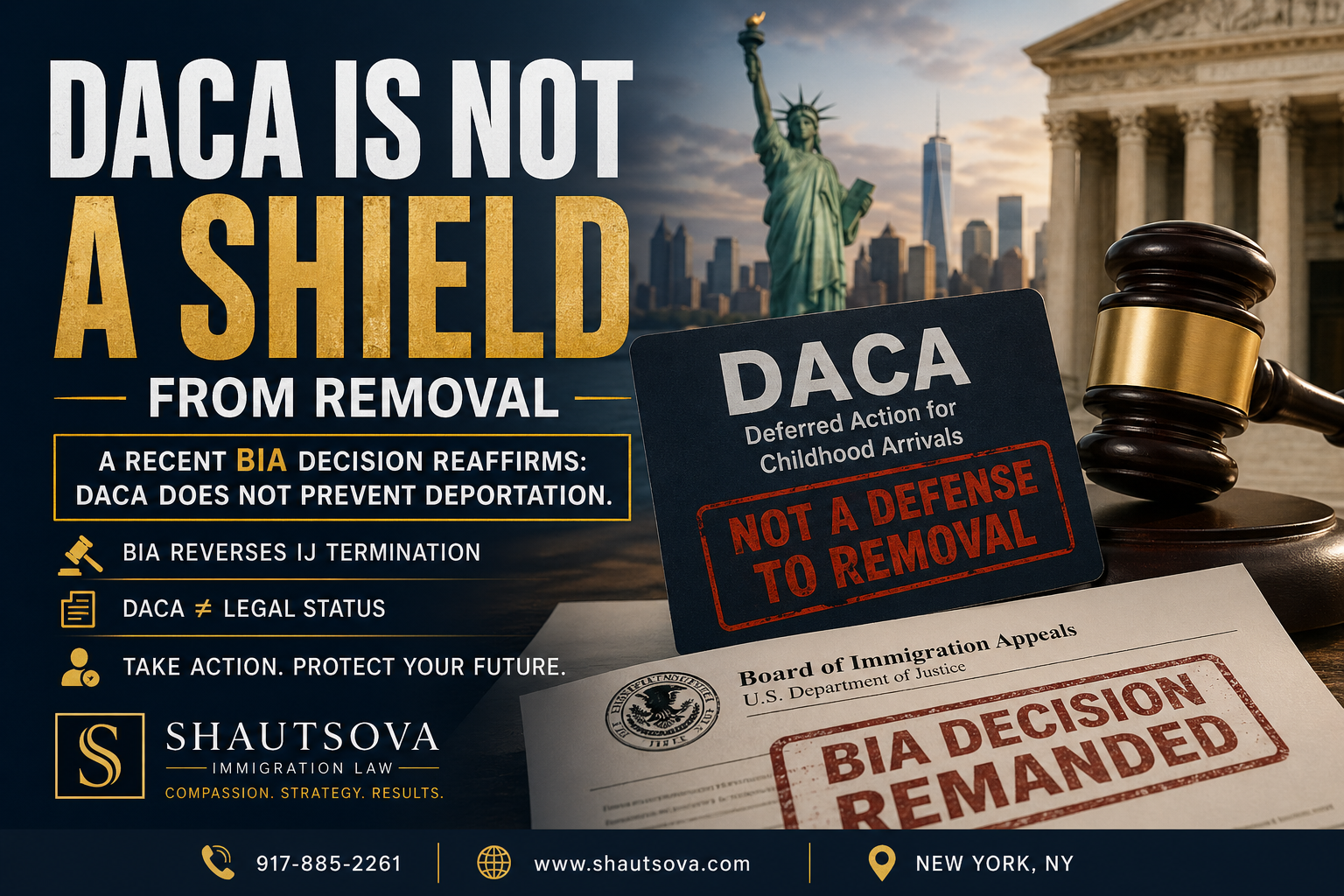 DACA Won’t Save You? A Wake-Up Call from the BIA That Every Immigrant in the U.S. Must Understand
Imagine building a life in the United States—years of schooling, a career in motion, perhaps even a marriage to a U.S. citizen—only to discover that the very protection you trusted may not shield you from deportation. That is not a hypothetical nightmare. It is the unsettling reality underscored by a recent BIA decision that is sending tremors through immigrant communities across the country.
If you or someone you love relies on DACA, this development is not merely legal trivia—it is a seismic shift that demands immediate attention.
The Illusion of Safety: What DACA Really Means
Deferred Action for Childhood Arrivals (DACA) has long been perceived as a sanctuary—a bureaucratic harbor offering temporary relief from removal and authorization to work. For many, it became synonymous with stability. But let’s be unequivocal: DACA has always been a discretionary benefit, not a legal status.
The recent BIA decision Matter of Catalina SANTIAGO-SANTIAGO lays this bare with surgical precision.
In this case, the respondent—placed into removal proceedings under INA § 212(a)(6)(A)(i) for unlawful presence—sought to terminate her case based on her DACA grant and a prospective path to a green card through marriage to a U.S. citizen. The Immigration Judge initially agreed and terminated proceedings. . The Immigration Judge cited the fact that the respondent’s DACA had not been terminated1 and relied on the regulations in 8 C.F.R. § 1003.18(d)(1)(ii)(C) (2025), which permit “discretionary termination” of removal proceedings where the alien is a beneficiary of deferred action.
But DHS appealed.
And the Board of Immigration Appeals did not hesitate.
The BIA reversed the termination and sent the case back for further proceedings. In doing so, it reaffirmed a critical legal principle: DACA does not extinguish removability, nor does it obstruct DHS from pursuing deportation.
The Core Legal Reasoning: Why the BIA Ruled This Way
The Board’s rationale is rooted in statutory clarity and longstanding doctrine.
DACA is, at its essence, an exercise of prosecutorial discretion. It does not grant lawful status. It does not erase unlawful presence. It does not confer any statutory right to remain in the United States. Think of it less as a shield and more as a pause button—one that DHS can choose to press or release.
DHS argued, convincingly, that:
- Deferred action does not provide legal admission or parole (* without an intendent application for advance parole!)
- It does not create a right to stay or reenter the United States.
- It does not bar removal proceedings.
The BIA agreed.
Even more striking was the absence of a filed immigrant petition (Form I-130) from the respondent’s U.S. citizen spouse. Without that foundational step, the argument for adjustment of status was speculative—an aspiration rather than a legal foothold.
The Board’s message was unmistakable: immigration relief must be grounded in concrete, procedural reality—not future possibilities.
Why This Decision Matters: A Broader Implication
This is not an isolated ruling. It is part of a broader trajectory within recent BIA decisions that signal a tightening interpretation of discretionary protections.
For DACA recipients, the implications are profound:
- You can still be placed in removal proceedings.
- Your DACA status does not compel an Immigration Judge to terminate your case.
- DHS retains the authority to pursue deportation even while DACA is valid.
In other words, DACA is not a legal fortress—it is a fragile reprieve.
A Dangerous Misconception Among Immigrants
Many individuals mistakenly conflate DACA with lawful presence or assume it automatically safeguards them from immigration enforcement. This misconception can lead to catastrophic consequences.
Picture a house built on sand. It may appear sturdy under calm conditions, but the moment the tide rises, its instability is exposed. That is precisely how reliance on DACA alone can unravel under legal scrutiny.
The BIA’s decision serves as a clarion call: do not anchor your future solely to DACA.
Adjustment of Status: The Missed Opportunity
One of the most poignant aspects of this case is the respondent’s claim of eligibility for adjustment of status through marriage. This pathway, if properly executed, can be transformative.
But timing and documentation are everything.
Without a filed and approved immigrant petition, the argument lacks legal substance. Immigration law does not operate on hypotheticals—it demands evidence, filings, and procedural compliance.
This is where the role of an experienced New York immigration lawyer becomes indispensable.
Strategic Takeaways for DACA Recipients
If you are currently protected under DACA, you must approach your situation with strategic vigilance.
Here is what this decision teaches:
- Do Not Assume Immunity from Removal
DACA is not a guarantee. It is a temporary administrative decision that can coexist with removal proceedings. - Actively Pursue Permanent Relief
If you are eligible for a green card—through family, employment, or another avenue—take action immediately. Delay can be the difference between stability and removal. - File Necessary Petitions Without Delay
A pending or approved petition strengthens your position significantly. Without it, your case may lack the legal scaffolding needed to withstand scrutiny. - Seek Legal Counsel Early
Navigating these complexities without guidance is akin to sailing through a storm without a compass. A seasoned immigration lawyer can chart a viable course.
The Role of the Immigration Judge vs. DHS
Another subtle but critical aspect of this decision is the delineation of authority.
Immigration Judges do not possess unlimited discretion to terminate proceedings based solely on equitable considerations like DACA. Their authority is circumscribed by regulation and precedent.
DHS, on the other hand, retains prosecutorial discretion. But as this case illustrates, DHS may choose to pursue removal—even in cases involving DACA recipients.
This dual dynamic creates a precarious landscape where assumptions can be perilous.
The Human Dimension: More Than Just a Case
Behind every BIA decision lies a human story—ambitions, relationships, and years of life woven into the fabric of the United States.
This respondent was not merely a case number. She was a person with a marriage, a future, and a belief in the protection DACA provided.
The reversal of her case is a stark reminder that immigration law, while structured and codified, often intersects with deeply personal realities.
As an immigration lawyer in New York, I have witnessed these stories unfold countless times. And each one underscores the same truth: preparation is not optional—it is essential.
How This Affects Future Cases
This decision will likely reverberate through immigration courts nationwide. Attorneys and judges alike will reference it when evaluating similar motions to terminate proceedings based on DACA.
Expect to see:
- Increased scrutiny of termination motions
- Greater emphasis on concrete eligibility for relief
- A more restrained approach by Immigration Judges
For practitioners, this means adapting strategies. For immigrants, it means acting with urgency.
A Practical Path Forward
If you are reading this and feel a sense of unease, that reaction is justified. But it should also be a catalyst for action.
Consider the following steps:
- Review your immigration history with a qualified attorney.
- Assess all potential avenues for relief, including adjustment of status, waivers, or asylum.
- Ensure all eligible petitions are filed promptly.
- Prepare for the possibility of removal proceedings, even if you currently hold DACA.
Proactivity can transform vulnerability into resilience.
Final Thoughts: Do Not Wait Until It Is Too Late
The recent BIA decision is not merely a legal development—it is a warning.
DACA, while invaluable, is not a permanent solution. It is a temporary reprieve in an ever-evolving legal landscape. Relying on it without pursuing long-term immigration relief is a gamble with profound consequences.
If you are serious about securing your future in the United States, you must move beyond assumptions and take decisive action.
As a New York immigration lawyer, I approach each case with both legal precision and human empathy. Your story deserves more than uncertainty—it deserves a strategy.
Need Guidance? Take the First Step Today
If you are a DACA recipient or facing removal proceedings, do not navigate this alone. The stakes are too high, and the law too intricate.
Contact my office today at 917-885-2261 or visit www.shautsova.com to schedule a consultation.
Your future in the United States should not depend on chance. It should be built on informed decisions, strategic planning, and unwavering advocacy.


