
Asylum for Ukrainian Nationals in 2026
Asylum for Ukrainian Nationals in 2026
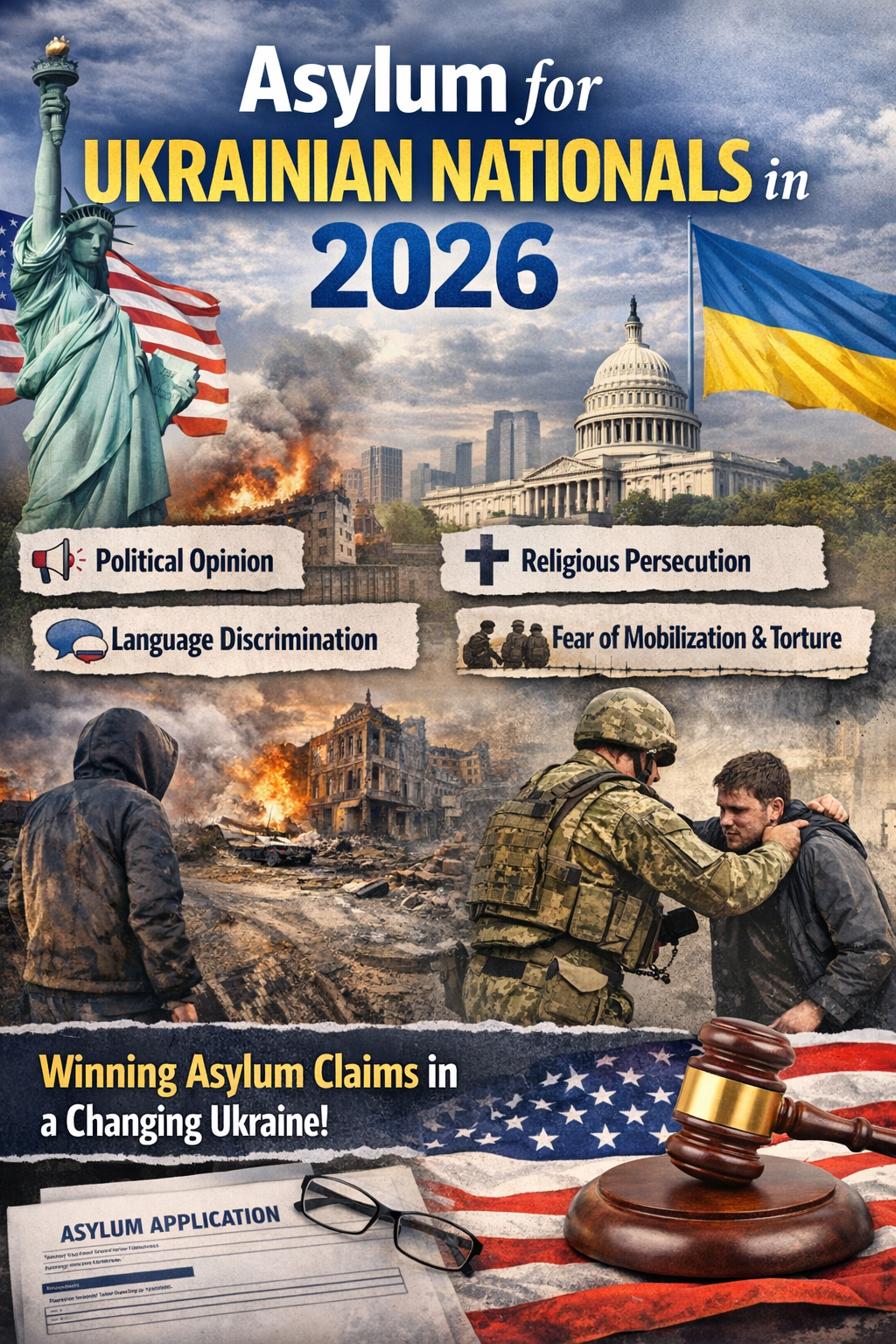
Author: New York Asylum Lawyer ALENA SHUATSOVA
The war in Ukraine has caused enormous suffering and displacement. Millions of Ukrainians have been forced to leave their homes and seek safety abroad. However, many people are surprised to learn that war alone does not automatically qualify someone for asylum in the United States.
If you are a Ukrainian national seeking protection in the U.S., understanding the legal requirements for asylum in 2026 is critical. Immigration courts and the Board of Immigration Appeals (BIA) continue to apply strict legal standards. At the same time, new political realities in Ukraine and evolving case law may create viable asylum strategies for some applicants.
This guide explains how asylum works for Ukrainian nationals today, the most common mistakes, and the legal arguments that may succeed in 2026.
If you need help with your case, call 917-885-2261 to schedule a consultation with a U.S. immigration lawyer.
War Alone Does NOT Qualify Someone for Asylum
Many Ukrainians believe that the ongoing war automatically qualifies them for asylum in the United States. Unfortunately, this is not how U.S. asylum law works.
Under the Immigration and Nationality Act (INA) and the 1951 Refugee Convention, asylum is only granted if you can prove persecution or a well-founded fear of persecution based on one of five protected grounds:
- Political opinion
- Religion
- Nationality
- Membership in a particular social group
- Race
This means:
- General danger from war is not enough
- Fear of military conflict alone is not enough
- Economic hardship caused by war is not enough
You must prove that someone wants to harm you specifically because of one of the protected grounds above.
For example:
✔ Political persecution
✔ Religious persecution
✔ Targeting because of language or identity
✔ Punishment because of political opposition
Those are the types of claims that may qualify for asylum.
Why Asylum Cases Are Becoming Harder in 2026
In 2026, asylum cases are more difficult for several reasons.
- Immigration judges rely heavily on BIA precedents
Recent Board of Immigration Appeals decisions require stronger proof of:
- Nexus between persecution and a protected ground
- Government involvement or inability to protect you
- Credibility and corroborating evidence
Take into consideration one of such precedents where a person’s personal situation changed, and even though the person was persecuted in the past, the BIA concluded due to the change in circumstances, a person no longer qualifies for asylum!
This is that the Board stated in Matter of R-B-E-, 29 I&N Dec. 499 (BIA 2026).
(1) If a respondent demonstrates past persecution, there is a presumption of a future threat to life or freedom on the basis of the original claim, but this presumption may be rebutted if there has been a fundamental change in circumstance such that the respondent’s life or freedom would not be threatened on account of a protected ground.
(2) Where a presumption of a future threat to life or freedom applies, an Immigration Judge cannot rely on generalized crime and widespread violence unrelated to the original claim to find the presumption has not been rebutted, particularly where other evidence suggests a fundamental change in circumstances such that a respondent will no longer be harmed on account of a protected ground.
- Appeals are becoming more limited
Many immigration cases today do not receive a meaningful second review. If a case is denied at the immigration court level, appeals may be difficult or unavailable depending on the procedure used.
This means your initial asylum application must be extremely strong.
The BIA will only cursory review your case due to changed regulations affecting the appeal process, and the recent US Supreme Court decision stated that the Federal courts will generally defer to the lower court’s decisions when reviewing Immigration appeals.
- “Changed country conditions” arguments
Government attorneys often argue that conditions in Ukraine vary significantly by region. Some Western regions are sometimes considered safer compared to active combat zones.
In asylum law, this leads to the argument that applicants can relocate internally within their country rather than receive asylum abroad.
Because of this, Ukrainian asylum claims must be carefully documented and tailored.
The TPS Problem: Many Ukrainians Have No Real Protection
Thousands of Ukrainians in the United States currently rely on Temporary Protected Status (TPS).
However, many applicants are stuck in pending TPS status.
This creates a dangerous situation.
If your TPS is still pending, you may not have:
- Protection from removal
- Work authorization
- Long-term immigration status
TPS also does not lead to a green card.
For many Ukrainians, asylum may be the only long-term protection available.
New Potential Asylum Claims for Ukrainians in 2026
While war itself is not enough for asylum, several new developments inside Ukraine may create stronger claims.
These claims must still be carefully documented.
Below are some examples that immigration courts may consider.
Political Opinion Claims
Political opinion remains one of the strongest grounds for asylum.
Possible examples include:
- Speaking publicly against corruption
- Criticizing government policies
- Opposing specific military decisions
- Participating in anti-government protests
Even past statements on social media can sometimes create a political opinion claim.
If government officials or authorities view you as opposed to the government, you may qualify for asylum.
Language-Based Discrimination (Russian Language)
Language can sometimes be linked to nationality or political opinion.
In Ukraine, tensions around the Russian language have increased since the war began.
Some individuals report discrimination or hostility toward Russian speakers. In asylum law, persecution linked to language can sometimes be framed as persecution based on:
- Nationality
- Political opinion
- Membership in a particular social group
Each case must be analyzed individually.
Religious Persecution Claims
Religious issues have also become more sensitive in Ukraine during the war.
For example, disputes involving churches perceived as aligned with Russia have created tensions.
Individuals who attend religious institutions disfavored by the government or who refuse to abandon their religious beliefs may face pressure or discrimination.
If religious practice leads to harassment, arrest, or threats, it may qualify as religious persecution.
Objection to Forced Military Mobilization
Another developing issue is forced military mobilization.
Since the war began, Ukraine introduced broad mobilization rules requiring many men to serve in the military. Men aged roughly 25–60 are subject to mobilization during martial law.
However, refusal to serve can lead to serious consequences.
Human rights groups report:
- Criminal prosecution for draft evasion
- Detention of conscientious objectors
- Forced recruitment practices
- Prison sentences for refusing mobilization
In some situations, refusal to serve may be tied to:
- Religious beliefs
- Political opposition
- Moral or ethical convictions
Under asylum law, punishment for military refusal can qualify as persecution if it is linked to a protected ground.
For example:
✔ Religious refusal to bear arms
✔ Political opposition to the war
✔ Punishment because authorities view you as politically disloyal
However, simply avoiding military service is usually not enough by itself.
Courts examine whether the government is punishing you because of your beliefs, not just because you broke a law.
Risk of Detention, Abuse, or Torture
Reports have also raised concerns about coercive recruitment practices.
Some recruitment offices have been accused of forcibly detaining men of conscription age and transporting them for mobilization, a controversial practice sometimes referred to as forced conscription operations.
In addition, critics have documented:
- Physical coercion during recruitment
- Criminal prosecution for refusal
- Social stigma against draft objectors
If someone faces detention or abuse because of their beliefs or identity, that risk may strengthen an asylum claim.
The Importance of a Strong Legal Strategy
In 2026, asylum cases require careful preparation.
A successful case usually includes:
A detailed personal declaration
You must clearly explain:
- What happened to you
- Why it happened
- Who persecuted you
- Why you cannot return
Supporting evidence
Examples include:
- News articles
- Human rights reports
- Witness statements
- Medical records
- Police reports
- Social media evidence
Legal arguments
Your attorney must connect your story to:
- One of the five asylum grounds
- Current country conditions
- Relevant BIA decisions
Mistakes That Destroy Many Ukrainian Asylum Cases
Many cases fail because of simple mistakes.
Common problems include:
❌ Filing asylum without legal guidance
❌ Submitting a weak personal declaration
❌ Relying only on the existence of war
❌ Failing to prove the connection to political opinion or religion
❌ Missing the one-year asylum filing deadline
Immigration judges review thousands of asylum cases. Weak or poorly prepared applications are often denied.
Final Thoughts
Asylum for Ukrainian nationals in 2026 requires a sophisticated legal strategy.
The war alone is not enough. To win your case, you must demonstrate persecution connected to:
- Political opinion
- Religion
- Nationality
- Membership in a particular social group
New realities inside Ukraine — including political tensions, religious disputes, language issues, and forced mobilization policies — may create legitimate asylum claims for some individuals.
But every case is different.
A strong asylum application requires careful legal analysis, credible evidence, and a well-prepared declaration.
📞 If you need help preparing an asylum case in the United States, call 917-885-2261 to schedule a consultation.
An experienced New York immigration lawyer can help you evaluate your eligibility, prepare a strong application, and present the best legal strategy for your case.


