
U.S. Pauses Immigrant Visas for Nationals of 75 Countries Starting January 21, 2026 — What This Means for You
 Starting January 21, 2026 — What This Means for You
U.S. Pauses Immigrant Visas for Nationals of 75 Countries Starting January 21, 2026 — What This Means for You
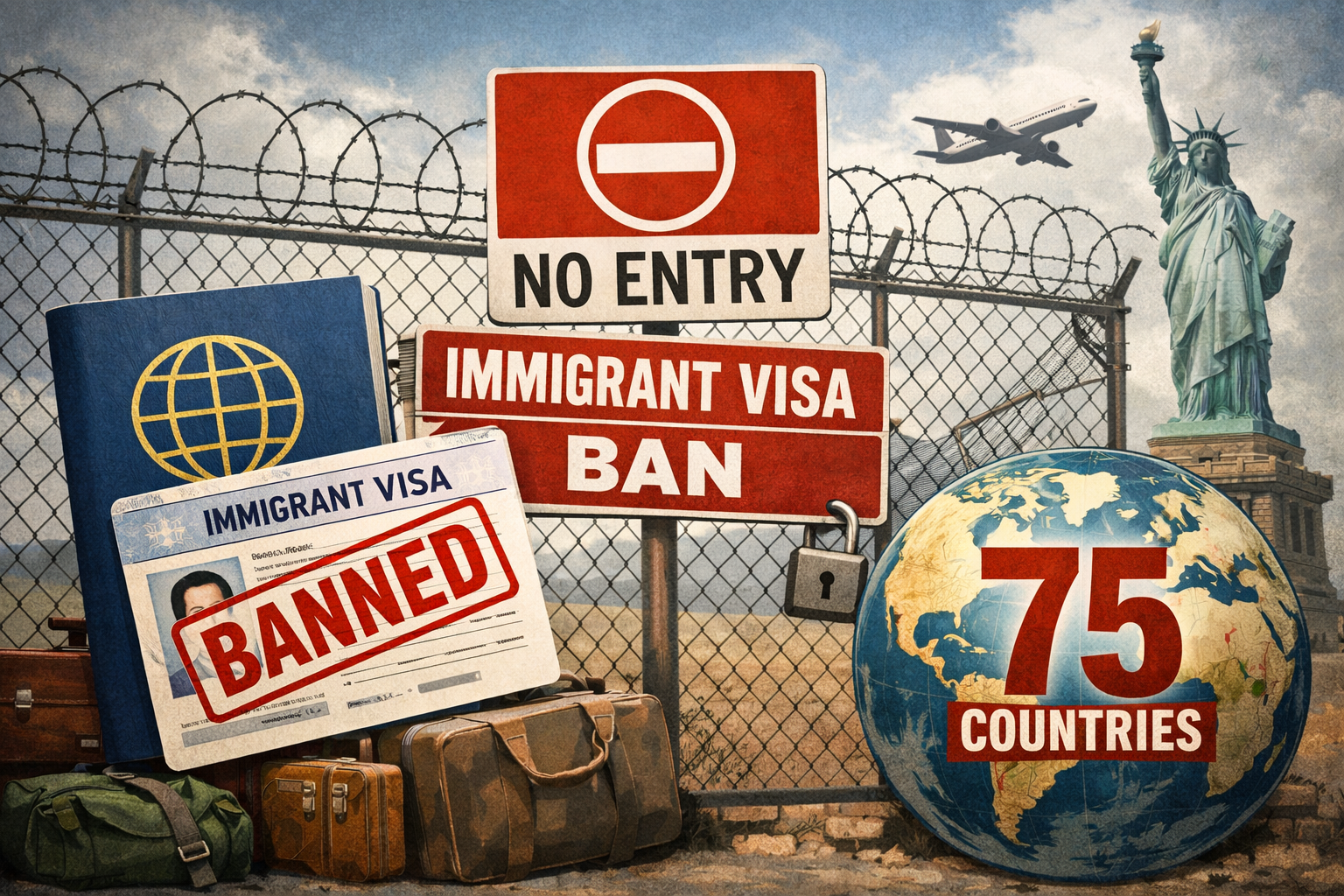
If you are planning to immigrate to the United States, the recent announcement that the U.S. government will pause immigrant visa issuance for nationals of 75 countries starting January 21, 2026 is a seismic shift. This policy, tied to expanded enforcement of the public charge rule, could impact thousands of family-based and employment-based immigrant visa applicants worldwide. (Travel.state.gov)
As an immigration lawyer in New York, I will walk you through what the policy is, who’s affected, what the government is saying on X (formerly Twitter), the full list of affected countries, and practical next steps to protect your immigration goals.
Why the Visa Pause Is Happening (Official Government Position)
According to the Department of State and statements shared on X by DHS and consular officials, the visa pause reflects an effort to prevent the entry of potential immigrants the government believes are likely to become a “public charge.” (Travel.state.gov)
🔹 Department of State Statement on X:
“The State Department will use its long-standing authority to deem ineligible potential immigrants who would become a public charge on the United States and exploit the generosity of the American people. Immigrant visa processing from these 75 countries will be paused while the State Department reassesses procedures to prevent the entry of foreign nationals who would take welfare and public benefits.” — State Department Spokesperson on X
This language mirrors official guidance published by the State Department, noting that the policy is tied to public charge concerns and a comprehensive review of screening procedures. (Travel.state.gov)
What Is “Public Charge” and Why Does It Matter? (Quick Recap)
The public charge ground of inadmissibility allows immigration officials to deny visas if they believe an applicant is likely to rely principally on public benefits. While this concept has existed for decades, recent enforcement has broadened the criteria and tightened financial thresholds.
Under the pending policy:
- Consular officers will weigh age, health, education, job prospects, English proficiency, finances, and past benefit use more stringently than before.
- The entire immigrant visa process for certain nationalities will be halted while these standards are re-evaluated. (Travel.state.gov)
Full List of 75 Countries Affected by the Immigrant Visa Pause
The U.S. Department of State has published the complete list of affected countries, spanning Africa, Asia, the Middle East, the Caribbean, Latin America, and Eastern Europe. The pause applies to immigrant visas (green cards) only, not visitor, student, or H-1B work visas. Exceptions apply for dual nationals presenting passports from countries not on this list. (Travel.state.gov)
Alphabetical List of Countries (75 Total)
Afghanistan
Albania
Algeria
Antigua and Barbuda
Armenia
Azerbaijan
Bahamas
Bangladesh
Barbados
Belarus
Belize
Bhutan
Bosnia and Herzegovina
Brazil
Burma (Myanmar)
Cambodia
Cameroon
Cape Verde
Colombia
Côte d’Ivoire
Cuba
Democratic Republic of the Congo
Dominica
Egypt
Eritrea
Ethiopia
Fiji
The Gambia
Georgia
Ghana
Grenada
Guatemala
Guinea
Haiti
Iran
Iraq
Jamaica
Jordan
Kazakhstan
Kosovo
Kuwait
Kyrgyzstan
Laos
Lebanon
Liberia
Libya
Moldova
Mongolia
Montenegro
Morocco
Nepal
Nicaragua
Nigeria
North Macedonia
Pakistan
Republic of the Congo
Russia
Rwanda
Saint Kitts and Nevis
Saint Lucia
Saint Vincent and the Grenadines
Senegal
Sierra Leone
Somalia
South Sudan
Sudan
Syria
Tanzania
Thailand
Togo
Tunisia
Uganda
Uruguay
Uzbekistan
Yemen (Travel.state.gov)
This pause does not revoke visas already issued before January 21, 2026, but prevents issuance of new immigrant visas to nationals of these countries until further policy changes are finalized. (Travel.state.gov)
What This Means for You and Your Family
Who Is Affected
- Family-based immigrant applicants (spouses, parents, children, siblings)
- Employment-based immigrants (including EB-1, EB-2, EB-3)
- Diversity Visa (DV) Lottery winners from these countries
- Fiancé(e) (K-1) visa applicants planning to adjust status later
Nonimmigrant categories like B-1/B-2 visitor visas, F-1 student visas, or H-1B work visas are not directly affected by the pause itself, although screening may become more intense. (Travel.state.gov)
Potential Exceptions and Strategic Options
✔ Dual nationals with a passport from a non-listed country might still be eligible
✔ Adjustment of status in the U.S. — if you are currently in status — may allow you to pursue a green card without consular processing
✔ Humanitarian pathways or waivers may remain available depending on your circumstances
Practical Advice Before the Pause Begins
If you are eligible and preparing to file:
- File immigrant petitions and applications now if timing permits
- Strengthen financial documentation for public charge evaluations
- Consider adjustment of status if you are in the United States
- Discuss alternative pathways with an immigration lawyer well before January 21, 2026
Additional Serious Consequences: Children Aging Out, I-601A Risks, and DACA Beneficiaries
- Beyond the immediate disruption to immigrant visa processing, this indefinite pause could trigger irreversible legal consequences for many families and workers.
- Children may “age out.”
If a child turns 21 years old during a prolonged immigrant visa suspension, they may permanently lose eligibility as a “child” under U.S. immigration law. While the Child Status Protection Act (CSPA) can help in some cases, it does not protect every child, especially when visa issuance itself is frozen. A delay caused by government policy—rather than applicant action—can still result in devastating family separation. - I-601A provisional waiver applicants are now strongly discouraged from leaving the U.S.
Individuals who obtained or planned to file an I-601A unlawful presence waiver typically rely on short consular trips abroad to complete immigrant visa processing. With immigrant visa issuance paused for nationals of affected countries, leaving the United States could mean being stuck abroad indefinitely, even with an approved waiver. In the current environment, travel for consular processing carries extreme risk and should not be undertaken without a careful legal strategy. - DACA beneficiaries planning consular immigrant visas face major uncertainty.
Many DACA recipients—particularly those pursuing employment-based green cards—planned to complete their process at a U.S. consulate abroad due to entry issues. If immigrant visas are suspended for their country of nationality, these individuals may find themselves unable to return, with no guarantee of visa issuance and no clear timeline for resolution. For DACA beneficiaries, this could mean losing both lawful presence protections and employment authorization.
Final Thoughts
This policy marks one of the most dramatic restrictions on legal immigration in recent U.S. history. Affected immigrant visa applicants from these 75 countries should act quickly and strategically rather than waiting for the pause to take effect.
If you or your loved ones have questions, don’t wait — we can evaluate your case and plan the best path forward before doors close.
📞 Call or text: 917-885-2261
🌐 Visit: www.shautsova.com
I specialize in navigating complex and evolving immigration policies with precision, urgency, and care — especially when government rules change fast.


