
September 2026 Visa Bulletin: Key Updates and What May Happen in October
September 2026 Visa Bulletin: Key Updates and What May Happen in October
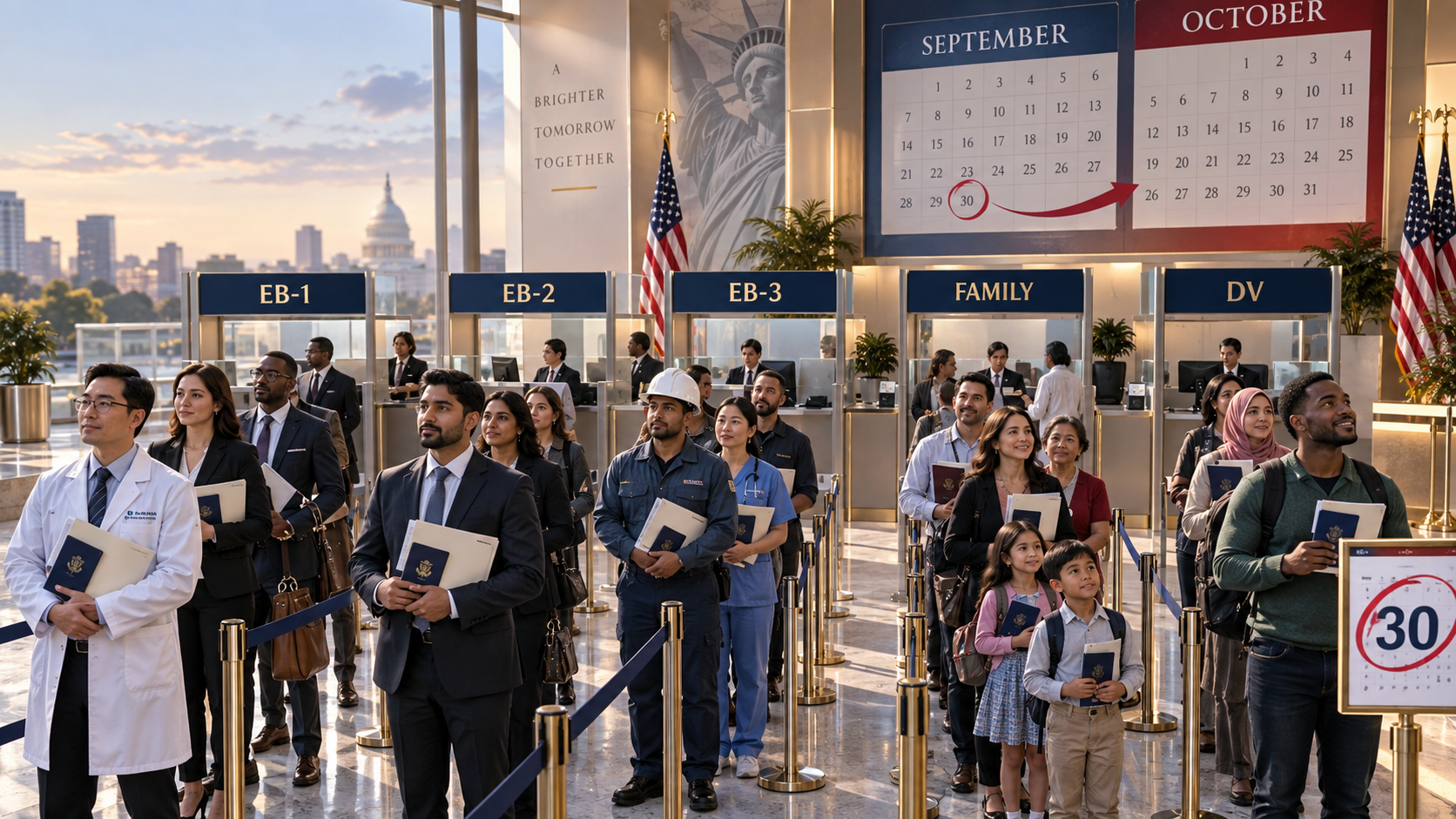
The September 2026 Visa Bulletin is not an ordinary monthly update. September is the final month of the federal fiscal year, and that creates both opportunities and risks for people waiting for a family-based or employment-based green card.
The U.S. Department of State advanced a number of cutoff dates during fiscal year 2026 because immigrant visa issuance was lower than expected. But the government also issued a clear warning: if demand increases or a numerical limit is reached, a category may retrogress or become unavailable even before September 30.
For Diversity Visa applicants, the urgency is even greater. The right to receive a DV-2026 visa ends on September 30, 2026. A visa cannot be issued after that date, even if the applicant was selected, submitted documents, attended an interview, or experienced administrative delays.
Below, I explain the most important September 2026 Visa Bulletin developments, what they mean in practical terms, and what may happen when the new fiscal year begins on October 1, 2026.
What Is the Visa Bulletin?
The Department of State publishes the Visa Bulletin every month to show whether immigrant visa numbers are available in preference categories subject to annual numerical limits.
To read the bulletin correctly, you need four pieces of information:
- Your immigrant visa category;
- Your priority date;
- Your country of chargeability, which is usually your country of birth—not citizenship or residence; and
- Whether you are pursuing adjustment of status with USCIS or immigrant visa processing through a U.S. consulate.
The bulletin has two different charts.
Final Action Dates determine when the government may finally approve an immigrant visa or Form I-485 application.
Dates for Filing determine when certain applicants may begin the document-submission stage. Applicants applying for adjustment of status cannot simply choose the more favorable chart. USCIS separately announces which chart may be used for family-sponsored and employment-based filings each month.
A priority date generally must be earlier than the date printed in the applicable chart. “C” means the category is current. “U” means visa numbers are unavailable and the government cannot approve cases in that category at that time.
Why September 2026 Is Especially Important
Immigrant visa numbers are allocated by fiscal year. Fiscal year 2026 ends on September 30, and fiscal year 2027 begins on October 1.
For FY 2026, the Department of State calculated a worldwide family-sponsored preference limit of 226,000 and an employment-based limit of 186,317. The ordinary per-country cap was 28,862, subject to the bulletin’s additional explanation concerning EB-5 carryover numbers.
The State Department reported that immigrant visa issuance rates decreased during FY 2026. It therefore advanced dates across several categories to make remaining numbers accessible to enough qualified applicants. That movement should not be misunderstood as a guarantee that every applicant whose date became current will receive approval in September.
If the government reaches an annual, category, or per-country limit, it may stop authorizing numbers. A case can therefore be approvable in every other respect yet remain pending because no visa number is available.
September 2026 Employment-Based Final Action Dates
The employment-based chart brings favorable news for some applicants and serious restrictions for others.
| Category | Most Countries | China | India | Mexico | Philippines |
|---|---|---|---|---|---|
| EB-1 | Current | July 1, 2023 | October 15, 2022 | Current | Current |
| EB-2 | Current | September 1, 2021 | Unavailable | Current | Current |
| EB-3 | September 1, 2024 | January 1, 2022 | January 1, 2014 | September 1, 2024 | August 1, 2023 |
| Other Workers | April 1, 2022 | May 1, 2019 | January 1, 2014 | April 1, 2022 | December 1, 2021 |
| EB-4 | December 15, 2022 | December 15, 2022 | December 15, 2022 | December 15, 2022 | December 15, 2022 |
| EB-5 Unreserved | Current | December 1, 2016 | Unavailable | Current | Current |
All three EB-5 set-aside categories—rural, high-unemployment, and infrastructure—are current for all chargeability areas in September.
EB-1 and EB-2: Strong results for most countries, but danger for India
EB-1 and EB-2 are current for applicants chargeable to most countries. This is highly significant for many multinational managers, outstanding professors and researchers, people of extraordinary ability, advanced-degree professionals, and EB-2 National Interest Waiver applicants.
India presents a very different picture. India EB-2 is unavailable for final action. India EB-1 remains at October 15, 2022, but the State Department specifically warned that high demand might require India EB-1 to become unavailable before the fiscal year ends.
This distinction matters: an approved I-140 does not itself guarantee that USCIS can approve the green card. Petition eligibility and visa-number availability are separate requirements.
EB-3 and Other Workers
For most countries, EB-3 has a September 1, 2024 final action date. The Other Workers cutoff is much older—April 1, 2022—because that subcategory has a substantially smaller annual allocation.
Applicants must identify the exact classification listed in the approved petition. A worker should not assume that an EB-3 priority date applies under the same cutoff to the Other Workers subcategory.
EB-5
The unreserved EB-5 category is current for most countries, backlogged for China, and unavailable for India. The reserved rural, high-unemployment, and infrastructure categories remain current.
The Department of State also warned that demand in unreserved EB-5 might require retrogression or unavailability before September 30. Investors should not treat “current” as protection against later allocation changes, nor should they make major financial decisions based on a chart without reviewing the immigration and investment consequences separately.
September 2026 Family-Sponsored Final Action Dates
For most countries, the September final action dates are:
| Category | Who Is Included | Most Countries |
|---|---|---|
| F1 | Unmarried sons and daughters, age 21 or older, of U.S. citizens | January 22, 2020 |
| F2A | Spouses and unmarried children under 21 of permanent residents | August 22, 2026 |
| F2B | Unmarried sons and daughters, age 21 or older, of permanent residents | August 22, 2019 |
| F3 | Married sons and daughters of U.S. citizens | October 22, 2014 |
| F4 | Brothers and sisters of adult U.S. citizens | October 22, 2011 |
Mexico and the Philippines have separate, generally older dates in several categories. India has a separate F4 final action date of November 1, 2006.
Why F2A deserves special attention
The F2A Dates for Filing chart is current for every country. That may create an important filing opportunity for certain spouses and unmarried children under 21 of lawful permanent residents—but only if USCIS permits use of that chart for the month and the applicant is otherwise eligible to adjust status.
“Current for filing” does not necessarily mean “immediately approvable.” In September, the F2A final action date is August 22, 2026 for most countries and August 22, 2025 for Mexico.
Applicants inside the United States also must examine lawful admission or parole, maintenance of status, unauthorized employment, INA § 245(c) restrictions, INA § 245(i), inadmissibility, and other case-specific issues. A favorable chart does not cure a legal bar.
Immediate relatives are different
Spouses of U.S. citizens, unmarried children under 21 of U.S. citizens, and parents of U.S. citizens who are at least 21 are immediate relatives. They are not subject to the family-preference cutoff dates in the Visa Bulletin.
That does not mean every immediate relative can adjust status inside the United States. The manner of entry, prior removal orders, fraud or misrepresentation, criminal history, and other grounds of inadmissibility still matter.
The Absolute September 30 Deadline for DV-2026
The September 2026 regional Diversity Visa rank cutoffs are:
- Africa: 101,250, except Algeria at 85,000 and Egypt at 50,000;
- Asia: 40,000, except Nepal at 13,500;
- Europe: 47,500;
- North America (Bahamas): Current;
- Oceania: 3,000; and
- South America and the Caribbean: 4,750.
A rank number below the applicable cutoff makes a case eligible for visa-number consideration; it does not guarantee issuance. The applicant must complete processing, remain legally eligible, and actually receive the visa or adjustment approval while a number is available.
DV-2026 eligibility ends on September 30, 2026. No DV-2026 visa may be issued in October. The same deadline applies to derivative spouses and children. The bulletin warns that all available DV numbers may be exhausted even before September 30.
Applicants facing missing documents, administrative processing, medical-exam issues, or unresolved admissibility questions should act immediately. Litigation or expedited requests may be relevant in exceptional situations, but no applicant should assume that a court or agency can extend the statutory DV year.
What Could Happen in the October 2026 Visa Bulletin?
The October bulletin had not been issued when this article was prepared. The following is a reasoned forecast—not an announcement of official cutoff dates.
1. Categories unavailable in September may reopen
October 1 begins a new fiscal year and a new annual allocation of family- and employment-based visa numbers. It is therefore reasonable to expect some categories marked unavailable in September—particularly India EB-2 and India EB-5 unreserved—to receive a cutoff date again in October.
But reopening does not mean becoming current. The State Department may set a conservative date because it must manage demand across the entire fiscal year. India EB-2 and EB-5 unreserved are likely to remain heavily backlogged.
2. India EB-1 may stabilize or reopen at a controlled date
If India EB-1 becomes unavailable before September 30, new FY 2027 numbers could permit the category to reopen in October. Even if it does not become unavailable in September, the October date may remain close to the September cutoff or move only modestly. High demand makes a dramatic forward jump less likely.
3. EB-2 for most countries may remain current—but that is not guaranteed
The September chart shows EB-2 current for most countries, while the bulletin warns that increased EB-2 demand could require retrogression or unavailability before year-end. A new allocation supports renewed availability in October, but demand carried into FY 2027 could lead the State Department to establish a cutoff rather than leave the category current.
In other words, applicants should prepare for either outcome: continued current status or a newly imposed date.
4. Family-sponsored movement may be modest
Family preference backlogs are driven by accumulated demand, annual category limits, and per-country limits. A new fiscal year replenishes numbers, but it does not erase the waiting list. October may bring limited forward movement or dates that largely hold, particularly in long-backlogged Mexican and Philippine categories and India F4.
F2A will deserve close attention. Its favorable September filing chart may continue, but the final action date and USCIS chart selection can change independently.
5. USCIS may allow more generous filing charts
Early in a fiscal year, USCIS sometimes has greater reason to permit use of the Dates for Filing charts because more visa numbers are expected to be available over the coming months. That makes October’s separate USCIS announcement especially important.
This is only a possibility. Applicants should not mail Form I-485 until they confirm the chart USCIS has designated for October and verify that the priority date is earlier than the applicable cutoff.
6. DV-2026 will end, and DV-2027 processing will begin
October does not provide a grace period for DV-2026. The new month begins the DV-2027 program year. DV-2026 selectees who did not receive visas by September 30 cannot transfer their eligibility into the new fiscal year.
What Applicants Should Do Now
Confirm the priority date. Use the I-797 approval or receipt notice and, where applicable, the labor certification—not memory.
Confirm the category. EB-3 Professional or Skilled Worker is not always treated the same as Other Workers. F2A is different from F2B, and marriage or turning 21 can affect family classification.
Use the correct chargeability column. Chargeability usually follows country of birth. Cross-chargeability through a spouse may help in some cases but requires individualized analysis.
Separate filing eligibility from approval eligibility. A person may be permitted to file under the Dates for Filing chart while still waiting for the Final Action Date before approval.
Check USCIS before filing Form I-485. The Department of State publishes both charts, but USCIS decides which chart adjustment applicants may use.
Prepare before the date becomes current. Civil documents, medical examinations, translations, affidavits of support, and admissibility analysis can take time. Waiting for a favorable bulletin before beginning preparation may waste a short filing window.
Analyze Child Status Protection Act issues immediately. CSPA calculations are technical. A child’s biological age, petition-pending time, visa availability, and the requirement to seek to acquire permanent residence can all matter.
Do not make risky travel or employment decisions from a headline. Visa availability does not replace analysis of advance parole, unlawful presence, maintenance of status, work authorization, consular risks, or a prior removal order.
Treat DV timing as final. A current rank number is not enough; issuance must occur no later than September 30.
When Should You Speak With an Immigration Lawyer?
A Visa Bulletin tells you whether a number may be available. It does not tell you whether you qualify for adjustment of status, whether consular processing creates a bar, whether a waiver is required, or whether a family member is protected from aging out.
Legal review is particularly important when:
- Your priority date recently became current;
- Your category retrogressed or became unavailable;
- You have a child approaching age 21;
- You are choosing between adjustment of status and consular processing;
- You entered without inspection, overstayed, or worked without authorization;
- You have a prior removal order, arrest, immigration misrepresentation, or visa denial;
- USCIS or a consulate has delayed the case despite apparent visa availability; or
- A DV-2026 case remains unresolved as September 30 approaches.
Final Thoughts
The September 2026 Visa Bulletin gives some applicants a valuable opportunity, but it also comes with unusually strong warnings. India EB-2 and India EB-5 unreserved are unavailable for final action. India EB-1, EB-2 generally, and unreserved EB-5 face the possibility of further restrictions before the fiscal year closes. DV-2026 applicants face an absolute deadline.
October should bring a new annual supply of visa numbers, and some unavailable categories may reopen. But a new fiscal year does not eliminate backlogs, guarantee forward movement, or make every category current. The only safe approach is to review the official October bulletin when released, check the separate USCIS filing-chart designation, and evaluate the applicant’s full immigration history before acting.
To discuss a family-based or employment-based green card case, EB-1, EB-2 NIW, adjustment of status, consular processing, or a Diversity Visa concern, contact the Law Office of Alena Shautsova, a New York immigration law firm, at 917-885-2261 or visit www.shautsova.com.
Disclaimer: This article is for general informational purposes only and does not constitute legal advice. Visa availability and agency procedures can change quickly. Consult a qualified immigration attorney about your individual circumstances.


