
Final Removal Order? A New BIA Decision Limits Immigration Judge Bond Jurisdiction
 Final Removal Order? A New BIA Decision Limits Immigration Judge Bond Jurisdiction
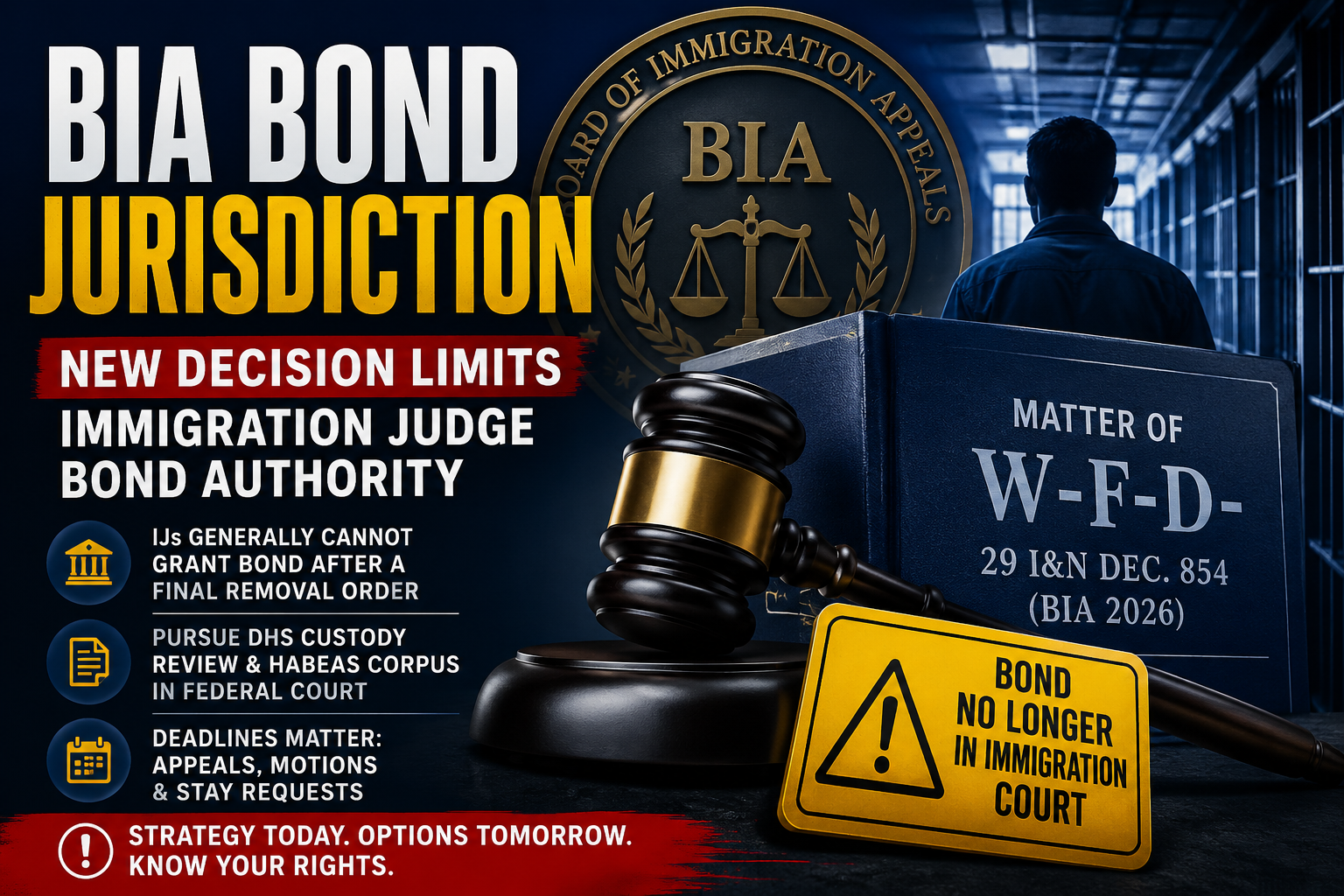
On August 25, 2026, the Board of Immigration Appeals issued an important precedent concerning immigration detention after a removal order becomes administratively final. In **Matter of W-F-D-, 29 I&N Dec. 854 (BIA 2026)**, the Board held that Immigration Judges generally lack jurisdiction to redetermine custody conditions once a person is subject to an administratively final order of removal.
The practical effect is serious. A person detained before a final removal order may, depending on the applicable detention statute and other jurisdictional rules, be able to request a bond hearing before an Immigration Judge. Once the removal order becomes administratively final, however, detention ordinarily shifts to the post-order framework under section 241(a) of the Immigration and Nationality Act. At that point, an Immigration Court is generally no longer the proper forum for seeking release based on prolonged post-order detention.
The Board explained that the available paths may instead include a written custody-review request to the Department of Homeland Security and a habeas corpus action in federal district court. These are different procedures, governed by different legal standards, and they should not be treated as interchangeable with an ordinary immigration bond motion.
The decision is also an urgent reminder of a broader reality: deadlines and procedural choices in removal cases can determine which remedies remain available later. An appeal must be filed on time. A motion to reopen must be prepared as though it may be the person’s only statutory motion. And when a person with a final removal order asks the BIA or Immigration Court for a stay in connection with a motion to reopen or reconsider, the person generally should first request a stay from DHS and provide proof of that request.
What Happened in Matter of W-F-D-?
The respondent was a citizen of the Democratic Republic of the Congo who entered the United States without inspection or admission in January 2025. DHS detained her and charged her as removable. In June 2025, an Immigration Judge ordered her removed, denied asylum and statutory withholding of removal, but granted protection under the regulations implementing the Convention Against Torture as to the Democratic Republic of the Congo.
The respondent did not timely appeal the Immigration Judge’s decision. As a result, the removal order became administratively final when the period allowed for an appeal expired. That change in procedural posture mattered enormously.
After more than a year in detention, the respondent requested a custody redetermination from the Immigration Court. She argued that release was justified because detention was harming her health, she was not a danger or flight risk, and she had a sponsor and a fixed residence. The Immigration Judge conducted a hearing and ordered her released upon payment of a $1,500 bond.
DHS appealed. The BIA sustained the appeal and vacated the bond order. The Board did not decide that the respondent necessarily had to remain detained indefinitely. Instead, it concluded that the Immigration Judge lacked jurisdiction to provide the remedy that had been granted.
That distinction is central: a strong factual case for release does not create jurisdiction where the governing statute and regulations have not given an Immigration Judge authority to act.
Why Did the Immigration Judge Lose Bond Jurisdiction?
Immigration detention does not operate under one single statute from the beginning of a case through the execution of a removal order. The source of detention authority can change as the case moves through different procedural stages.
Before an order of removal becomes final, custody may be governed by pre-final-order detention provisions. Subject to important exclusions and case-specific rules, 8 C.F.R. § 1236.1(d)(1) authorizes Immigration Judges to review certain DHS custody determinations before a final order is entered.
After the removal order becomes administratively final, detention is generally governed by INA § 241(a), 8 U.S.C. § 1231(a). The statute provides for a 90-day removal period during which detention is mandatory. Certain people may remain detained beyond that period under INA § 241(a)(6), while others may be released under supervision.
In Matter of W-F-D-, the BIA emphasized that Immigration Judges and the Board possess only the authority delegated to them by statute and regulation. The Supreme Court’s decision in **Zadvydas v. Davis, 533 U.S. 678 (2001)** recognized an implicit reasonable-time limitation on detention under INA § 241(a)(6), but Zadvydas did not grant Immigration Judges authority to conduct post-final-order bond hearings.
The Board also relied on **Johnson v. Arteaga-Martinez, 596 U.S. 573 (2022)**, in which the Supreme Court held that INA § 241(a)(6) does not itself require the government to provide bond hearings before Immigration Judges after six months of detention.
Accordingly, the BIA held that Immigration Judges generally cannot redetermine custody once the removal order is administratively final. The Board identified a narrow exception when DHS refers a matter to an Immigration Judge under 8 C.F.R. § 241.14(g), after determining that special circumstances warrant continued detention following the removal period. DHS made no such referral in Matter of W-F-D-.
CAT or Withholding Protection Does Not Necessarily Eliminate the Removal Order
Matter of W-F-D- also illustrates a point that often causes confusion. The respondent had received CAT protection regarding removal to the Democratic Republic of the Congo, yet she remained subject to a final removal order.
Withholding of removal and CAT protection are country-specific. They prevent removal to the particular country where the person is likely to face persecution or torture, but they do not necessarily cancel the removal order or prevent DHS from seeking removal to a legally permissible third country.
This is different from asylum, which carries broader benefits and may eventually provide a path to permanent residence. A person granted withholding or deferral of removal may still face post-order detention questions, supervision requirements, and the possibility that DHS will investigate removal to another country.
What Remedies Remain After a Final Removal Order?
The BIA stated that a person in post-removal-period detention is not necessarily without a remedy. It identified two principal pat
1. Submit a Written Custody-Review Request to DHS
DHS conducts post-order custody reviews under regulations including 8 C.F.R. § 241.4 and 241.13. Under 8 C.F.R. § 241.13, a detained person may submit a written request asserting that there is no significant likelihood of removal in the reasonably foreseeable future.
Under Zadvydas, after six months of post-order detention, once the detained person provides good reason to believe that removal is not significantly likely in the reasonably foreseeable future, the government must respond with evidence sufficient to rebut that showing.
A meaningful request should be supported by evidence rather than general statements. Depending on the facts, useful documentation may include evidence of unsuccessful travel-document efforts, communications with a consulate, DHS records regarding removal attempts, proof that the destination country will not accept the person, evidence that removal to a third country is not realistically available, medical records, proof of cooperation, a proposed residence, a sponsor’s affidavit, and evidence showing that the person is not a danger or flight risk.
The exact legal theory and supporting record will depend on the person’s detention history, nationality, designated country of removal, protection order, cooperation with DHS, and any efforts to arrange third-country removal.
2. File a Habeas Corpus Petition in Federal District Court
The second possible remedy is a petition for a writ of habeas corpus under 28 U.S.C. § 2241 in the appropriate federal district court. A habeas petition may raise statutory or constitutional challenges to post-removal-period detention.
Federal habeas litigation is not simply another bond hearing. Jurisdiction, venue, the proper respondent, exhaustion arguments, detention length, foreseeability of removal, the person’s cooperation, and circuit-specific law can all matter. The requested relief must also be framed carefully.
Importantly, a federal habeas petition challenging detention is different from a petition for review challenging the removal order. A petition for review is generally filed in the appropriate federal court of appeals and is governed by strict statutory deadlines. A habeas case challenging custody ordinarily proceeds in federal district court. Choosing the wrong forum or confusing the two forms of relief can waste critical time.
## Why a Timely BIA Appeal Is More Important Than Ever
Matter of W-F-D- demonstrates what can happen when the period for appeal expires. The removal order becomes administratively final, the governing detention statute changes, and ordinary Immigration Judge bond jurisdiction may disappear.
For Immigration Judge decisions issued on or after March 9, 2026, the general deadline for filing an appeal with the BIA was reduced from 30 days to **10 days**, subject to a statutory 30-day period for certain appeals involving the grant or denial of asylum. The asylum exception is technical and does not apply in every case in which asylum was mentioned. For example, the 2026 rule applies the 10-day period where the person was barred from applying for asylum based on an asylum cooperative agreement, the one-year filing bar, or a prior asylum denial.
Never assume that you have 30 days. Read the Immigration Judge’s written appeal notice immediately and have a qualified immigration attorney identify the controlling deadline. The Notice of Appeal must be received as required by the applicable rules; waiting until the last day can be disastrous.
A timely appeal may prevent an Immigration Judge’s order from becoming administratively final while the appeal is pending. By contrast, a late appeal may leave the person with a final order, exposure to enforcement, and far narrower options.
A Motion to Reopen Does Not Automatically Stop Removal
Many people incorrectly believe that filing a motion to reopen automatically prevents ICE from executing a final order. In most cases, it does not. Unless a specific automatic-stay provision applies, DHS may continue to enforce the removal order while the motion remains pending.
One important exception involves certain motions to reopen and rescind in absentia removal orders, for which the regulations may provide an automatic stay. But no one should assume that an automatic stay exists without a case-specific legal analysis.
If there is a risk of removal, the strategy may require both a motion to reopen or reconsider and a separate request for a stay of removal.
Request the Stay From DHS First
In **Matter of Herrera-Nunez, 29 I&N Dec. 691 (BIA 2026)**, the BIA announced that a person with a final removal order should first request a stay from DHS before the Board considers a stay request filed in connection with a motion to reopen or reconsider a Board or Immigration Court order.
Going forward, the person should submit proof that a stay was requested from DHS. The request generally should be given to DHS with enough time for the agency to respond, and a copy of DHS’s decision should be filed with the BIA as part of the BIA stay request. If there was not enough time to allow DHS to act such as a genuine emergency involving imminent removal the filing should explain why.
DHS’s denial does not necessarily prevent the BIA or Immigration Judge with jurisdiction over the pending motion from granting a discretionary stay. But the procedural order matters:
1. Assess the final order and the immediate enforcement risk.
2. Prepare the motion to reopen or reconsider and the supporting record.
3. Request a stay from DHS under 8 C.F.R. § 241.6.
4. Preserve proof of submission and, if available, DHS’s decision.
5. Submit the appropriate stay request to the BIA or Immigration Court with the required proof or a detailed explanation of any emergency.
Because removal can occur before a motion is decided, these filings must be coordinated. A legally strong motion may become practically useless if the person is removed before counsel secures appropriate emergency protection.
You May Have Only One Statutory Motion to Reopen
The need for careful preparation became even more urgent after **Matter of M-M-L-J-, 29 I&N Dec. 843 (BIA 2026)**. There, the BIA held that a person is generally permitted to file only one motion to reopen, whether filed with the Immigration Court or the BIA, subject to a limited statutory exception for qualifying battered spouses, children, and parents. The Board also held that equitable tolling does not overcome the numerical limit in jurisdictions that have not adopted a contrary controlling rule.
The decision noted but did not decide the application of the number bar to motions seeking asylum or related protection based on changed country conditions. Other statutory or regulatory exceptions may also require careful analysis, and controlling federal circuit law may affect the result.
Still, the warning is unmistakable: do not waste a motion to reopen.
Before filing, counsel should obtain and review the complete record of proceedings; identify the correct tribunal; analyze time and numerical limitations; determine whether an exception applies; investigate ineffective assistance of counsel requirements where relevant; gather affidavits and objective evidence; confirm eligibility for the ultimate relief; address discretionary factors; and coordinate any necessary stay request.
A short, unsupported, or strategically premature motion can consume the person’s one statutory opportunity. Later discovery of stronger evidence may not cure that mistake.
Practical Steps for a Person With a Final Removal Order
If you or a family member has received an order of removal, take the following steps immediately:
– Obtain the Immigration Judge’s written decision, oral decision transcript if available, appeal-waiver information, BIA decisions, and prior motion rulings.
– Confirm whether the order is administratively final and identify the exact date it became final.
– Determine whether the deadline for a BIA appeal or federal petition for review is still open.
– Do not assume that filing a motion to reopen creates a stay of removal.
– If detained after a final order, analyze DHS post-order custody review and federal habeas options rather than relying on a standard Immigration Court bond motion.
– Preserve all documents concerning travel-document efforts, custody reviews, consular communications, reporting appointments, and ICE check-ins.
– Do not file a motion to reopen merely to put something on file. It may be the only statutory motion available.
– If requesting a stay from EOIR in connection with a motion, first submit the stay request to DHS when required and preserve proof.
– Seek counsel promptly. These cases may involve Immigration Court, the BIA, DHS, a federal district court, and a federal court of appeals each with different jurisdiction and deadlines.
The Bottom Line
Matter of W-F-D- closes an important door: once a removal order becomes administratively final, an Immigration Judge generally lacks authority to grant release through an ordinary custody redetermination hearing. The primary avenues identified by the BIA are a written DHS custody-review request and a federal habeas corpus action, subject to the facts and applicable law. A narrow DHS-referral exception exists, but it will not apply in the ordinary case.
The larger lesson is that procedural timing can change substantive options. A timely appeal may keep an order from becoming final. A properly prepared motion to reopen may be the one meaningful opportunity to return to court. A stay request must be coordinated with the motion, and Matter of Herrera-Nunez generally requires the person to seek a DHS stay first before asking the BIA to act.
If you or a loved one is detained, has received a removal order, missed an appeal deadline, or is considering a motion to reopen, the case should be evaluated immediately. The Law Office of Alena Shautsova represents clients in complex deportation defense matters, BIA appeals, motions to reopen, stays of removal, and federal immigration litigation. Call **917-885-2261** or visit(https://shautsova.com to schedule a paid consultation.
*This article provides general information and does not create an attorney-client relationship. Immigration detention and appellate rules are highly case-specific and may change. Obtain individualized legal advice before taking action.*
Primary Authorities
– [Matter of W-F-D-, 29 I&N Dec. 854 (BIA 2026)](https://www.justice.gov/eoir/media/1459006/dl?inline)
– [Matter of M-M-L-J-, 29 I&N Dec. 843 (BIA 2026)](https://www.justice.gov/eoir/media/1458296/dl)
– [Matter of Herrera-Nunez, 29 I&N Dec. 691 (BIA 2026)](https://www.justice.gov/eoir/media/1445646/dl?inline)
– [Appellate Procedures for the Board of Immigration Appeals, 91 Fed. Reg. 5267 (Feb. 6, 2026)](https://www.federalregister.gov/documents/2026/02/06/2026-02326/appellate-procedures-for-the-board-of-immigration-appeals)


