
USCIS CHANGES RULES FOR AFFIRAMTIVE ASYLUM PROCEDURE
USCIS CHANGES RULES FOR AFFIRAMTIVE ASYLUM PROCEDURE
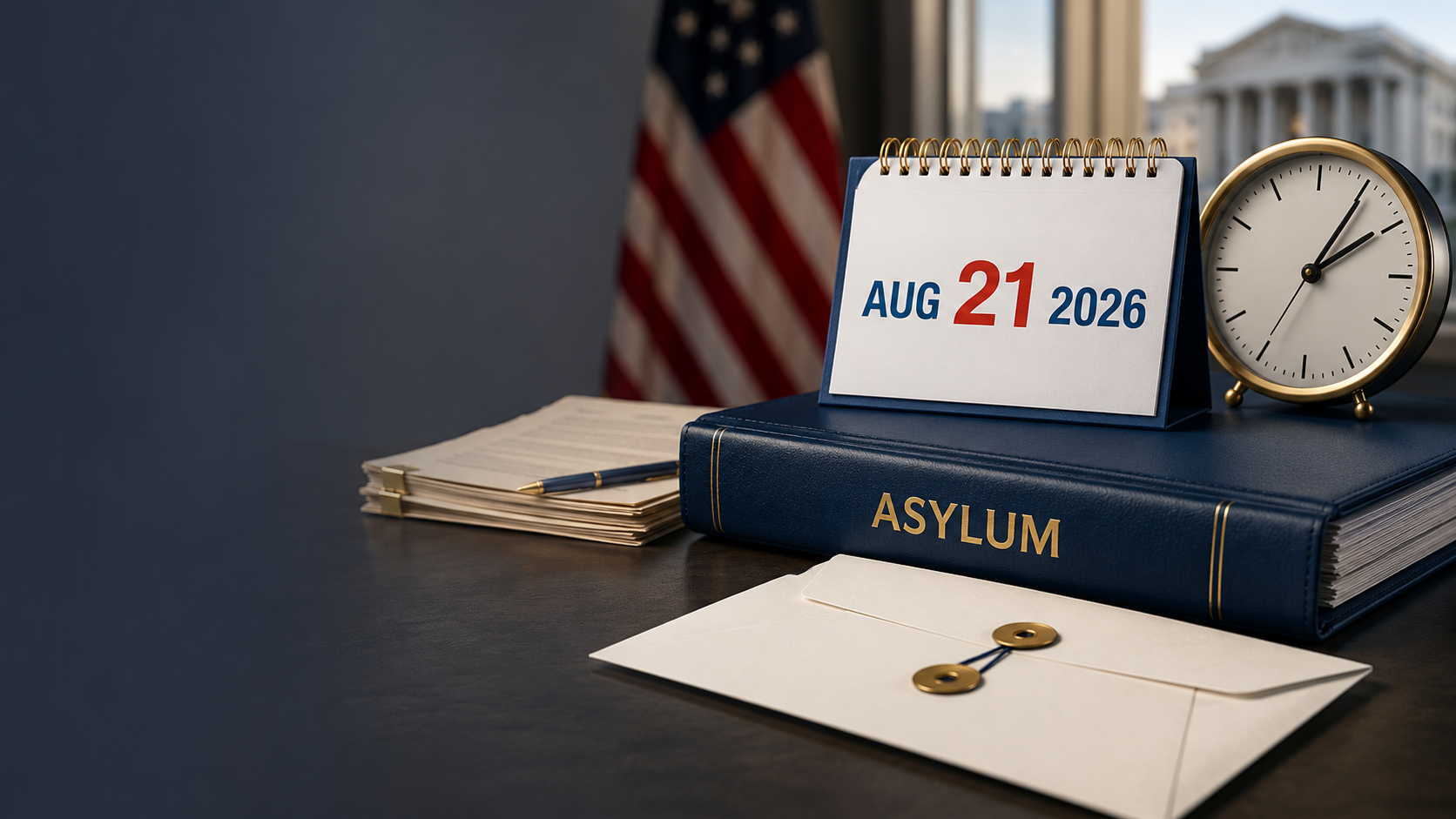
Beginning August 21, 2026, asylum seekers who ask U.S. Citizenship and Immigration Services (USCIS) to reschedule an affirmative asylum interview must establish exceptional circumstances. The same heightened requirement will apply when a person misses a biometrics appointment connected to a pending Form I-589, Application for Asylum and for Withholding of Removal, and asks for a new appointment.
These changes are not minor scheduling updates. Missing an asylum interview or biometrics appointment—or submitting important evidence late—may place your entire asylum application at risk. Depending on your immigration status, USCIS may dismiss the application or refer the case to an immigration judge. A delay caused by the applicant may also affect eligibility for an asylum-based employment authorization document, commonly called an asylum work permit or EAD.
If you are an asylum seeker with a pending affirmative asylum case, now is the time to review your address, notices, evidence, interpreter arrangements, transportation, childcare, and legal strategy. Do not wait until the week of the interview to begin preparing.
The New Rule: “Exceptional Circumstances” Required to Reschedule
Under the USCIS alert, starting August 21, 2026, an ordinary scheduling conflict may no longer be enough to obtain a new affirmative asylum interview date. You must establish that exceptional circumstances justify rescheduling.
Immigration law treats “exceptional circumstances” as a demanding standard. Under INA § 240(e)(1), 8 U.S.C. § 1229a(e)(1), the term generally refers to circumstances beyond the person’s control, including examples such as battery or extreme cruelty, serious illness, or the death of a spouse, child, or parent. The statute expressly indicates that less compelling circumstances do not qualify.
This does not mean that every illness, family problem, transportation issue, work conflict, or misunderstanding will satisfy USCIS. The decision will depend on the specific facts and the quality of the evidence. A request should clearly explain:
- What happened;
- When it happened;
- Why it was beyond your control;
- Why it prevented you from attending as scheduled;
- What steps you took to notify USCIS; and
- What reliable documents support your explanation.
Depending on the reason, supporting evidence might include hospital or medical records, a physician’s letter, a death certificate, police records, court documents, proof of a serious accident, or other contemporaneous documentation. A bare statement such as “I was sick” or “I could not attend” may be insufficient. Never submit a false, altered, or exaggerated document. Credibility is central to an asylum case, and dishonest evidence can cause consequences far beyond the scheduling request.
An experienced asylum lawyer can help determine whether the facts may meet the legal standard, organize corroborating evidence, and present the request in a clear and timely way. No attorney can guarantee that USCIS will accept a particular explanation.
USCIS Will No Longer Send a Failure to Appear Warning Notice
One of the most important changes is the elimination of an additional warning after a missed affirmative asylum interview. Under the announced procedure, USCIS will no longer issue a Failure to Appear Warning notice after you miss the interview.
That means asylum seekers should not assume that another letter will arrive and provide a second chance. The original interview notice may be the only warning before serious action is taken.
If you miss the asylum interview and did not request rescheduling before the appointment, the USCIS alert provides a critical deadline: submit the rescheduling request within 10 calendar days after the missed interview date. The request must establish exceptional circumstances. “Calendar days” include weekends and holidays, so do not calculate this as 10 business days.
The governing regulation, 8 C.F.R. § 208.10, states that failure to appear for a scheduled asylum interview without prior authorization may result in dismissal of the application or waiver of the interview. It also provides that a failure to appear may be excused when the notice was not mailed to the applicant’s properly reported current address, unless USCIS determines the applicant received reasonable notice, or when exceptional circumstances are shown.
If you did not receive the notice because you moved, the details matter. You should preserve evidence showing when and how you updated your address with USCIS. Forwarding mail through the U.S. Postal Service does not replace the obligation to update your address with immigration agencies through the proper procedure.
What Happens After a Missed Asylum Interview?
The possible consequence depends heavily on whether you have another lawful basis to remain in the United States.
If you maintain a lawful basis to remain
If you fail to appear without submitting a timely and sufficient request to reschedule, USCIS may dismiss your affirmative asylum application. A separate lawful basis might include certain valid nonimmigrant status, but whether any person continues to maintain lawful status is a fact-specific legal question. A pending immigration benefit request does not automatically mean that you have lawful immigration status.
Dismissal can be devastating. The years spent waiting do not replace the need to comply with the interview process, and the dismissal may affect an asylum-based EAD. Anyone facing this problem should speak with an asylum attorney immediately.
If you do not maintain a lawful basis to remain
USCIS may refer your asylum application to an immigration judge. This is when an affirmative asylum matter can become a defensive asylum case in removal proceedings.
Asylum in court is materially different from an affirmative USCIS interview. Immigration court is adversarial: a Department of Homeland Security attorney may oppose the claim, the immigration judge controls the hearing, formal evidentiary and procedural requirements matter, and the applicant may face a removal order if relief is denied. The applicant still bears the burden of proving eligibility for asylum and should also evaluate withholding of removal and protection under the Convention Against Torture when appropriate.
A referral is not the same thing as an asylum denial by an immigration judge, but it is a serious escalation. If your case has been referred, seek help from an asylum lawyer experienced in both USCIS asylum interviews and asylum in court.
Special Warning for Parolees
The USCIS alert contains an additional warning for parolees. If a parolee misses an asylum interview, USCIS will determine whether the purposes of parole have been served and decide, case by case, whether to terminate parole and refer the matter to an immigration judge.
Parole is not the same as admission in a nonimmigrant status. A parolee should not assume that a pending Form I-589 protects parole from termination. Ukrainians, Afghans, Cubans, Haitians, Venezuelans, and other people who entered or remained through a parole process may face program-specific facts, documents, and deadlines. If you are a parolee and cannot attend, obtain legal advice before the appointment whenever possible. If the appointment was already missed, act immediately because the 10-calendar-day period is extremely short.
New 14-Day Evidence Deadline for Affirmative Asylum Interviews
Starting August 21, 2026, USCIS says that all evidence supporting an affirmative asylum application must reach the asylum office at least 14 calendar days before the scheduled interview.
Evidence filed fewer than 14 calendar days before the interview may not be included with the asylum application, or USCIS may reschedule the interview. If USCIS reschedules because you submitted evidence late, that applicant-caused delay may affect eligibility for an employment authorization document.
This new deadline makes early preparation essential. A strong asylum filing may include:
- A detailed personal declaration consistent with Form I-589;
- Identity, immigration, and entry documents;
- Police reports, medical records, court records, threats, messages, photographs, or other proof of past harm;
- Witness declarations;
- Evidence connecting the persecution to race, religion, nationality, political opinion, or membership in a particular social group;
- Country-condition reports from reliable sources;
- Certified English translations for foreign-language documents;
- Evidence addressing the one-year filing deadline, if necessary;
- Evidence responding to possible bars, inconsistencies, arrests, or discretionary concerns; and
- A legal brief when the facts or law require explanation.
The 14-day rule should be treated as the final submission deadline, not the date to begin collecting evidence. Translation, authentication, medical-record requests, expert reports, and witness declarations may take weeks or months. A rushed submission is more likely to contain contradictions, missing pages, poor translations, and unexplained gaps.
The USCIS page on preparing for an affirmative asylum interview should be reviewed together with the interview notice and any instructions issued by the asylum office.
Missed Biometrics Appointments: A Separate 10-Day Deadline
The updated procedures also apply to biometrics appointments connected to Form I-589. Beginning August 21, 2026, if you miss a biometrics appointment and need a new date, you must submit the request within 10 calendar days of the missed appointment.
USCIS states that you may make the request through your online account at my.uscis.gov or by calling the USCIS Contact Center. You must also provide evidence of the exceptional circumstances that caused the missed appointment, either through the online account or to the asylum office as instructed.
Failure to request a new appointment on time, failure to provide the requested evidence, or failure to establish exceptional circumstances may cause USCIS to dismiss the asylum application when the applicant maintains a lawful basis to remain—or refer the application to an immigration judge when the applicant does not.
Parolees again face a separate case-by-case determination about whether the purposes of parole have been served, whether parole should be terminated, and whether the case should be referred to an immigration judge. USCIS provides general appointment guidance on its Preparing for Your Biometric Services Appointment page.
How Rescheduling or Late Evidence Can Affect an Asylum Work Permit
Many asylum seekers depend on employment authorization while Form I-589 is pending. But not every day that an asylum application is pending necessarily counts the same way for EAD eligibility. A delay requested or caused by the applicant—including certain interview rescheduling requests or late evidence that causes rescheduling—may stop or otherwise affect the time counted toward employment authorization.
The precise impact depends on the case history and the applicable EAD rules. Do not assume that USCIS’s decision to grant a new interview date means there will be no work-permit consequence. Before requesting a postponement, discuss both the asylum strategy and the potential EAD impact with a qualified immigration attorney. USCIS has published a notice about applicant-caused delays and the impact on employment authorization.
What Every Asylum Seeker Should Do Now
First, confirm that USCIS has your correct address and review your online account regularly. Save copies of every notice, envelope, online confirmation, and request you submit.
Second, build an emergency plan for the interview. Know the location, expected travel time, interpreter rules, childcare plan, and backup transportation. Arrange time away from work well in advance. Ordinary inconvenience may not qualify as exceptional circumstances.
Third, begin evidence preparation now. Compare the declaration, Form I-589, supporting documents, prior visa applications, border records, credible-fear statements, and any immigration court filings for consistency. Do not “fix” a discrepancy by hiding it. Identify it and prepare a truthful explanation.
Fourth, if an emergency arises, document it while it is happening. Notify your asylum lawyer immediately. When possible, submit a complete rescheduling request before the interview rather than relying on the 10-day post-interview window.
Fifth, if you have already missed an asylum interview or biometrics appointment, do not wait for another notice. Count the calendar days carefully and obtain legal advice at once.
Why Legal Preparation Matters More Under the New USCIS Asylum Rules
An asylum case is not only a personal story. It is a legal claim requiring proof of persecution or a well-founded fear of persecution, a protected ground, a connection between the harm and that ground, government involvement or inability or unwillingness to protect where required, and the absence of applicable filing or eligibility bars. Credibility, corroboration, deadlines, and discretion can determine the outcome.
The new procedures add another layer of risk. An applicant may have a compelling fear of return yet still lose the opportunity for a USCIS adjudication because of a missed appointment, an unsupported rescheduling request, or a late evidence submission. Once the case is placed before an immigration judge, the person must be ready to litigate asylum in court while also defending against removal.
When searching online for the “best asylum lawyer” or “best asylum attorney in New York,” look beyond advertising language. Ask whether the attorney regularly prepares Form I-589 applications, attends affirmative asylum interviews, handles immigration court proceedings, understands asylum-based EAD rules, and gives you a concrete evidence and deadline plan. The right asylum lawyer should identify weaknesses before the government does and help you present truthful facts in a legally organized way.
Speak With a New York Asylum Lawyer Before a Deadline Is Missed
If your affirmative asylum interview or biometrics appointment is approaching, preparation should begin immediately. If you need to reschedule, have already missed an appointment, submitted evidence late, received a referral notice, or now face asylum in court, the response must be tailored to your immigration history and documents.
To schedule a consultation with the Law Office of Alena Shautsova, call 917-885-2261 or visit shautsova.com. I assist asylum seekers with affirmative asylum applications, interview preparation, exceptional-circumstances requests, and representation before immigration judges.
Important: This article provides general educational information based on the USCIS procedures announced to take effect on August 21, 2026. It is not legal advice and does not create an attorney-client relationship. Immigration rules and agency procedures can change, and the correct strategy depends on the facts of your case.
Official Sources
- USCIS: Preparing for Your Affirmative Asylum Interview
- USCIS: The Affirmative Asylum Process
- USCIS: Preparing for Your Biometric Services Appointment
- 8 C.F.R. § 208.10: Failure to Appear or Follow Fingerprint Requirements
- INA § 240(e)(1), 8 U.S.C. § 1229a(e)(1): Exceptional Circumstances
- USCIS Notice: Applicant-Caused Delays and Employment Authorization


