
Asylum in the United States in 2026: How to Build a Winning Case Despite New Challenges
Asylum in the United States in 2026: How to Build a Winning Case Despite New Challenges
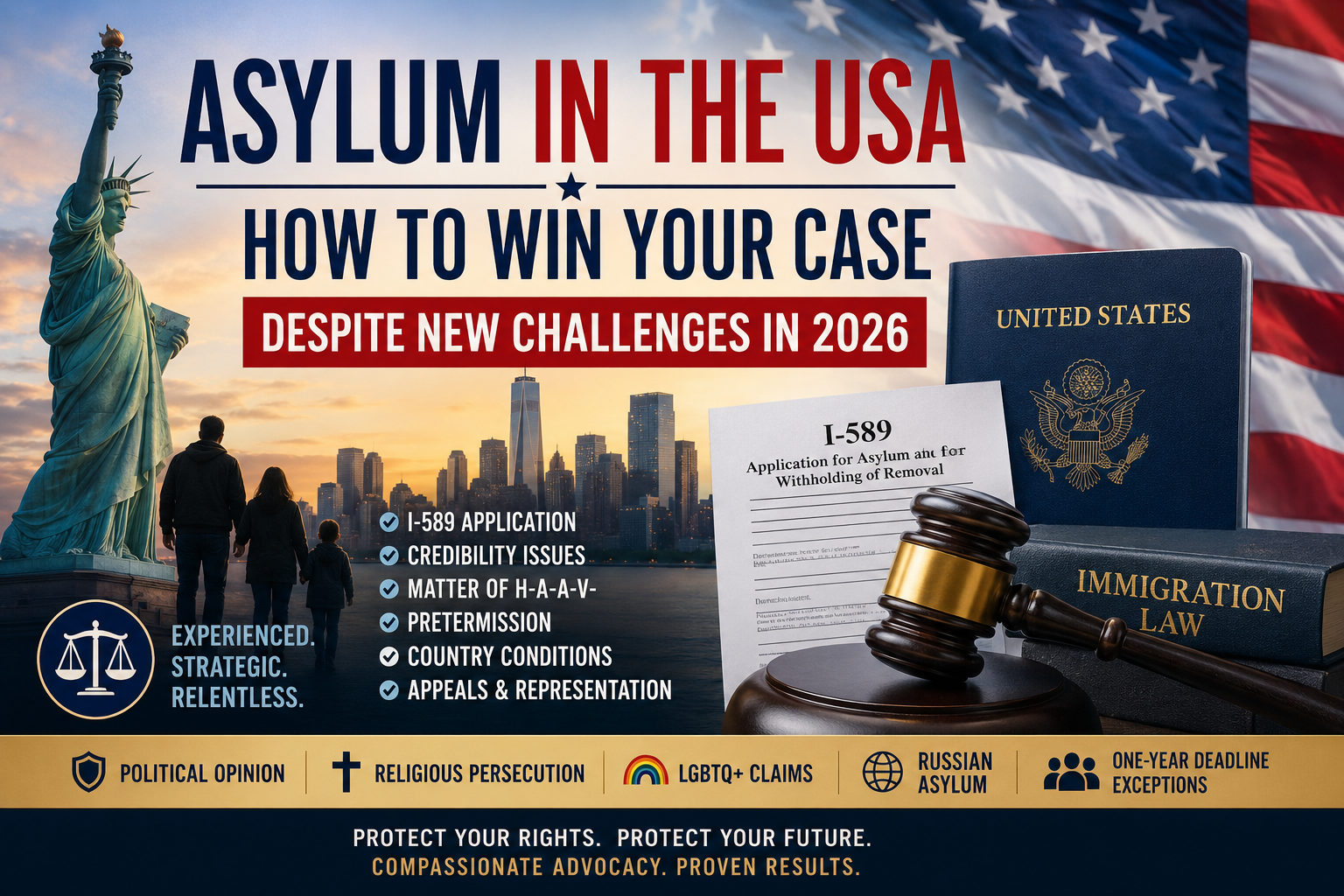
If you are seeking protection in the United States, you have probably noticed that the asylum process has become significantly more difficult in recent years. USCIS and Immigration Courts are applying greater scrutiny to applications, asking more detailed questions, relying heavily on credibility findings, and increasingly using procedural tools such as pretermission to deny asylum applications without a full hearing.
At the same time, new Board of Immigration Appeals (BIA) decisions—including Matter of H-A-A-V-, 29 I&N Dec. 233 (BIA 2025)—have changed how asylum cases are analyzed and have increased the importance of submitting a legally sufficient asylum application from the very beginning.
If you are considering filing for asylum, or if your case is already pending, this guide explains how to maximize your chances of success.
As an experienced asylum lawyer USA, I have represented asylum seekers from Russia, Ukraine, Belarus, Central Asia, Latin America, the Middle East, Africa, and many other countries for nearly two decades. Every case is different, but successful asylum claims share one thing in common—they are carefully prepared from day one.
Why Hiring an Experienced Asylum Lawyer Matters
The consequences of losing an asylum case today are much more severe than they were several years ago.
A denial may lead to:
- placement into removal proceedings;
- loss of work authorization;
- expensive appeals;
- years in Immigration Court;
- eventual deportation.
Working with an experienced asylum lawyer New York or political asylum lawyer means identifying legal issues before they become fatal mistakes.
An experienced attorney does far more than simply complete Form I-589.
Your lawyer should:
- identify the strongest protected ground;
- gather supporting evidence;
- prepare country condition reports;
- anticipate government arguments;
- prepare you for testimony;
- explain inconsistencies before the government finds them.
Understanding the Two Types of Asylum
Affirmative Asylum Process USA
The affirmative asylum process USA applies when you are not yet in removal proceedings.
Generally:
- File Form I-589.
- Attend biometrics.
- Attend asylum interview.
- USCIS either:
- approves;
- refers the case to Immigration Court;
- in limited situations, issues a discretionary denial.
Because procedures continue to evolve, applicants should not assume that every case will automatically receive an interview.
Defensive Asylum
A defensive asylum attorney represents individuals already in Immigration Court.
Common situations include:
- referral after USCIS denial;
- Notice to Appear issued by DHS;
- asylum requested after arrest by ICE;
- asylum raised as a defense to removal.
Court cases require extensive preparation because testimony occurs before an Immigration Judge under oath.
Matter of H-A-A-V- Has Changed Asylum Practice
One of the most important recent precedents is Matter of H-A-A-V-, 29 I&N Dec. 233 (BIA 2025).
The Board explained that if the allegations contained in the asylum application—even if accepted as true—do not establish a legally sufficient asylum claim, the application may be pretermitted without proceeding to a full evidentiary hearing.
This represents a significant shift.
Previously, many applicants expected to explain their cases during testimony.
Now, the legal sufficiency of the written application itself has become critically important.
Simply describing unfortunate events is no longer enough.
Your application must clearly establish:
- persecution;
- nexus;
- protected ground;
- government involvement or inability/unwillingness to protect;
- eligibility under the Immigration and Nationality Act.
This is one reason hiring an experienced I-589 immigration lawyer has become more important than ever.
What Is Pretermission?
Many asylum applicants have never heard this word until it appears in court.
Pretermission means that the Immigration Judge may dismiss or deny the asylum application before holding a full merits hearing because the application is legally insufficient.
Examples include:
- missing legal elements;
- failure to establish protected ground;
- one-year filing deadline problems;
- asylum bars;
- facially deficient allegations.
Instead of hearing testimony, the court may conclude that even if every allegation were true, asylum could not legally be granted.
That is why your written I-589 should never be treated as a simple government form.
It is a legal pleading.
Credibility Is Everything
One of the most common reasons asylum cases fail is credibility.
Immigration Judges evaluate credibility under the REAL ID Act.
Even relatively small inconsistencies may become significant when viewed together.
Examples include:
- different arrest dates;
- inconsistent employment history;
- conflicting travel records;
- differences between interview testimony and court testimony;
- omitted political activities;
- contradictory family information.
Applicants often believe that “small mistakes don’t matter.”
Unfortunately, they frequently do.
Common Credibility Problems
Several issues repeatedly appear in denied asylum cases.
- Omissions
Leaving important events out of the I-589 can later appear suspicious.
Applicants sometimes think they can explain details later.
Instead, officers may ask:
“Why didn’t you mention this earlier?”
- Inconsistent Statements
Statements made:
- during visa applications,
- border interviews,
- credible fear interviews,
- USCIS interviews,
- Immigration Court,
are often compared.
Any inconsistency should be addressed proactively.
- Translation Problems
Many applicants rely on interpreters.
Translation mistakes happen.
Your attorney should identify translation issues before the government uses them against you.
- Documentary Problems
Documents that appear altered or inconsistent can destroy credibility.
Never submit fraudulent documents.
One fraudulent document may undermine an otherwise strong asylum claim.
Country Conditions Can Win or Lose Your Case
Country condition evidence has become increasingly important.
A judge wants to know:
Is your fear objectively reasonable?
Good country evidence includes:
- U.S. State Department reports;
- UN reports;
- Human Rights Watch publications;
- Amnesty International reports;
- expert affidavits;
- news articles;
- NGO reports;
- academic publications.
Good country condition evidence connects your personal experience to documented patterns of persecution.
Russian Asylum USA
Many people ask whether Russian asylum USA claims are still possible.
Yes.
However, every case depends on its specific facts.
Strong cases may involve:
- anti-war political activity;
- opposition to the government;
- participation in protests;
- journalism;
- whistleblowing;
- military refusal in certain circumstances;
- LGBTQ status;
- religious persecution.
Simply disagreeing with government policy is usually not enough.
You must show persecution or a well-founded fear of persecution connected to a protected ground.
Applicants seeking asylum for Russians in USA should present substantial documentary evidence demonstrating both personal targeting and broader country conditions.
Asylum Based on Political Opinion
One of the most common asylum grounds is asylum based on political opinion.
Political opinion includes more than party membership.
Examples may include:
- anti-corruption activism;
- human rights advocacy;
- anti-war speech;
- investigative journalism;
- exposing government misconduct;
- election monitoring;
- opposition protests.
The key legal issue is nexus.
You must prove persecution occurred because of your political opinion.
Religious Persecution Asylum USA
Religion remains one of the classic protected grounds.
Examples include persecution based on:
- religious conversion;
- underground churches;
- minority religions;
- refusal to abandon religious beliefs;
- punishment for religious practices.
Evidence often includes:
- baptism records;
- clergy letters;
- witness affidavits;
- country reports.
LGBTQ Asylum Lawyer
LGBTQ asylum claims continue to be recognized under U.S. asylum law.
Strong evidence may include:
- threats;
- violence;
- arrests;
- discrimination rising to persecution;
- forced medical treatment;
- inability of government protection.
Country reports frequently play a critical role.
An experienced LGBTQ asylum lawyer understands how to present sensitive evidence while protecting client privacy.
Asylum After Visa Overstay
Many applicants believe that overstaying a visa automatically prevents asylum.
That is incorrect.
Asylum after visa overstay remains possible.
However, another issue immediately arises.
The one-year filing deadline.
Asylum One Year Deadline Exception
Generally, asylum must be filed within one year of the applicant’s last arrival into the United States.
Fortunately, the law recognizes important exceptions.
Examples include:
Changed Circumstances
- political upheaval;
- war;
- religious conversion;
- LGBTQ identity developments;
- major changes in country conditions.
Extraordinary Circumstances
- serious illness;
- ineffective assistance of counsel (with proper procedural compliance);
- maintenance of lawful immigration status in certain circumstances;
- other legally recognized exceptions.
Proper legal briefing often determines whether an exception succeeds.
Preparing Form I-589
Form I-589 is far more than paperwork.
An experienced I-589 immigration lawyer carefully prepares:
- legal theory;
- timeline;
- protected ground;
- nexus;
- supporting evidence;
- declarations;
- witness statements.
Poorly prepared applications frequently create credibility problems that continue throughout the entire case.
Asylum Interview Preparation Lawyer
The interview is one of the most stressful parts of the asylum process.
Working with an experienced asylum interview preparation lawyer often includes:
- mock interviews;
- difficult credibility questions;
- timeline review;
- explanation of legal issues;
- interpreter preparation;
- evidence review.
Applicants should know their case thoroughly.
Memorization is unnecessary.
Consistency is essential.
Credible Fear Interview Lawyer
Individuals arriving at the border may first undergo a credible fear interview.
A credible fear interview lawyer can help prepare applicants by explaining:
- the legal standard;
- likely questions;
- importance of consistency;
- documentary evidence;
- preserving issues for later proceedings.
Statements made during credible fear interviews may later be used in Immigration Court.
Preparation matters.
How to Win Asylum Case USA
Many people search online for how to win asylum case USA.
There is no guaranteed formula.
However, successful cases usually include these elements.
- Strong Protected Ground
Political opinion.
Religion.
Nationality.
Race.
Particular social group.
- Clear Nexus
Explain exactly why the persecutor targeted you.
- Credible Testimony
Tell the truth.
Remain consistent.
Do not exaggerate.
- Excellent Country Conditions
Support your testimony with objective evidence.
- Organized Documentary Evidence
Chronological.
Clearly translated.
Professionally prepared.
- Legal Brief
Complex cases often benefit from a detailed legal memorandum explaining why asylum should be granted.
What Happens If Asylum Is Denied?
Not every denial ends the case.
An experienced asylum denial appeal lawyer may evaluate options such as:
- appeal to the Board of Immigration Appeals;
- motion to reconsider;
- motion to reopen;
- federal court review in appropriate cases.
Deadlines are extremely important.
Waiting too long may permanently eliminate appeal rights.
Asylum Work Permit Lawyer
Many applicants ask when they can begin working.
An experienced asylum work permit lawyer helps determine:
- eligibility date;
- filing strategy;
- renewal timing;
- avoiding delays caused by applicant-created clock issues.
Maintaining eligibility throughout the asylum process is essential.
Asylum Green Card After 1 Year
One of the major benefits of asylum approval is the ability to obtain lawful permanent residence.
Generally, after being granted asylum and remaining physically present in the United States for one year, eligible asylees may apply for adjustment of status to become lawful permanent residents.
The application must still satisfy all statutory requirements, and applicants should carefully prepare supporting documentation.
Once permanent residence is granted, many individuals eventually become eligible to apply for U.S. citizenship.
Practical Tips to Strengthen Your Case
If you are considering filing for asylum, these practical steps can significantly improve your chances of success:
- File as early as possible. Waiting may create unnecessary one-year filing deadline issues.
- Prepare your declaration carefully. Your personal statement should tell a clear, truthful, chronological story and explain why the harm occurred because of a protected ground.
- Do not underestimate credibility. Review your visa applications, travel history, border interviews, and any prior immigration filings before your interview or hearing.
- Collect corroborating evidence. Medical records, police reports, photographs, social media posts, witness affidavits, membership cards, court documents, and media coverage can all strengthen your claim when available.
- Invest in country conditions research. Generic articles are rarely enough. Your evidence should specifically relate to your political opinion, religion, LGBTQ identity, or other protected ground and demonstrate current conditions in your country.
- Prepare extensively for testimony. Whether appearing before USCIS or an Immigration Judge, understand your timeline, be honest, and answer only the question asked.
- Address weaknesses before the government does. If there are inconsistencies, visa overstays, delayed filing, or prior denials, work with your attorney to explain them proactively.
- Treat Form I-589 as a legal document, not just an application. In the post-Matter of H-A-A-V- landscape, a well-drafted application can determine whether your case proceeds to a full hearing or faces pretermission.
Final Thoughts
Asylum law in 2026 is more demanding than ever. Immigration Judges and USCIS officers expect legally sufficient applications, detailed supporting evidence, consistent testimony, and strong country conditions documentation. Recent developments—including Matter of H-A-A-V- and the increased use of pretermission—mean that applicants can no longer rely on simply telling their story at a hearing. The written application itself must establish every required legal element.
Whether you are pursuing the affirmative asylum process USA, defending your case in Immigration Court, seeking asylum for Russians in USA, filing an asylum based on political opinion claim, requesting religious persecution asylum USA, or preparing an LGBTQ claim, careful preparation is essential.
A successful asylum case is built long before the interview or courtroom hearing. It begins with a strategically prepared Form I-589, thorough credibility review, persuasive country conditions evidence, and a legal theory tailored to your unique facts.
If you are looking for an asylum lawyer USA, an asylum lawyer New York, or the best asylum attorney NYC to guide you through every stage of the process—from the initial application to appeals and adjustment of status—obtaining experienced legal representation early may be one of the most important decisions you make for your future in the United States. CALL 917 885 2261.


