
US Supreme Court TPS Decision: What Haiti and Syria TPS Holders Must Do Now
US Supreme Court TPS Decision: What Haiti and Syria TPS Holders Must Do Now
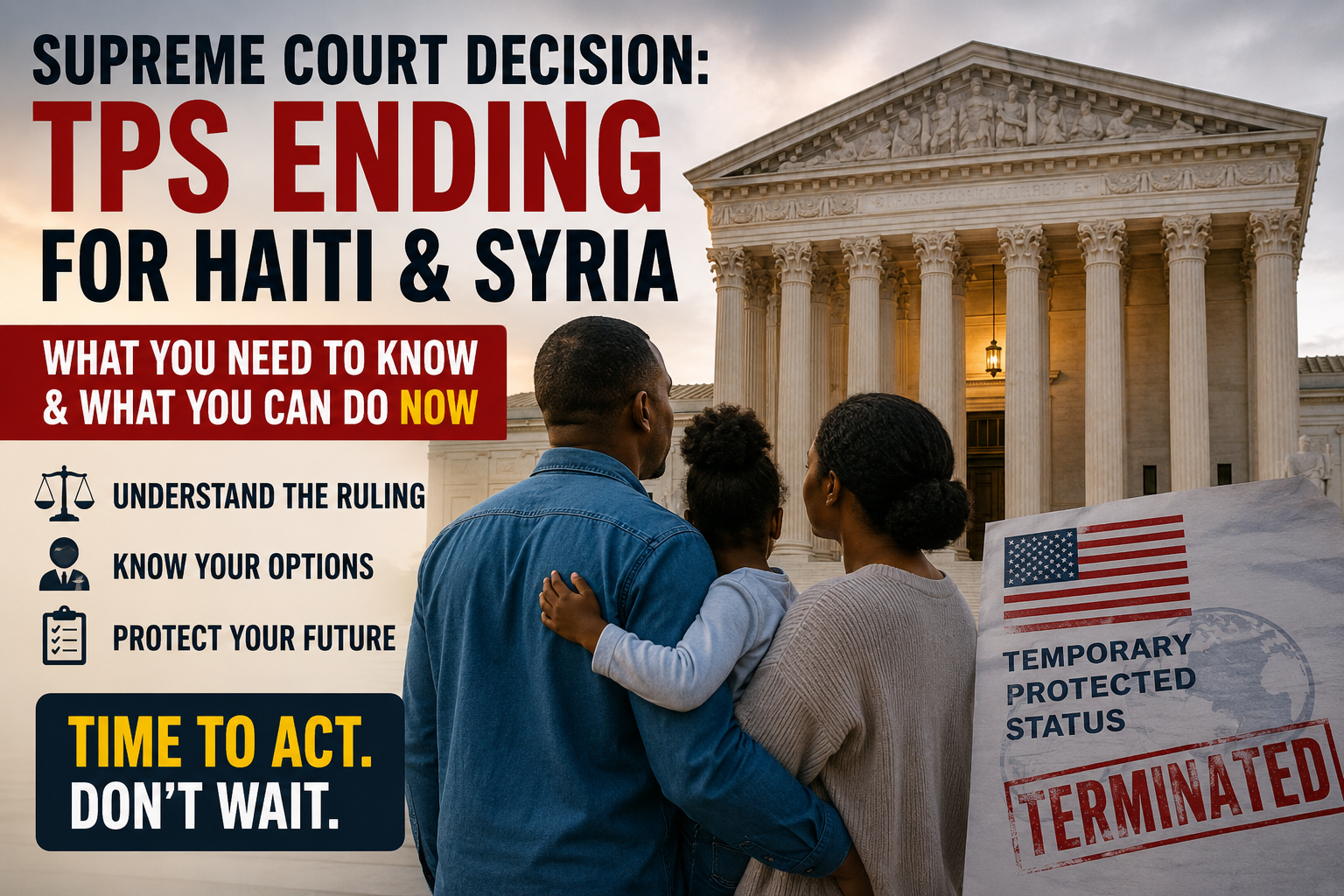
The United States Supreme Court has issued a major immigration decision affecting Haitian and Syrian nationals who have relied on Temporary Protected Status, commonly known as TPS. In Mullin v. Doe, decided on June 25, 2026, the Supreme Court allowed the Trump Administration to move forward with terminating TPS protections for Haiti and Syria.
For many families, this decision is frightening. TPS holders have lived in the United States for years, worked legally, paid taxes, raised U.S. citizen children, purchased homes, opened businesses, and built their lives here. The Supreme Court decision does not mean every TPS holder will be removed tomorrow. But it does mean that people with Haiti TPS and Syria TPS must act quickly and strategically.
As a New York immigration lawyer, I want TPS holders to understand one thing clearly: the end of TPS does not always mean the end of all immigration options. But the time to explore those options is now.
What the Supreme Court Decided
The Supreme Court’s decision focused on whether lower courts could stop DHS from ending TPS for Haiti and Syria while litigation continued. Lower courts in New York and Washington, D.C. had temporarily blocked the government from terminating the protections. The Supreme Court reversed those rulings.
The majority relied heavily on the TPS statute’s judicial-review bar. Justice Samuel Alito wrote that the statutory language prohibiting judicial review “is clear, and its plain meaning is very broad.” In practical terms, the majority concluded that courts generally cannot review DHS’s decision to terminate a country’s TPS designation.
The Court emphasized that the TPS statute bars review of “any determination” regarding the designation, extension, or termination of TPS. The majority interpreted the word “determination” broadly. It said the term can include not only the final decision itself, but also the process and steps leading to that decision.
That is extremely important.
The TPS holders argued that even if courts could not review the substance of DHS’s decision, courts should still be able to review procedural violations. For example, they argued that DHS did not properly consult other agencies regarding country conditions before terminating TPS. The majority rejected that argument. The Court reasoned that if the final TPS termination decision is unreviewable, then related procedural steps are also generally beyond judicial review.
This is the central legal impact of the decision: the Supreme Court gave DHS broad protection from court review when it terminates TPS designations.
Why the Decision Matters for Haiti TPS
Haiti TPS has a long history. Haiti was first designated for TPS after the devastating 2010 earthquake. Since then, country conditions have remained unstable, with political violence, gang control, economic collapse, humanitarian crisis, displacement, and severe safety concerns.
Many Haitian TPS holders have lived in the United States for more than a decade. Some have U.S. citizen children. Some entered as young adults and now have entire lives here.
The Supreme Court decision does not erase those facts. But legally, it allows DHS to proceed with ending Haiti TPS despite the humanitarian concerns raised by the plaintiffs.
The majority also addressed the Haitian TPS holders’ constitutional claim. The plaintiffs argued that the termination was influenced by racial bias. The Court stated that this claim was unlikely to succeed, even though it acknowledged that some statements cited by the plaintiffs contained “heated language.” The majority concluded that the cited statements were not enough, at this stage, to stop the termination.
Justice Kagan strongly disagreed.
The Dissent: Justice Kagan’s Warning
Justice Elena Kagan, joined by Justices Sonia Sotomayor and Ketanji Brown Jackson, wrote a powerful dissent.
She explained that the Haitian and Syrian TPS holders were not asking the Court to decide the entire case immediately. They were asking only to remain protected while their legal challenges continued. As she wrote, they asked “for only one thing”: to remain in the United States while they litigated their claims.
Justice Kagan warned that removing TPS protections could expose people to “devastating” and even “life-threatening” harm.
She also rejected the majority’s broad reading of the judicial-review bar. In her view, courts should still be able to review whether DHS followed required procedures before making a TPS termination decision. She distinguished between the ultimate country-designation decision and the mandatory steps DHS must take before reaching that decision.
Justice Kagan also took the race-discrimination claim seriously. She wrote that the evidence offered by Haitian TPS holders included statements that, in her view, showed race had played a role in the decision-making process.
Her dissent ended with a deeply troubling warning: TPS beneficiaries may now be placed “on the next plane.”
For TPS holders, this dissent captures the human reality of the decision. For immigration lawyers, it also signals that constitutional and procedural challenges may continue, but they will be much harder after this ruling.
Does This Mean All Haitian and Syrian TPS Holders Will Be Deported Immediately?
No. The decision allows the government to proceed with TPS termination, but each person’s situation must be reviewed individually.
Some TPS holders may have:
- a pending asylum application,
- a family petition,
- an approved I-130,
- a marriage to a U.S. citizen,
- a U.S. citizen child over 21,
- an employment-based petition,
- a pending U visa,
- a potential T visa case,
- eligibility for adjustment of status,
- eligibility for cancellation of removal,
- or other relief.
The mistake would be assuming that because TPS is ending, there is nothing else to do.
That is often wrong.
Important Asylum Point: Ending TPS May Help Explain a Late Asylum Filing
Many TPS holders worry because asylum generally must be filed within one year of arrival in the United States. This is a serious issue. But the law contains exceptions.
A person may be allowed to file asylum after the one-year deadline if they can show changed circumstances that materially affect eligibility for asylum or extraordinary circumstances related to the delay.
The end of TPS may be an important changed circumstance.
Why? Because while TPS existed, the person had temporary protection from removal and authorization to remain in the United States. Once TPS ends, the person may face a new and immediate risk of return to the country of feared persecution. That change may materially affect the person’s need to seek asylum.
This does not mean every late asylum case will automatically be accepted. The applicant must still prove the asylum claim, including fear of persecution on account of race, religion, nationality, political opinion, or membership in a particular social group. The applicant must also file within a reasonable period after the changed circumstance.
But for Haitian and Syrian TPS holders, the termination of TPS should be carefully analyzed as a potential basis to overcome the one-year asylum deadline.
For example, a Haitian TPS holder who fears gang violence alone may face challenges because general violence is usually not enough for asylum. But if the person can connect the danger to political opinion, family membership, anti-gang resistance, past threats, activism, profession, or another protected ground, asylum may be possible.
Similarly, a Syrian TPS holder may have claims based on political opinion, religion, ethnicity, military refusal, family association, perceived opposition, or other protected grounds depending on the facts.
The key is not to file a weak asylum case simply because TPS is ending. The key is to analyze whether there is a real asylum claim and whether TPS termination helps explain why the application is being filed now.
Option 1: Adjustment of Status
Adjustment of status may be one of the best options for some TPS holders.
Possible examples include:
- marriage to a U.S. citizen,
- petition by a U.S. citizen child over 21,
- petition by a U.S. citizen parent,
- employment-based immigrant petition,
- approved family petition with a current priority date.
But adjustment is technical. TPS by itself does not always solve entry-related problems. Some people were inspected and admitted. Some were paroled. Some entered without inspection. Some traveled on TPS advance parole. Some may need a waiver. Some may need consular processing. Some may face unlawful presence issues.
A careful review is essential before filing anything.
Option 2: U Visa
A U visa may be available to victims of certain crimes in the United States who helped law enforcement.
Qualifying crimes may include domestic violence, felonious assault, sexual assault, trafficking, kidnapping, extortion, witness tampering, and other serious offenses.
For TPS holders who were victims of crime, this option should be explored immediately. The U visa process can be long, but it may provide protection and eventually a path to permanent residence.
Option 3: T Visa
A T visa is available for victims of human trafficking. Many people do not realize that trafficking can include labor exploitation, not only sex trafficking.
Possible examples include:
- forced labor,
- threats by an employer,
- debt bondage,
- confiscation of documents,
- coercion,
- being forced to work under abusive conditions,
- being threatened with immigration consequences.
For some TPS holders, especially those who experienced exploitation after arriving in the United States, a T visa may be a powerful option.
Option 4: Asylum, Withholding of Removal, and CAT
Asylum should be reviewed carefully, especially now that TPS termination may support an argument for a changed circumstance excusing a late filing.
But asylum is not the only protection-based remedy. Some people may also qualify for withholding of removal or protection under the Convention Against Torture.
These forms of protection are different from asylum. They have different standards and different benefits. They are often raised in immigration court when a person fears return to the home country.
Option 5: Cancellation of Removal
If a TPS holder is placed in removal proceedings, cancellation of removal may be available in limited cases.
For nonpermanent residents, this generally requires:
- at least 10 years of continuous physical presence,
- good moral character,
- no disqualifying criminal convictions,
- and exceptional and extremely unusual hardship to a U.S. citizen or lawful permanent resident spouse, parent, or child.
This is a difficult standard, but for some long-term TPS holders with U.S. citizen children or spouses, it may be an option.
Practical Tips for TPS Holders Now
First, do not wait until your work permit expires. Many options require time, documents, legal analysis, and careful preparation.
Second, obtain your immigration records. You may need FOIA records from USCIS, CBP, ICE, or EOIR.
Third, review your entries and exits from the United States. This is critical for adjustment of status and waiver analysis.
Fourth, review prior applications. Any inconsistency in old immigration forms may create problems later.
Fifth, collect proof of residence, taxes, employment, family ties, medical issues, school records for children, and community involvement.
Sixth, if you fear return to Haiti or Syria, write down the reasons now. Include dates, incidents, threats, political activity, family history, religion, ethnicity, social group, and evidence.
Seventh, consult an experienced immigration lawyer before filing. A rushed filing can create serious consequences.
The US Supreme Court TPS decision in Mullin v. Doe is a major turning point for Haiti TPS and Syria TPS holders. The Court’s majority gave DHS broad authority to terminate TPS with limited judicial review. The dissent warned that the human consequences may be severe.
But TPS holders should not panic and should not assume that no options remain.
The end of TPS may open the door to urgent legal analysis, including adjustment of status, U visa, T visa, asylum, withholding of removal, CAT protection, cancellation of removal, waivers, and other immigration strategies.
Most importantly, TPS termination may be a significant changed circumstance for people who need to file asylum after the one-year deadline. That argument must be prepared carefully, supported by facts, and filed within a reasonable time.
If you have Haiti TPS, Syria TPS, or another expiring TPS status, now is the time to review your immigration history and build a strategy. An experienced New York immigration lawyer can help determine which options may be available before your protection expires.
The Law Office of Alena Shautsova assists immigrants with TPS, asylum, adjustment of status, U visas, T visas, waivers, and removal defense. To explore your options, visit www.shautsova.com.


