
ACA Asylum Denials Are Rising: New BIA Decisions May Change the Future of Thousands of Asylum Cases
ACA Asylum Denials Are Rising: New BIA Decisions May Change the Future of Thousands of Asylum Cases
By Alena Shautsova, New York Immigration Lawyer
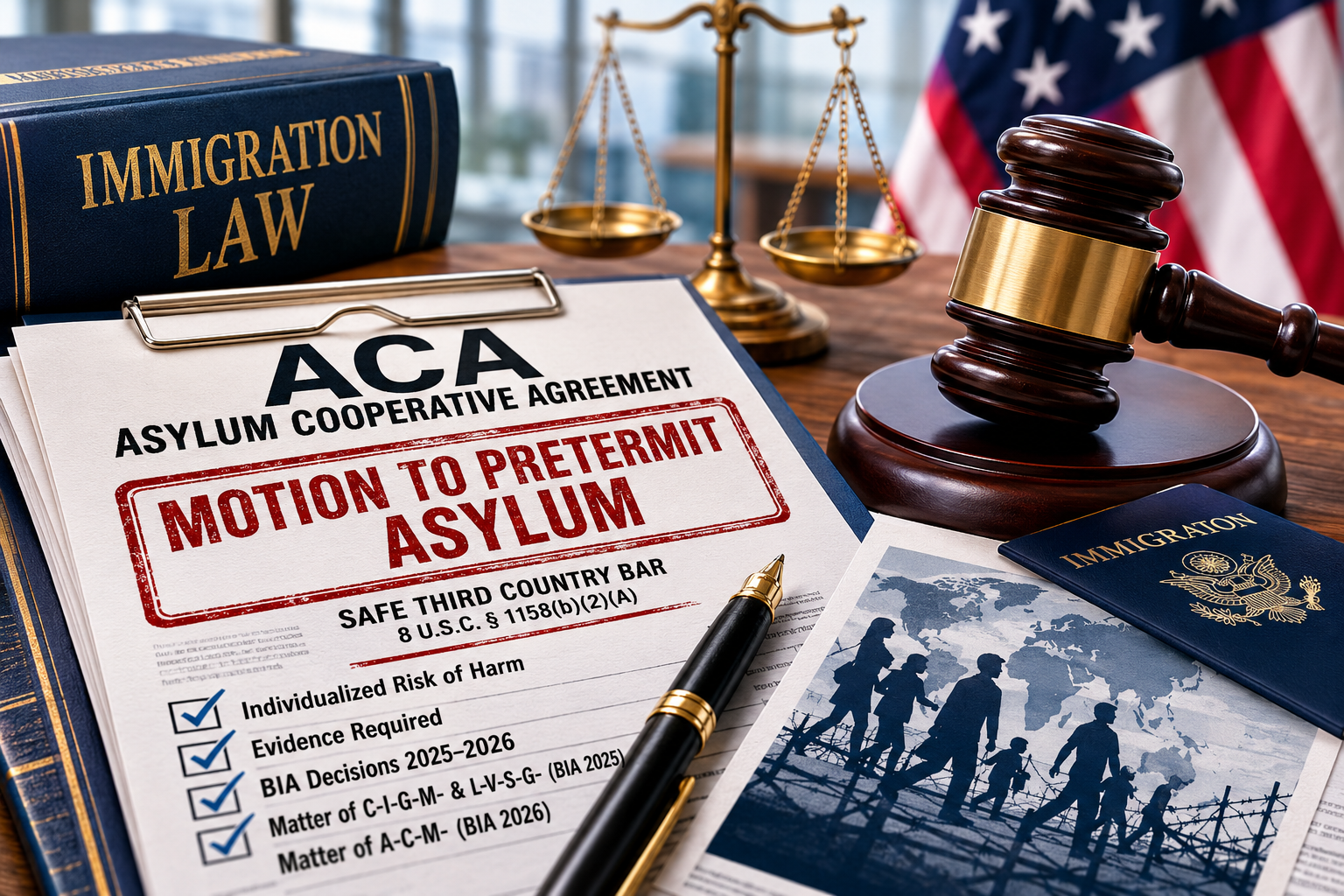
In late 2025 and throughout the first half of 2026, one of the most devastating trends in immigration court was the rapid increase in asylum denials based on the government’s use of Asylum Cooperative Agreements (ACAs), often referred to as the safe third country bar.
Across immigration courts nationwide, attorneys began seeing a disturbing pattern. At the very first Master Calendar Hearing, attorneys from the Office of the Principal Legal Advisor (OPLA) would file a Motion to Pretermit Asylum. Immigration Judges frequently granted those motions without allowing applicants to testify or present evidence regarding their fear of persecution.
For many asylum seekers, this meant their asylum applications were effectively denied before they ever had an opportunity to explain their case.
Now, in 2026, the first significant decisions from the Board of Immigration Appeals (BIA) are beginning to emerge, and they provide important guidance regarding how ACA-based asylum denials will be handled moving forward.
If your asylum case was denied, pretermitted, or dismissed because of an Asylum Cooperative Agreement, this article explains what these agreements are, why they became so important in 2025 and 2026, and what recent BIA decisions mean for your case.
What Is an Asylum Cooperative Agreement (ACA)?
An Asylum Cooperative Agreement (ACA) is an agreement between the United States and another country that allows the United States to transfer certain asylum seekers to that third country to seek protection there instead of in the United States.
The legal basis comes from:
INA §208(a)(2)(A)
This provision states that an asylum applicant may be barred from applying for asylum in the United States if the government determines that the applicant can be removed to a country pursuant to an agreement where the applicant would have access to a full and fair asylum procedure.
This concept is often referred to as the safe third country bar.
The theory behind the law is simple:
If another country can provide protection, the applicant should seek asylum there instead of in the United States.
However, in practice, ACA cases have become far more complicated.
Why ACA Denials Became So Common in 2025 and 2026
Beginning in late 2025, DHS and OPLA dramatically increased the use of ACA-based pretermission motions.
Instead of litigating asylum claims on the merits, government attorneys often argued that:
- The respondent was subject to an ACA;
- The safe third country bar applied;
- Therefore, the asylum application should be dismissed without a full evidentiary hearing.
Many Immigration Judges agreed.
As a result, thousands of asylum applicants found themselves unable to present testimony regarding:
- Political persecution;
- Religious persecution;
- Sexual orientation-based persecution;
- Domestic violence;
- Ethnic persecution;
- Human rights violations.
Instead, the focus shifted to one issue:
Does the ACA apply?
If the answer was yes, asylum could be denied before the applicant ever testified.
The Key Legal Question
One major issue quickly emerged.
Must an Immigration Judge hold an evidentiary hearing before deciding whether the ACA safe third country bar applies?
Many immigration attorneys argued that due process requires an applicant to have the opportunity to present evidence showing that transfer to the designated ACA country would place them in danger.
The government often argued the opposite.
According to DHS, if the record contains no evidence showing individualized danger in the ACA country, there is no need for a hearing.
The Board of Immigration Appeals has now begun answering that question.
Matter of C-I-G-M- & L-V-S-G-, 29 I&N Dec. 291 (BIA 2025)
In 2025, the BIA issued an important precedent decision:
Matter of C-I-G-M- & L-V-S-G-, 29 I&N Dec. 291 (BIA 2025).
This case established significant guidance regarding ACA-related asylum bars.
The Board explained that an Immigration Judge does not necessarily need to conduct a full evidentiary hearing when the record lacks evidence suggesting that the applicant faces a specific risk of harm in the ACA country.
The decision signaled a willingness by the BIA to allow Immigration Judges to resolve ACA issues at earlier stages of proceedings.
For many asylum practitioners, this decision raised serious concerns regarding due process and access to a meaningful hearing.
Matter of A-C-M-, 29 I&N Dec. 703 (BIA 2026)
The Board recently reinforced this position in another significant decision:
Matter of A-C-M-, 29 I&N Dec. 703 (BIA 2026).
In this case, DHS filed an interlocutory appeal after an Immigration Judge denied a motion to pretermit the respondent’s asylum application.
The Board sustained DHS’s appeal and remanded the case.
Most importantly, the BIA stated:
When an alien is subject to an asylum cooperative agreement (“ACA”) and the record is devoid of evidence showing the alien faces an individualized risk of harm in the ACA country of removal, it is generally unnecessary to hold an evidentiary hearing to resolve the applicability of the safe third country bar to asylum.
The Board specifically relied upon its earlier decision in:
Matter of C-I-G-M- & L-V-S-G-, 29 I&N Dec. 291 (BIA 2025).
This language is extremely important.
The phrase:
“record is devoid of evidence showing individualized risk of harm”
is likely to become the central issue in ACA litigation moving forward.
What Does “Individualized Risk of Harm” Mean?
This phrase may determine whether an asylum applicant receives a hearing.
General evidence about dangerous conditions in a country may not be enough.
Instead, applicants may need to show specific evidence demonstrating why they personally would face harm in the ACA country.
Examples might include:
- Prior persecution in the ACA country;
- Threats from criminal organizations;
- Political targeting;
- Religious persecution;
- Ethnic discrimination;
- Human trafficking risks;
- Gender-based violence;
- Medical vulnerabilities;
- Family circumstances creating unique danger.
The BIA appears to be saying that without such evidence in the record, Immigration Judges may decide ACA issues without hearing testimony.
Why This Matters for Asylum Applicants
The practical consequences are enormous.
Many asylum seekers do not realize they need to develop evidence regarding the ACA country itself.
Traditionally, asylum cases focus on persecution in the applicant’s home country.
ACA litigation introduces an entirely different inquiry.
Now attorneys may need to demonstrate:
- Why the applicant cannot safely return home;
- Why the applicant also cannot safely seek protection in the designated ACA country.
Failure to address the second issue may result in pretermission.
Potential Due Process Concerns
Many immigration lawyers remain concerned about the due process implications of ACA-based pretermission.
Fundamental fairness generally requires individuals facing removal to have a meaningful opportunity to present evidence.
Critics argue that pretermitting asylum applications before testimony is taken may create situations where:
- Relevant evidence never enters the record;
- Vulnerable applicants cannot explain their circumstances;
- Immigration Judges make decisions based on incomplete information.
Future federal court litigation may address whether some ACA-related pretermissions violate constitutional due process protections.
What Should Attorneys Be Doing Now?
The recent BIA decisions provide a roadmap.
Attorneys handling ACA cases should consider submitting evidence as early as possible showing individualized danger in the ACA country.
Potential evidence may include:
Country Conditions Reports
Reports from:
- U.S. Department of State;
- Human Rights Watch;
- Amnesty International;
- United Nations agencies.
Expert Opinions
Country condition experts may provide valuable testimony regarding risks faced by particular groups.
Psychological Evaluations
Trauma-related evidence may demonstrate unique vulnerabilities.
Medical Evidence
Medical conditions may increase danger if the applicant is transferred.
Personal Declarations
Detailed affidavits should specifically explain why the ACA country presents danger.
Can Existing ACA Denials Be Challenged?
Possibly.
Every case is different.
Some individuals may have options including:
- Appeal to the BIA;
- Petition for review in federal court;
- Motion to reconsider;
- Motion to reopen;
- New evidence submissions.
The viability of these options depends on:
- Deadlines;
- Procedural history;
- The evidence available;
- Whether the case is already final.
Anyone whose asylum application was pretermitted because of an ACA should immediately consult an experienced asylum attorney.
What We Expect Next
Matter of A-C-M- is unlikely to be the final word.
Several important questions remain unanswered:
- What level of evidence is sufficient to establish individualized risk?
- When must that evidence be submitted?
- Can testimony alone create a factual dispute requiring a hearing?
- What due process protections apply?
- How will federal circuit courts interpret these BIA decisions?
As more ACA cases move through the appellate process, we expect additional guidance from both the BIA and federal courts.
Why Legal Representation Matters More Than Ever
ACA cases have become highly technical.
Winning asylum today often requires much more than proving persecution in the home country.
Applicants may need to challenge:
- Safe third country determinations;
- ACA designations;
- Pretermission motions;
- DHS evidentiary submissions;
- Complex regulatory provisions.
An experienced asylum lawyer can identify legal defenses and develop evidence before critical deadlines pass.
Waiting until after an Immigration Judge grants a motion to pretermit may significantly reduce available options.
Final Thoughts
The rise of ACA-based asylum denials in late 2025 and early 2026 represents one of the most significant developments in asylum law in recent years.
The Board’s decisions in Matter of C-I-G-M- & L-V-S-G- and Matter of A-C-M- signal that Immigration Judges may increasingly resolve ACA issues without evidentiary hearings when the record lacks evidence of individualized danger in the ACA country.
For asylum applicants and their attorneys, the lesson is clear:
Evidence regarding the ACA country matters.
The future of many asylum cases may depend on whether the record contains sufficient evidence demonstrating individualized risk of harm in the designated third country.
If your asylum application has been denied, pretermitted, or challenged under an Asylum Cooperative Agreement, seek legal advice immediately. Early intervention can make the difference between preserving your rights and losing valuable legal options.
Need Help With an ACA Asylum Case?
If your case involves an Asylum Cooperative Agreement (ACA), a safe third country determination, or an asylum application that has been pretermitted in Immigration Court, contact the Law Office of Alena Shautsova.
As a New York Immigration Lawyer with extensive experience handling complex asylum matters, appeals, motions to reopen, and federal immigration litigation, we can evaluate your options and develop a strategy tailored to your case.
Law Office of Alena Shautsova
New York Immigration Lawyer
Phone: 917-885-2261
Website: https://www.shautsova.com
The information in this article is for educational purposes only and does not constitute legal advice. Every immigration case is unique and should be evaluated individually.


