
Immigration Fraud Waiver in 2026: How the New Matter of Texperts Decision Changes Fraud Findings and Why You May Need an Immigration Waiver
Immigration Fraud Waiver in 2026: How the New Matter of Texperts Decision Changes Fraud Findings and Why You May Need an Immigration Waiver
If you are applying for a green card, adjustment of status, immigrant visa, H-1B petition, family petition, or any other immigration benefit, allegations of fraud or misrepresentation can have devastating consequences. A fraud finding can make you permanently inadmissible to the United States, prevent approval of future immigration benefits, and place your entire immigration future at risk.
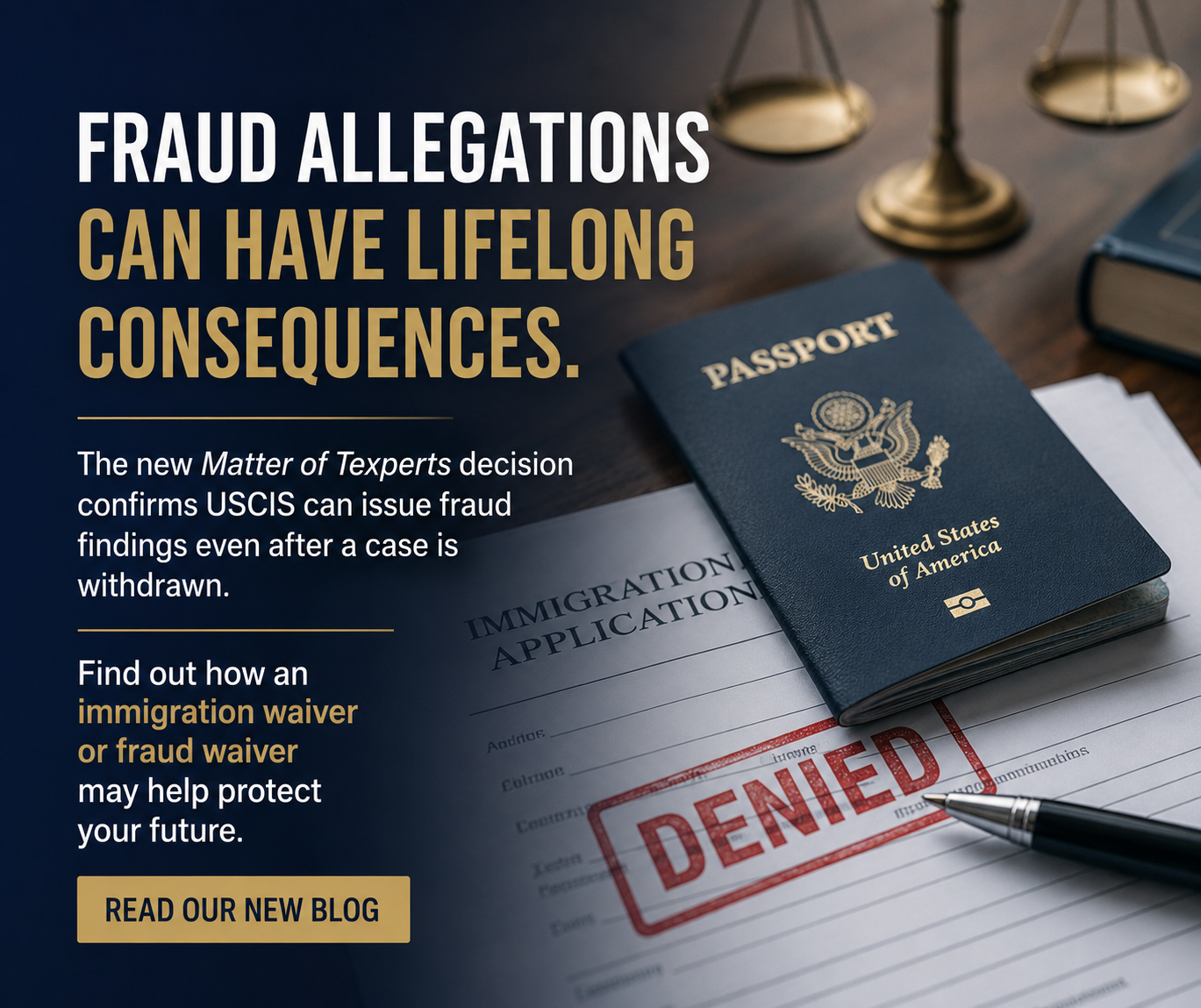
In 2026, the U.S. Citizenship and Immigration Services (USCIS) Administrative Appeals Office (AAO) issued a groundbreaking precedent decision, Matter of Texperts, Inc., 29 I&N Dec. 491 (AAO 2026). While the case arose from an H-1B petition, its impact reaches far beyond employment-based immigration. The decision confirms that USCIS may issue formal fraud and willful misrepresentation findings even after an application or petition has been withdrawn.
For individuals facing such allegations, understanding the availability of an immigration waiver, particularly a fraud waiver, has become more important than ever.
If USCIS has accused you of fraud or misrepresentation, consulting an experienced fraud waiver attorney immediately may be critical to protecting your ability to remain in or immigrate to the United States.
What Is Immigration Fraud Under U.S. Immigration Law?
Under Section 212(a)(6)(C)(i) of the Immigration and Nationality Act (INA), a person becomes inadmissible if he or she:
Obtained, sought to obtain, or attempted to obtain a visa, admission into the United States, or another immigration benefit through fraud or willful misrepresentation of a material fact.
The consequences are severe.
Unlike many immigration violations that expire after a certain period of time, a fraud or misrepresentation finding generally results in a lifetime inadmissibility bar.
Examples of allegations commonly raised by USCIS include:
- Submitting false employment records;
- Using fake educational credentials;
- Providing inaccurate information on immigration forms;
- Entering into a fraudulent marriage;
- Presenting altered documents;
- Concealing prior immigration violations;
- Misrepresenting qualifications for employment-based petitions;
- Making false statements during visa interviews.
Even an error that occurred years ago can become the basis for a fraud allegation today.
The New Matter of Texperts Decision
In Matter of Texperts, USCIS addressed an issue that has troubled employers and foreign nationals for years.
The petitioner attempted to withdraw an H-1B petition after USCIS raised concerns regarding fraud and misrepresentation. Historically, many practitioners believed that withdrawal would terminate USCIS review and prevent a formal fraud determination.
The AAO disagreed.
The decision held that USCIS retains authority to continue reviewing evidence and issue fraud findings even after a petition is withdrawn.
The AAO emphasized that USCIS possesses broad authority under the Immigration and Nationality Act and implementing regulations to protect the integrity of the immigration system.
As a result, withdrawal of a petition does not necessarily eliminate the risk of a fraud determination.
Why This Decision Matters Beyond H-1B Cases
Although Matter of Texperts involved an H-1B petition, the legal reasoning is not limited to employment-based visas.
The AAO relied on USCIS’s general authority to investigate and identify fraud in immigration filings.
Consequently, the precedent may affect:
- I-140 immigrant petitions;
- PERM-based employment cases;
- EB-1 petitions;
- EB-2 National Interest Waiver cases;
- Family-based petitions;
- Marriage-based green cards;
- Adjustment of status applications;
- Naturalization applications;
- Consular processing cases;
- VAWA petitions;
- U visas;
- Asylum applications.
In practical terms, USCIS may now feel empowered to continue investigating alleged fraud even if the applicant, petitioner, or employer attempts to withdraw the filing.
The Growing Risk of Fraud Findings
One of the most concerning aspects of the decision is the possibility that USCIS may create an official fraud record that follows an applicant for years.
Fraud findings are often entered into government databases and can be referenced during:
- Future visa applications;
- Green card applications;
- Naturalization proceedings;
- Consular interviews;
- Immigration court proceedings.
Once USCIS makes a fraud determination, overcoming it can be extremely difficult.
This is why individuals facing allegations should seek legal assistance immediately rather than assuming a withdrawn application resolves the issue.
What Is a Fraud Waiver?
A fraud waiver is a form of immigration waiver that allows certain individuals to overcome inadmissibility based on fraud or willful misrepresentation.
The most common fraud waiver is found in INA §212(i).
This waiver permits USCIS to forgive fraud or misrepresentation if specific legal requirements are met.
Importantly, not everyone qualifies.
Eligibility depends on the applicant’s immigration category and family relationships.
Who Can Apply for a Fraud Waiver?
Generally, an applicant may seek a fraud waiver if they can demonstrate that refusal of admission would cause extreme hardship to a qualifying relative.
Qualifying relatives include:
- U.S. citizen spouse;
- Lawful permanent resident spouse;
- U.S. citizen parent;
- Lawful permanent resident parent.
Notably, children are generally not qualifying relatives for purposes of INA §212(i), although hardship to children may still be considered indirectly when evaluating hardship to a qualifying spouse or parent.
What Is Extreme Hardship?
Many applicants mistakenly believe that ordinary emotional hardship is enough.
USCIS applies a much higher standard.
Extreme hardship may involve:
Financial Hardship
Examples include:
- Loss of family income;
- Inability to maintain housing;
- Loss of business opportunities;
- Significant debt obligations.
Medical Hardship
Examples include:
- Serious medical conditions;
- Need for ongoing treatment;
- Lack of medical care abroad;
- Psychological conditions requiring specialized treatment.
Educational Hardship
Examples include:
- Disruption of children’s education;
- Loss of specialized educational programs;
- Significant academic setbacks.
Country Conditions
Examples include:
- Political instability;
- Human rights concerns;
- Economic collapse;
- Dangerous security conditions.
Family Separation
Examples include:
- Long-term separation from family members;
- Emotional and psychological consequences;
- Caregiving responsibilities.
An experienced fraud waiver attorney will typically present evidence across multiple hardship categories rather than relying on a single factor.
Proving a Fraud Waiver Case
A successful immigration waiver application requires substantial evidence.
Common supporting documents include:
- Medical records;
- Psychological evaluations;
- Tax returns;
- Employment records;
- Expert reports;
- Country condition evidence;
- Affidavits from family members;
- School records;
- Financial documentation.
The strongest waiver cases present a detailed narrative supported by objective evidence.
Simply stating that separation would be difficult is rarely sufficient.
Why Fraud Findings Have Become More Dangerous After Matter of Texperts
Before Matter of Texperts, some petitioners believed that withdrawing a petition could prevent a formal fraud finding.
That strategy is now significantly riskier.
USCIS may continue evaluating evidence and issue findings even after withdrawal.
This means that individuals accused of misrepresentation should not assume that abandoning an application will solve the problem.
Instead, a proactive legal strategy is often necessary.
Potential responses may include:
- Challenging the fraud allegations;
- Demonstrating lack of materiality;
- Showing absence of willful intent;
- Presenting evidence of innocent mistakes;
- Seeking an immigration waiver where appropriate.
Each case requires a careful legal analysis.
Can USCIS Make a Mistake?
Absolutely.
USCIS officers are not infallible.
Many fraud allegations arise from:
- Translation errors;
- Clerical mistakes;
- Misunderstandings;
- Incomplete evidence;
- Employer errors;
- Third-party preparer misconduct.
Not every inconsistency amounts to fraud.
To establish willful misrepresentation, USCIS generally must show that:
- A representation was made;
- The representation was false;
- The false statement was willful;
- The fact was material;
- The statement was made to obtain an immigration benefit.
Failure to establish any one of these elements may undermine the fraud allegation.
How a Fraud Waiver Attorney Can Help
Fraud and misrepresentation cases are among the most complex matters in immigration law.
A knowledgeable fraud waiver attorney can:
- Analyze USCIS allegations;
- Identify legal defenses;
- Prepare responses to Notices of Intent to Deny (NOIDs);
- Respond to Requests for Evidence (RFEs);
- Develop waiver strategies;
- Prepare hardship evidence;
- Coordinate expert evaluations;
- Represent clients before USCIS and immigration courts.
The earlier legal counsel becomes involved, the greater the opportunity to challenge the allegations before they become permanent findings.
Practical Advice If You Receive a Fraud Allegation
If USCIS raises concerns about fraud or misrepresentation:
Do Not Ignore the Notice
Deadlines are strict.
Failure to respond may result in denial and adverse findings.
Do Not Admit Fraud Without Legal Advice
Statements made to USCIS can have long-term consequences.
Gather Documentation Immediately
Preserve emails, records, applications, contracts, and supporting evidence.
Seek Experienced Representation
Fraud cases require specialized knowledge that differs significantly from routine immigration filings.
The Future of Fraud Investigations After Matter of Texperts
Matter of Texperts signals a continued emphasis by USCIS on fraud detection and immigration enforcement.
The decision effectively formalizes a practice that many practitioners observed for years: USCIS may continue investigating fraud allegations regardless of whether a filing remains pending.
As a result, employers, petitioners, and beneficiaries should assume that any submission to USCIS may be scrutinized even after withdrawal.
For foreign nationals, the consequences can be life-changing because a fraud finding may trigger lifetime inadmissibility and create the need for a fraud waiver.
Conclusion
The AAO’s precedent decision in Matter of Texperts fundamentally changes how fraud allegations may be handled across the immigration system. Although the case originated in the H-1B context, its reasoning extends to family-based immigration, employment-based petitions, adjustment of status applications, immigrant visa processing, and many other immigration benefit requests.
If USCIS has accused you of fraud or willful misrepresentation, your case may still be defensible. In some situations, a carefully prepared immigration waiver or fraud waiver may provide a path forward. In others, the allegation itself may be challenged successfully.
Because the stakes are extraordinarily high, it is essential to seek advice from an experienced fraud waiver attorney as early as possible.
If you need assistance with an immigration waiver, fraud waiver, adjustment of status, immigrant visa application, or any other immigration matter, contact the Law Office of Alena Shautsova at 917-885-2261 or visit www.shautsova.com to schedule a consultation and discuss your legal options.


