
Immigration News & Green Card Impact: Supreme Court Case on Birthright Citizenship Explained
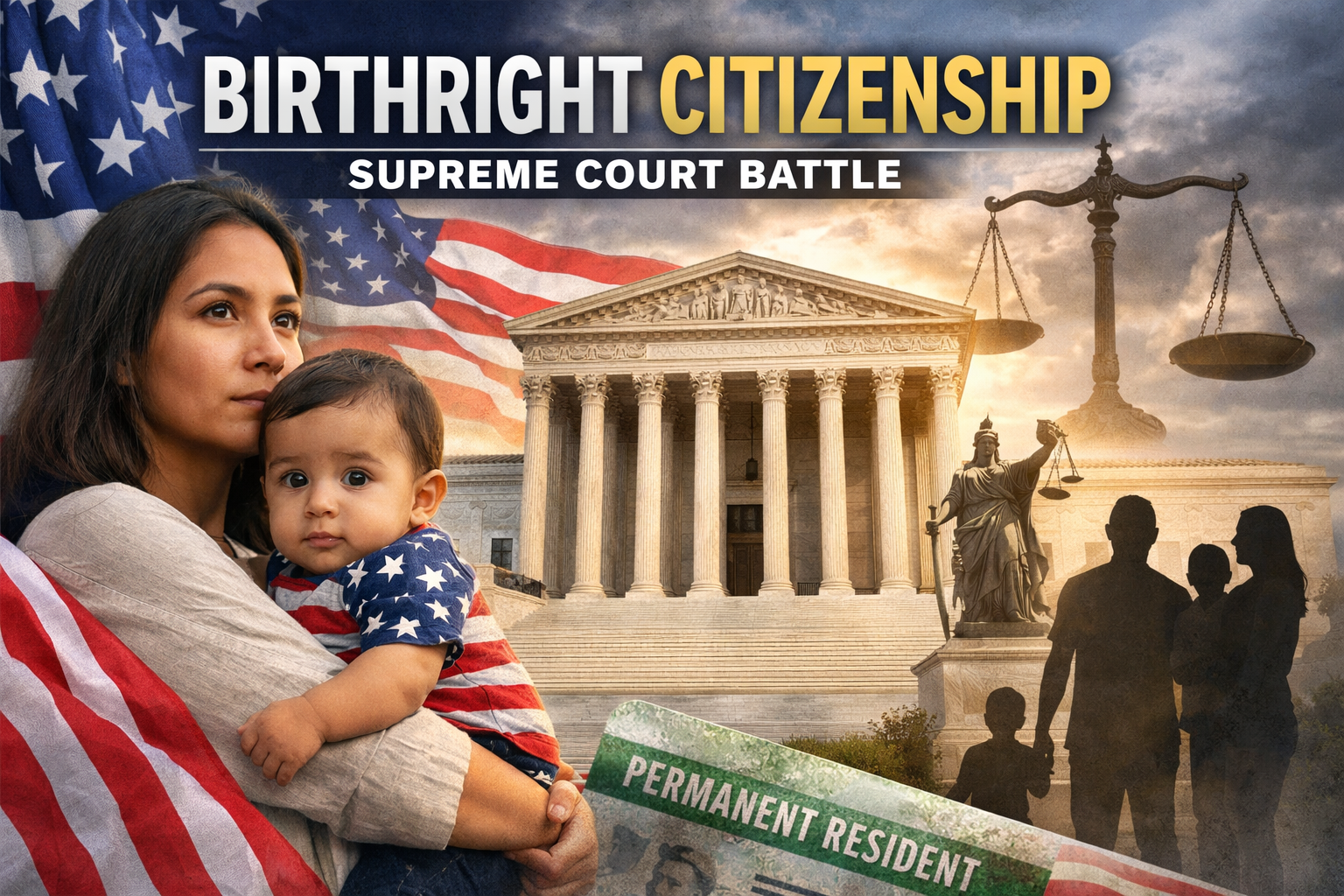
A major immigration case heading to the U.S. Supreme Court is poised to reshape one of the most fundamental principles of American immigration law: birthright citizenship. This issue is not only constitutional—it directly affects long-term immigration strategies, green card pathways, and the stability of immigrant families living in the United States.
What Is Birthright Citizenship?
Birthright citizenship is rooted in the 14th Amendment, which guarantees that anyone born on U.S. soil is automatically a U.S. citizen. For more than a century, this rule has applied broadly, regardless of the immigration status of the child’s parents. It has been a cornerstone of U.S. immigration policy and a key factor in how immigrant families plan their future.
Policy experts widely recognize birthright citizenship as a constitutional guarantee that helps integrate new generations into American society [5].
What Is the Supreme Court Case About?
The current case arises from a controversial executive order seeking to limit automatic citizenship for children born to undocumented immigrants or temporary visa holders. The administration argues that the Constitution’s phrase “subject to the jurisdiction thereof” should exclude certain groups.
The Supreme Court is expected to hear oral arguments in April 2026 in what is considered one of the most significant immigration cases of the decade.
If upheld, the policy would significantly narrow the long-standing interpretation of the 14th Amendment, fundamentally changing how citizenship is granted at birth.
Key Legal Arguments
The case centers on two competing interpretations:
- Traditional View (Supported by Precedent):
- Citizenship applies to nearly all individuals born in the U.S.
- Supported by decades of Supreme Court precedent and historical interpretation
- Restrictive View (Proposed in the Case):
- Citizenship should apply only to those fully subject to U.S. jurisdiction
- Could exclude children of undocumented immigrants or temporary visa holders
A related class-action lawsuit challenges the executive order, arguing it violates constitutional protections.
Why This Matters for Immigration News and Green Card Holders
This case is not just about citizenship—it has major implications for green card strategies and immigration planning:
- Family-Based Immigration Changes
Many immigrant families rely on U.S.-born children as part of long-term planning. While children cannot sponsor parents immediately, birthright citizenship provides future stability. Limiting this could disrupt family-based immigration expectations. - Increased Legal Uncertainty
If the Court narrows citizenship rights, new categories of U.S.-born individuals could lack legal status at birth, potentially creating a new class of undocumented individuals. - Impact on Green Card Pathways
Immigration policy is interconnected. A change in citizenship rules may influence how lawmakers approach:- Adjustment of status
- Family sponsorship rules
- Removal defense strategies
- State-by-State Differences
Some legal experts warn that enforcement could vary, creating inconsistent outcomes across the country depending on how federal and state authorities implement the decision.
Broader Immigration Policy Implications
The outcome could signal a broader shift in U.S. immigration policy. If the Court supports a restrictive interpretation, it may encourage additional reforms aimed at tightening immigration benefits and eligibility.
On the other hand, if the Court upholds traditional birthright citizenship, it would reinforce long-standing protections and provide clarity for millions of immigrant families.
Importantly, a prior Supreme Court decision already gave the administration a procedural victory in a related case, showing that the Court is actively engaged in redefining immigration boundaries.
Practical Tips for Immigrants (Green Card & Immigration Strategy)
If you are following immigration news or planning your green card strategy, consider the following:
- Stay Updated on Court Decisions
This case is evolving quickly. A final ruling could come within months after oral arguments. - Do Not Rely Solely on Future Citizenship Benefits
If your long-term plan involves U.S.-born children, consult an immigration lawyer to explore alternative legal pathways. - Strengthen Your Current Status
Focus on:- Securing lawful status
- Filing for adjustment when eligible
- Maintaining compliance with immigration laws
- Explore Independent Immigration Options
Consider employment-based green cards (EB-2 NIW, EB-1, O-1) or humanitarian options such as asylum or VAWA if applicable.
Final Thoughts
This Supreme Court case represents a turning point in U.S. immigration law. It is not just a legal debate—it directly affects real families, future citizens, and the structure of the immigration system.
For anyone following immigration news and green card developments, this case is critical. The decision will either reaffirm a long-standing constitutional guarantee or redefine the meaning of citizenship in America.
Either way, the impact will be felt for generations.


