
Defending Your Green Card in Removal Proceedings After an I-751 Denial
Defending Your Green Card in Removal Proceedings After an I-751 Denial
Author: 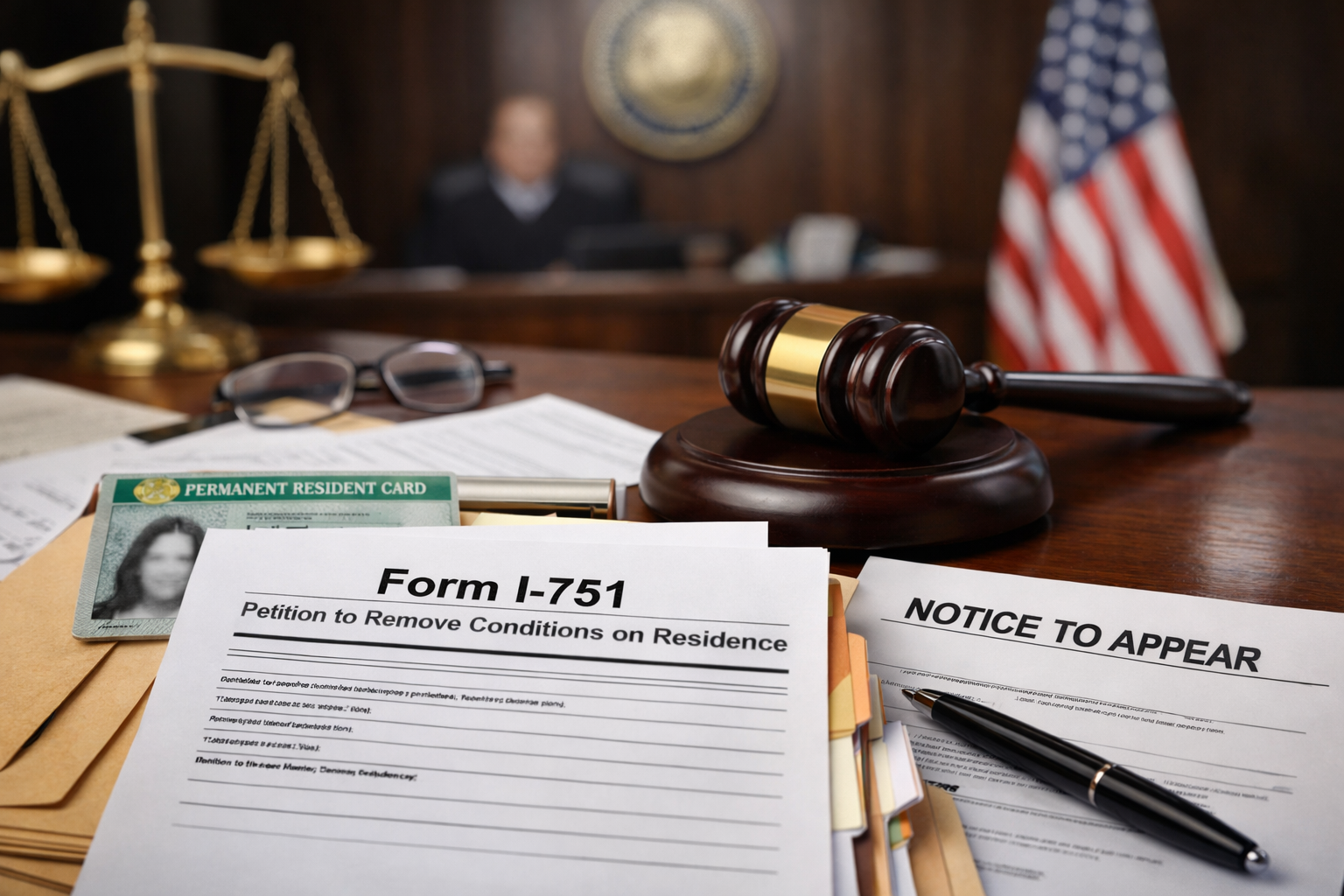 Alena Shautsova
If your I-751 petition to remove conditions on your green card was denied and you are now facing deportation proceedings, you are in a legally complex and high-risk situation. As a New York immigration lawyer and deportation lawyer, I regularly represent conditional residents whose cases were referred to Immigration Court within weeks of an I-751 denial — something that has become increasingly common.
This article explains:
-
What Immigration Court can (and cannot) review after an I-751 denial
-
Why marriage-based green cards are heavily scrutinized at this stage
-
Why an I-751 waiver can be filed at any time
-
What other immigration options may be available in court
-
Practical, step-by-step tips for submitting documents in Immigration Court under the EOIR Practice Manual
What Happens After an I-751 Petition Is Denied?
When USCIS denies your Form I-751, your conditional permanent resident status is terminated by law under INA §216(c)(3)(D). USCIS is then required to place you into removal (deportation) proceedings by issuing a Notice to Appear (NTA).
Important enforcement shift
In the past, USCIS sometimes delayed court referrals for years. Today, this is no longer happening.
👉 Now, referrals to Immigration Court often occur within weeks of the I-751 denial.
If you live in New York, your case will likely be scheduled before the New York Immigration Court, where strict procedural rules apply.
What Can the Immigration Judge Review After an I-751 Denial?
This is a critical limitation that many people — and even some attorneys — misunderstand.
The Immigration Court may review ONLY:
✔️ The specific grounds for denial that USCIS identified and relied on
The court may NOT:
❌ Review new reasons USCIS never raised
❌ Consider unrelated new evidence
❌ Re-adjudicate your case from scratch
This means the judge will focus on whether:
-
Your marriage was bona fide
-
USCIS correctly evaluated credibility
-
USCIS properly weighed the evidence you submitted
👉 The court cannot fix mistakes caused by weak or incomplete filings at USCIS.
Why Marriage-Based Green Cards Are Especially Vulnerable at the I-751 Stage
Many conditional residents believe that receiving a two-year green card means the hardest part is over. In reality, the I-751 stage is often where cases fail.
USCIS applies heightened scrutiny because:
-
The burden of proof is on YOU
-
Officers expect long-term, commingled marital evidence
-
Interviews often focus on inconsistencies
-
Credibility findings are difficult to overturn in court
By the time your case reaches a deportation lawyer, the government is often alleging that the marriage itself was not genuine.
Key Legal Protection: An I-751 Waiver Can Be Filed at Any Time
One of the most important facts about the I-751 petition is often overlooked:
An I-751 waiver is NOT limited to the 90-day filing window.
Under USCIS policy and case law:
-
A waiver-based I-751 (divorce, abuse, or extreme hardship)
-
May be filed at any time, including:
-
After denial
-
During removal proceedings
-
Even years later, if jurisdiction allows
-
This can be a lifeline if your joint petition failed.
Immigration Court Options After an I-751 Denial
An I-751 denial does not automatically mean deportation. Depending on your circumstances, a New York deportation lawyer may explore the following options:
1. Defending the I-751 Denial in Court
You may ask the Immigration Judge to review USCIS’s denial and determine whether your marriage was entered into in good faith.
This requires:
-
Organized documentary evidence
-
Consistent testimony
-
Strict compliance with EOIR filing rules
2. New Adjustment of Status With a New Spouse
If your prior marriage ended and you entered into a new bona fide marriage to a U.S. citizen, you may be eligible for adjustment of status in Immigration Court.
⚠️ This option requires careful analysis if USCIS alleged marriage fraud in the first case.
3. VAWA Relief: Self-Petition or Cancellation of Removal
If your U.S. citizen or permanent resident spouse abused you, you may qualify for:
-
VAWA self-petition (Form I-360)
-
VAWA adjustment of status
-
VAWA cancellation of removal (if already in court)
VAWA cases do not require the abuser’s cooperation and can proceed even after divorce.
Practical Tips: Submitting Documents in Immigration Court (EOIR Practice Manual)
Immigration Court is not USCIS. Many cases fail because documents are submitted incorrectly.
Here are essential tips every respondent should follow:
1. Follow the EOIR Practice Manual Exactly
The Immigration Judge expects strict compliance with the EOIR Practice Manual, including:
-
Proper formatting
-
Deadlines
-
Service on DHS
Failure to comply can result in evidence being excluded.
2. Always File in Triplicate if your case does not have EROP
Unless otherwise instructed, you must submit:
-
📄 One copy to the Immigration Court
-
📄 One copy to DHS (ICE Office of Chief Counsel)
-
📄 One copy for your records
Include a Certificate of Service with every filing
3. Organize Evidence With Index and Tabs
Your submission should include:
-
A cover page
-
Table of contents
-
Clearly labeled exhibits (Exhibit A, B, C…)
Judges are far more receptive to organized, indexed filings.
4. Respect Filing Deadlines
Most Immigration Judges require:
-
Evidence filed at least 30 days before the hearing
Late submissions may be rejected — even if highly relevant.
5. Translate Everything Properly
All foreign-language documents must include:
-
A full English translation
-
A signed translator certification
Uncertified translations may be excluded.
Why You Need a New York Deportation Lawyer for an I-751 Denial
Defending a green card after an I-751 denial requires:
-
Removal defense experience
-
Knowledge of marriage-fraud law
-
Mastery of EOIR court procedure
This is not a paperwork case — it is litigation.
Final Takeaways
✔️ An I-751 denial often leads quickly to removal proceedings
✔️ Immigration Court reviews only USCIS’s stated grounds for denial
✔️ I-751 waivers can be filed at any time
✔️ Marriage-based green cards are heavily scrutinized in court
✔️ EOIR procedural mistakes can destroy an otherwise strong case
✔️ Early strategy with a New York immigration lawyer matters
Speak With a New York Immigration and Deportation Lawyer
If your I-751 petition was denied or you are already in deportation proceedings, do not wait.
📞 Call 917-885-2261
🌐 www.shautsova.com
I represent clients nationwide, with a strong focus on New York Immigration Court, complex I-751 cases, and removal defense. The earlier you act, the more options you may have.


